For this task I had to find examples of different visual conventions used to convey time
and/or place/space.
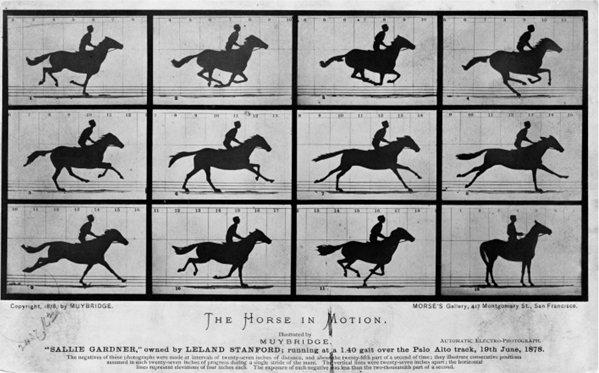
The first piece I thought of was Eadweard Muybridge’s The Horse in Motion, which shows film stills that show a horse running.
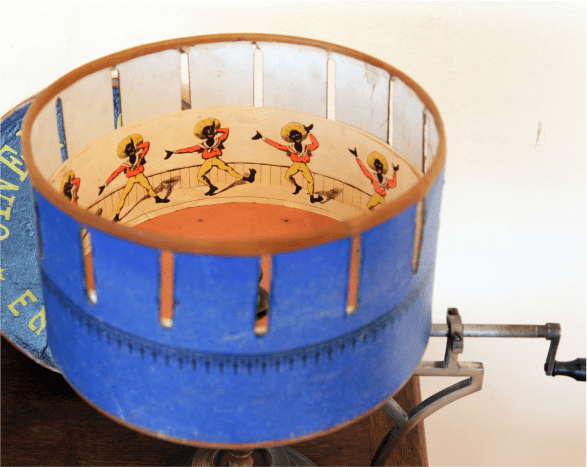
Whilst looking for the above image I came across an old invention, the Zoetrope, invented by William George Horner in 1831. This used by spinning it and the images inside tell a story by spinning the images inside.
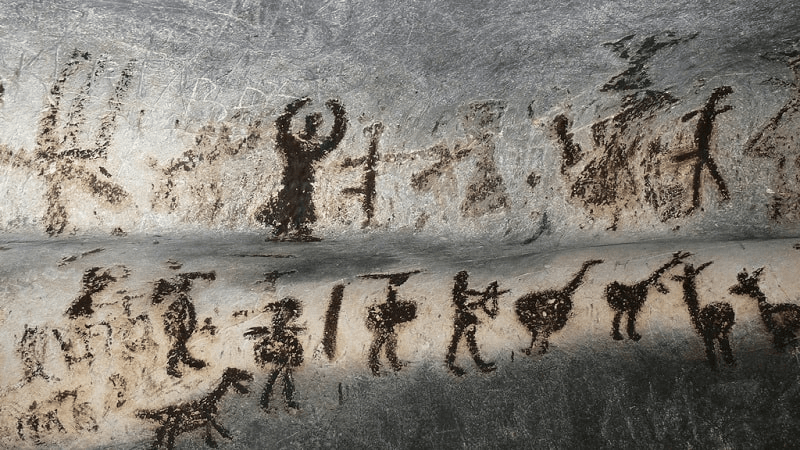
Time can be seen represented as far back as the stone age through cave paintings. These works go back as far as 30,000 years.
Jean Morin’s Memento Mori is an interesting representation of time as it’s a still life, so there isn’t a visual timeline to follow.
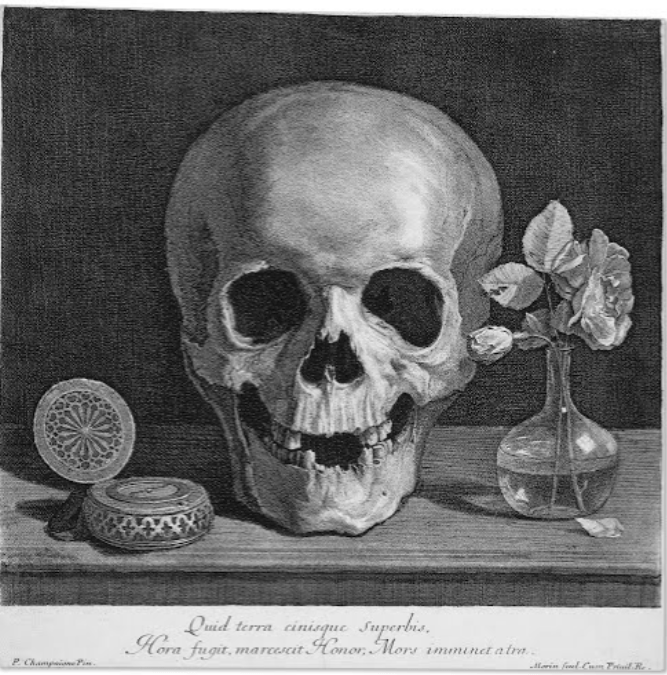
Time is shown in the image by the falling petals and the skull. There is also an object that looks more like a compass to me but must be a pocket watch. The symbolism in the image is what tells the story and takes us through time.
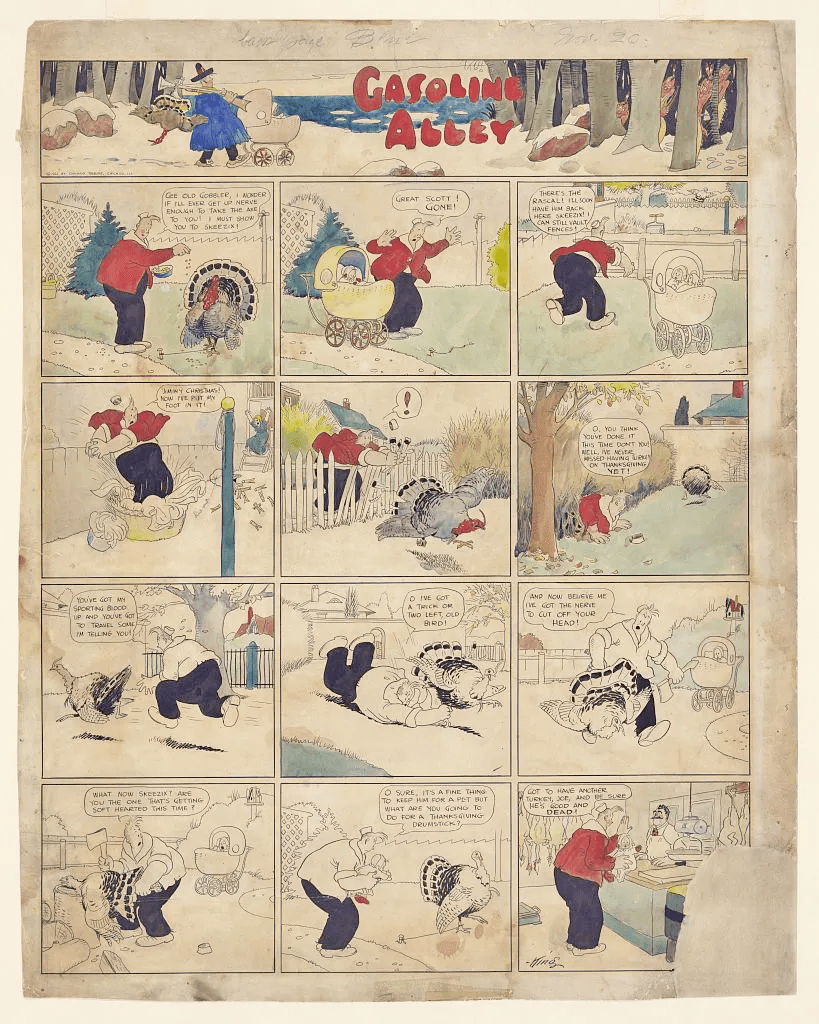
Comic strips use a good method of showing the passing of time. Different panels show stages of time, so multiple panels are able to communicate a detailed story. The above comic strip is Gasoline Alley by Frank King. The use of many panels paired with the dialogue effectively communicate the story to the reader.
Whilst researching for this task I came to the conclusion that visual conventions of time/space/place are all just ways of telling a story. Whether the methods are simple or complex, in the end, after viewing the image, a story would have been revealed.
Stories have been documented in many ways and through multiple materials.
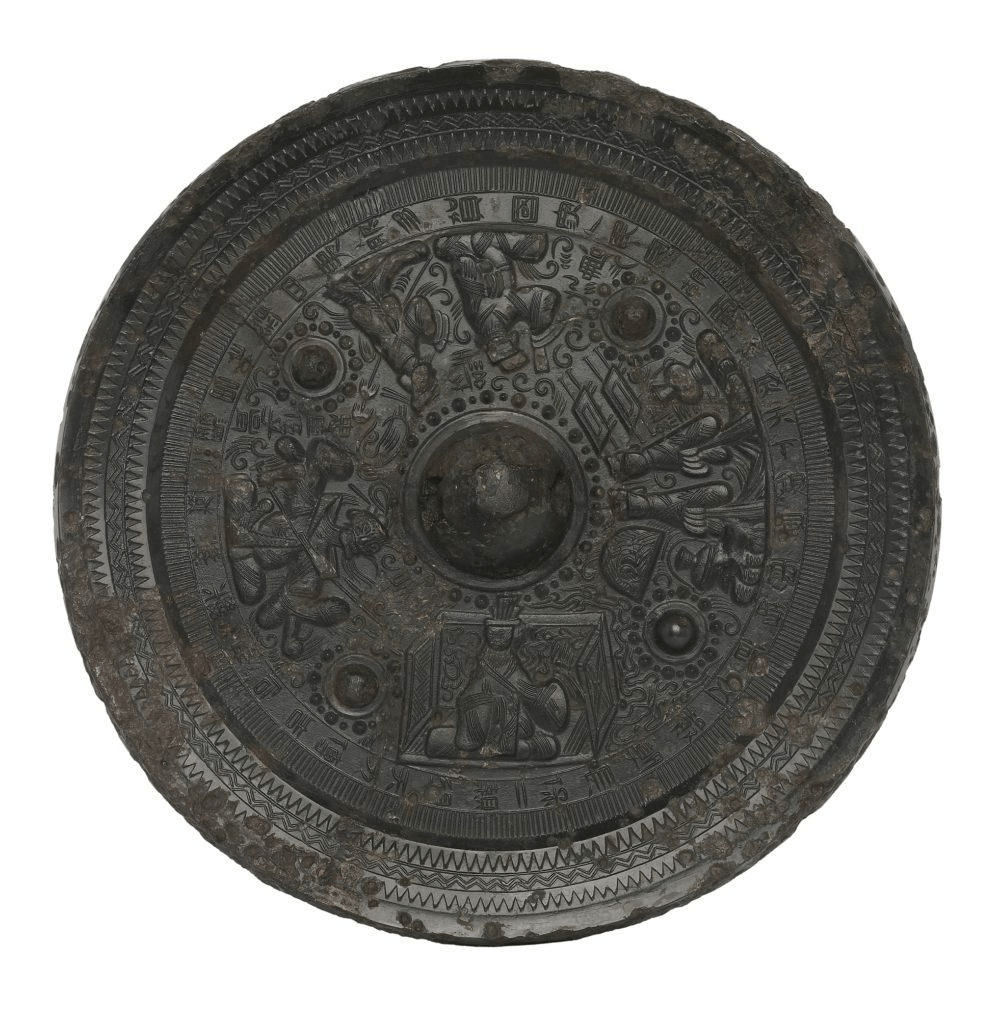
Above is a Chinese bronze mirror telling the story of a war between Wu and Yue, two states. I find that the material used also helps locate the time and place of a story as ancient story telling seems to have been done largely through tougher materials such as stone and metal. Through these works we can also see how the styles used today have been developed. An example of this would be scrolls painted in Japan. From these scrolls you can see the influences used in manga.
With the development of technology creating visual representations of space is getting easier. One way of doing this is through 3D art.
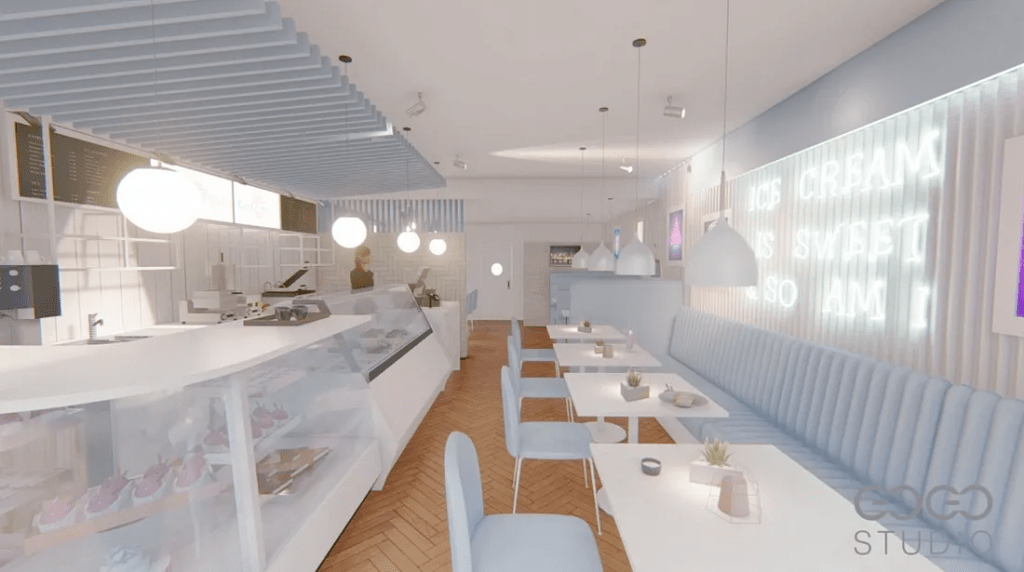
The above image is a 3D image that shows a room. It effectively represents the space of the through the perspective presented. By carefully picking which angle to show the room from the depth is made clear and the viewer can easily see the amount of space and the direction it goes in.
Doing this in the past has been a lot harder as the methods and technology we have available to us now wasn’t available. One way space has been shown before is through blue prints, which represents the space in a basic way. Photography is also a good way to show this.
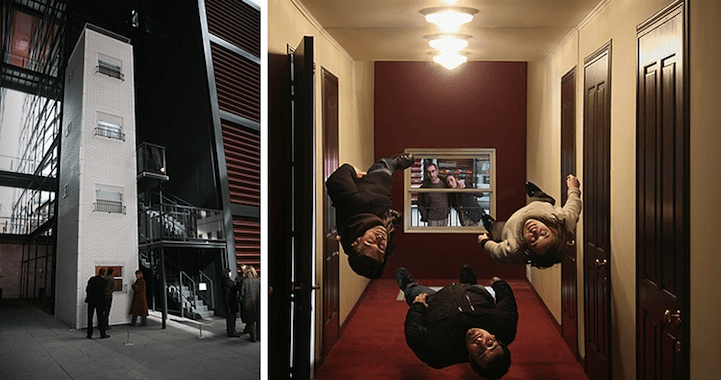
The image above does this in an interesting way. The perspective is completely skewed so that the people inside look as though they are walking on the walls. The space is also enhanced by them being stood on, what seems to be glass. This elongates the corridor and adds depth to the image.
The visual representation of space in an image relies of the visual perspective seen by the eye. This has to be replicated in the image to make it recognisable to the brain, which creates the illusion of space on a 2D picture.
Depth can be added to an image by adding shade and highlights.
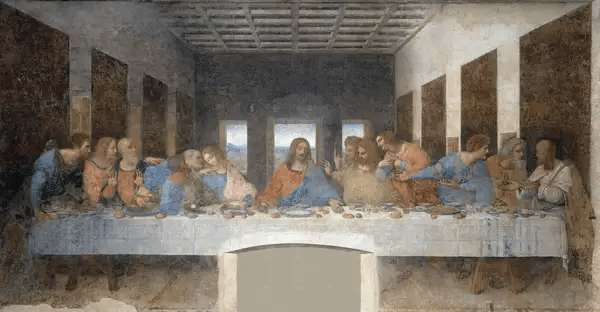
Leonardo da Vinci did this well as evidenced above in Last Supper. Here he created space by darkening the background and using the linear perspective method. By creating space in an image it helps identify the location. More details are able to be added, allowing the viewer to know where the image takes place.
I found the process of researching for this task difficult. Finding terms search was harder than expected as I would end up finding what I wasn’t looking for. I tried finding books that I could use for the task however because I didn’t know what to search under I didn’t have much luck. What I did find came from finding one result and then a string of images and search terms came to mind. Lots of them ended up without giving me what I was looking for but from there I was able to rephrase and narrow down what I needed.
 Illustration log