Exercise One: Writing a Brief
To start part two I was tasked with writing a brief. This brief had to be of a professional standard. To start with I had to find a piece of work by an illustrator whose work I find some connection with. I chose to use the front cover of a book called The Cerulean, illustrated by Craig Shields.
I have always been drawn towards fantasy, which I believe has influenced my choice. The limited colour palette attracted my attention because of the noticeable contrast between them. I also like how the clouds are formed, reminiscent of a forest, and separate to reveal the city. It reminds me of Atlantis, possibly lent by the colour scheme.
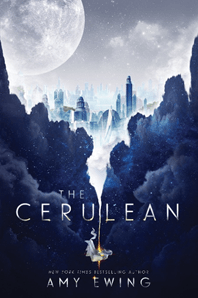
To start the exercise, I researched how to write a brief as I don’t remember ever writing one before. Doing this I came across an article on twine.fm that came in very helpful as it laid out exactly what was expected in a brief. I then chose the image I wanted to use. I found deciding what to include in the brief harder than I expected as I didn’t want to include too much detail as a real brief wouldn’t tell the artist exactly what to do but would give them room to experiment.
Brief
Project: The Cerulean Front cover The Cerulean is the first book of a pair to be written by Amy Ewing. It is a Young Adult fantasy novel and will be of standard printing size at 6 inches wide and 9 inches tall.
The book is based around Sera, a girl who lives in a city above the sky. The city is tethered to a planet by magic, which is one day destined to be broken. Sera is chosen as the sacrifice to break the tether and ends up falling to the country below the city.
Vision for the project: the book will be displayed among hundreds of other books so the colour needs to be eye-catching. The cover of this book should appeal to fans of sci-fi and fantasy. There is a feel of mystery throughout the book and this should be expressed through the cover. The city should be made a prominent feature in the image. Sera, the main character, should be displayed in some way. Maybe falling between the two worlds. The only text to be displayed should be the title of the novel and the authors name. Digital media should be used the give the effect envisioned.
Target audience: 12 to 18 year olds.
Exercise Two: Spider Diagrams
The second exercise was Spider Diagrams. This involved creating spider diagrams for a set of words: Seaside, Childhood, Angry and Festival. I had to draw on my own experiences with these subjects to fill the diagrams.
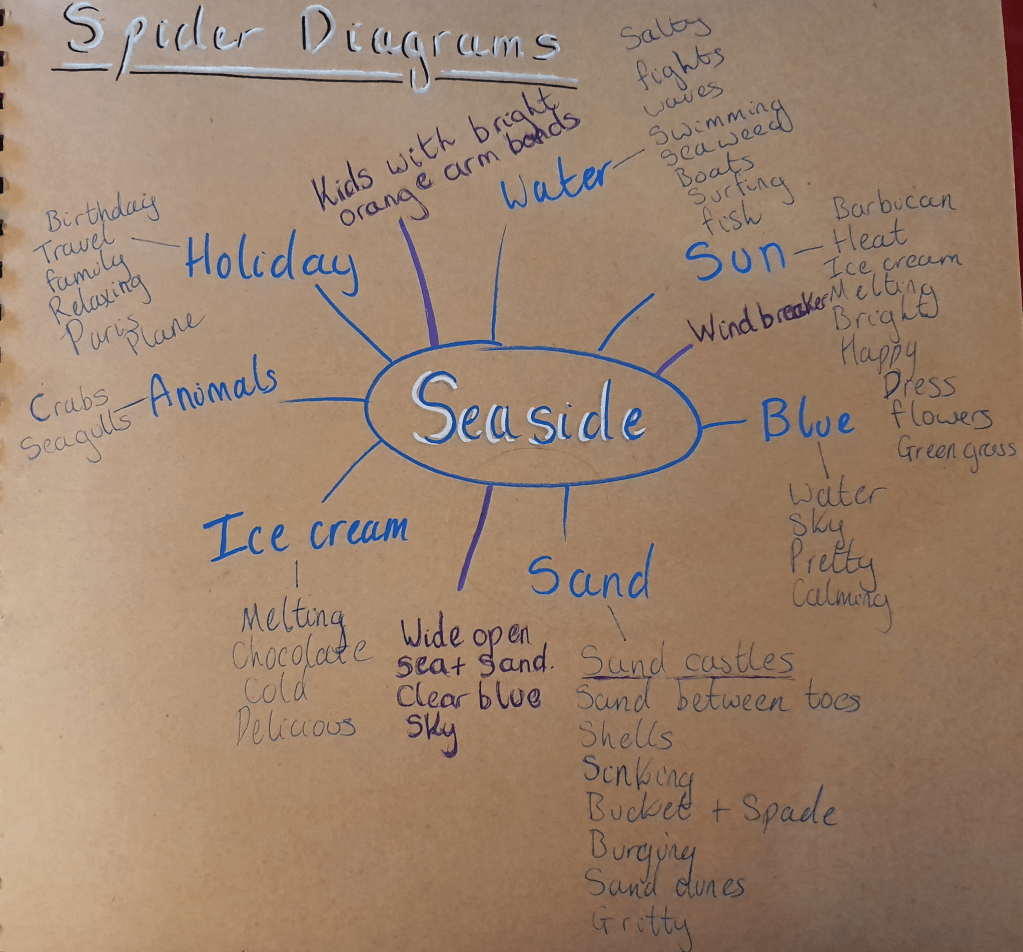
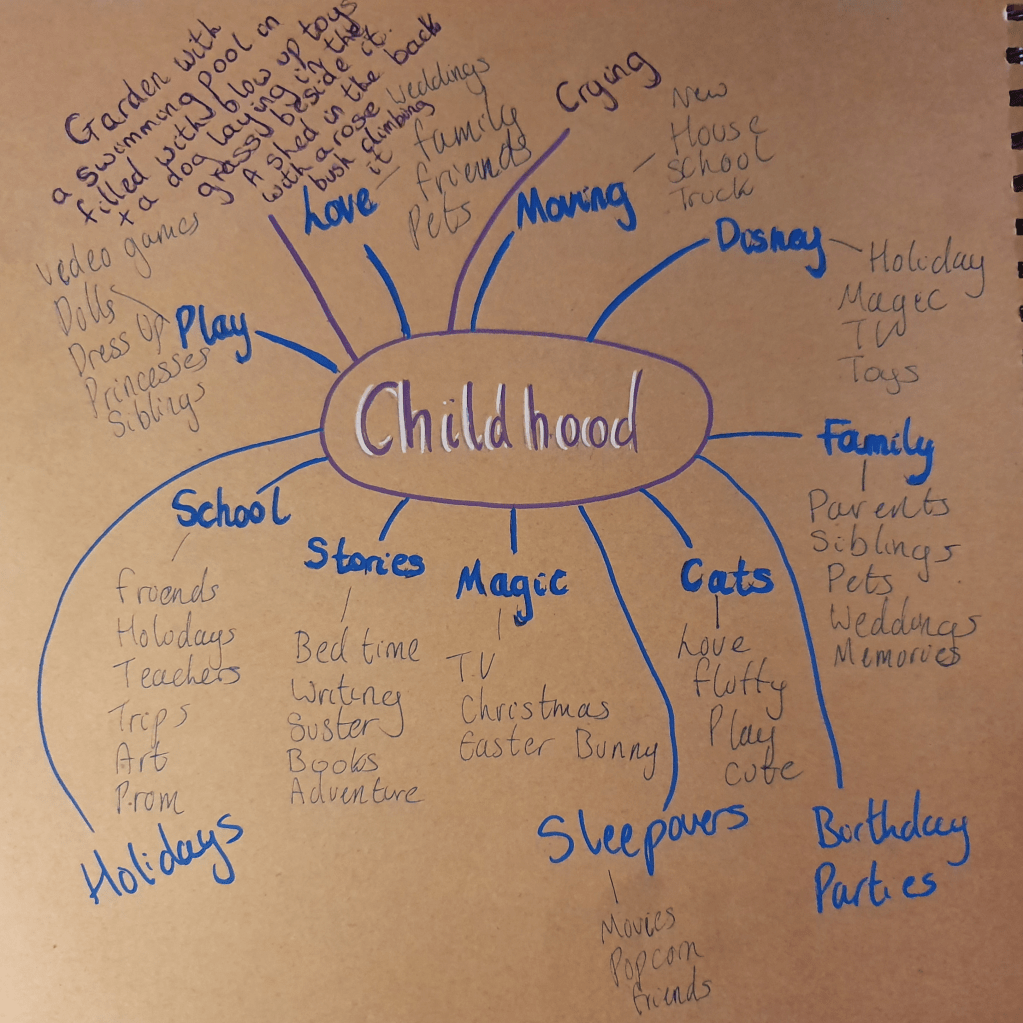
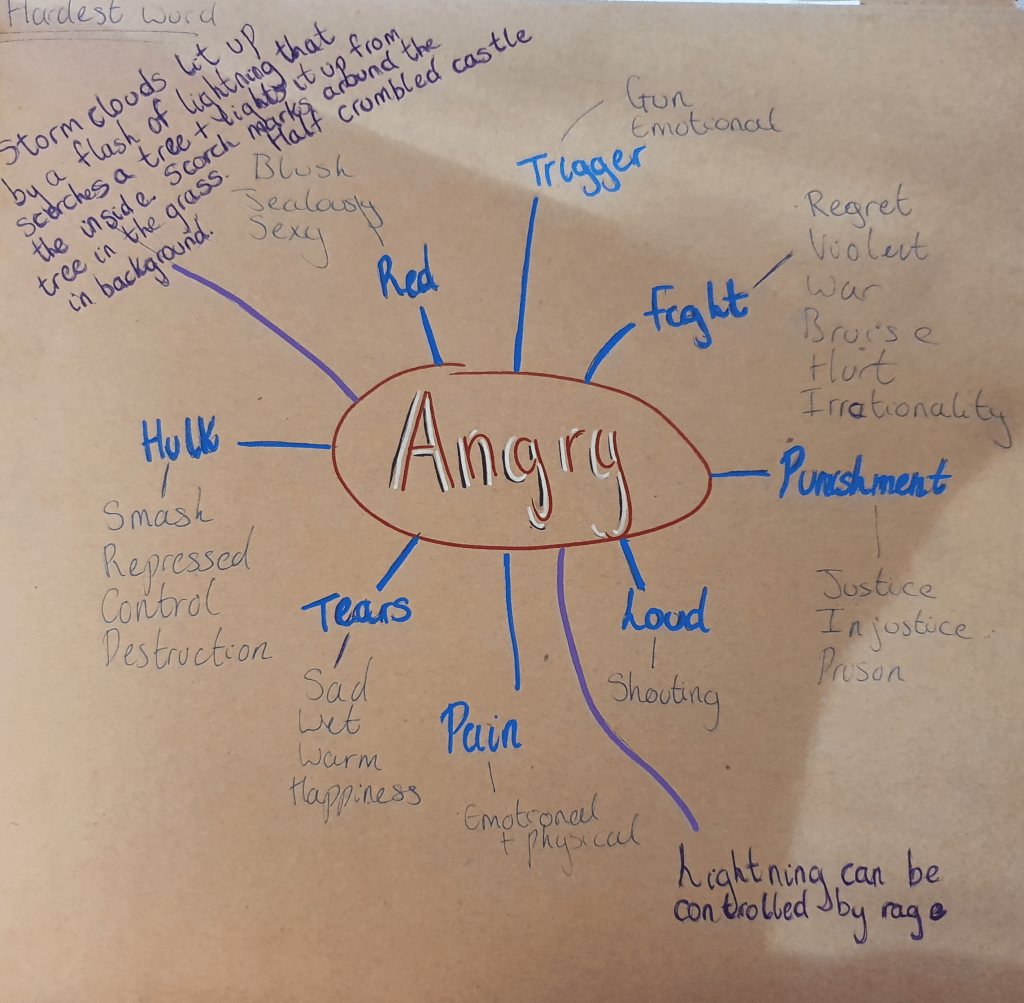
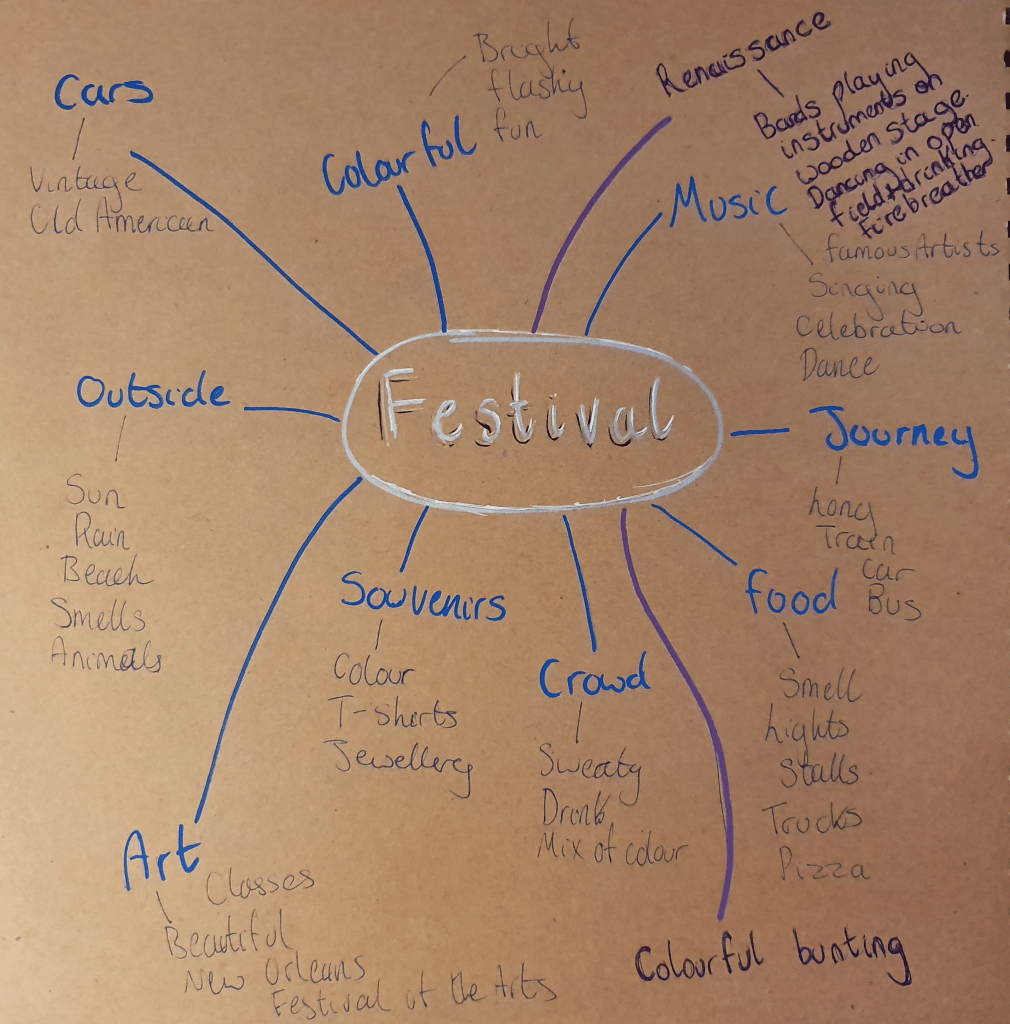
I found filling these diagrams harder than I initially thought. Some words were harder than others, especially when thinking of the least obvious things. Of course the first things I thought of were sandcastles and ice cream but I wanted to go deeper than that, think of things that were more personal and specific to me. This wasn’t easy. I ended up with more generic answers than I am happy with. Having not been to the beach since I was kid I only had my memories and TV to draw on, as is the case with most of what I wrote. Everything in blue is what I thought of and the purple is what other people thought of. A lot of our thoughts over lapped.
I found the word angry hardest to fill. I think this is because as an emotion it doesn’t create a visual memory, therefore I have few visuals to work from, which I found was easier for me to think of. One of the first things I did think of however, was the Hulk and the scene in Avengers when he smashed Loki into the ground, over and over. Of course, a big angry green man isn’t really what the exercise was looking for but having thought of it I felt I should include it.
I probably found childhood the easiest to draw from. Turns out this was a time for lots of changes. New house, new step dad, new sister in law, new schools. Whilst uploading this I realised I mostly wrote down objects and since doing this exercise I have thought of a few things to add: the journey from house to house, the slightly rough feel of cardboard boxes under your fingers bending with the weight of what’s packed inside and the smell of freshly applied paint.
The best way I found to think of more subjects was to give it time. Trying to fill each diagram straight away only succeeded in thinking of the obvious and mundane.
Exercise Three: Turning Words into Pictures
Turning words into pictures was interesting, and I later realised was preparation for a future exercise. Once again I was presented with a list of subjects, but this time I had to pick only one to work with. I picked Exotic, but didn’t feel that I had drawn my images quick enough, therefore defeating the purpose of the exercise. The second word I picked was childhood, where I made a point of drawing my pictures quicker.
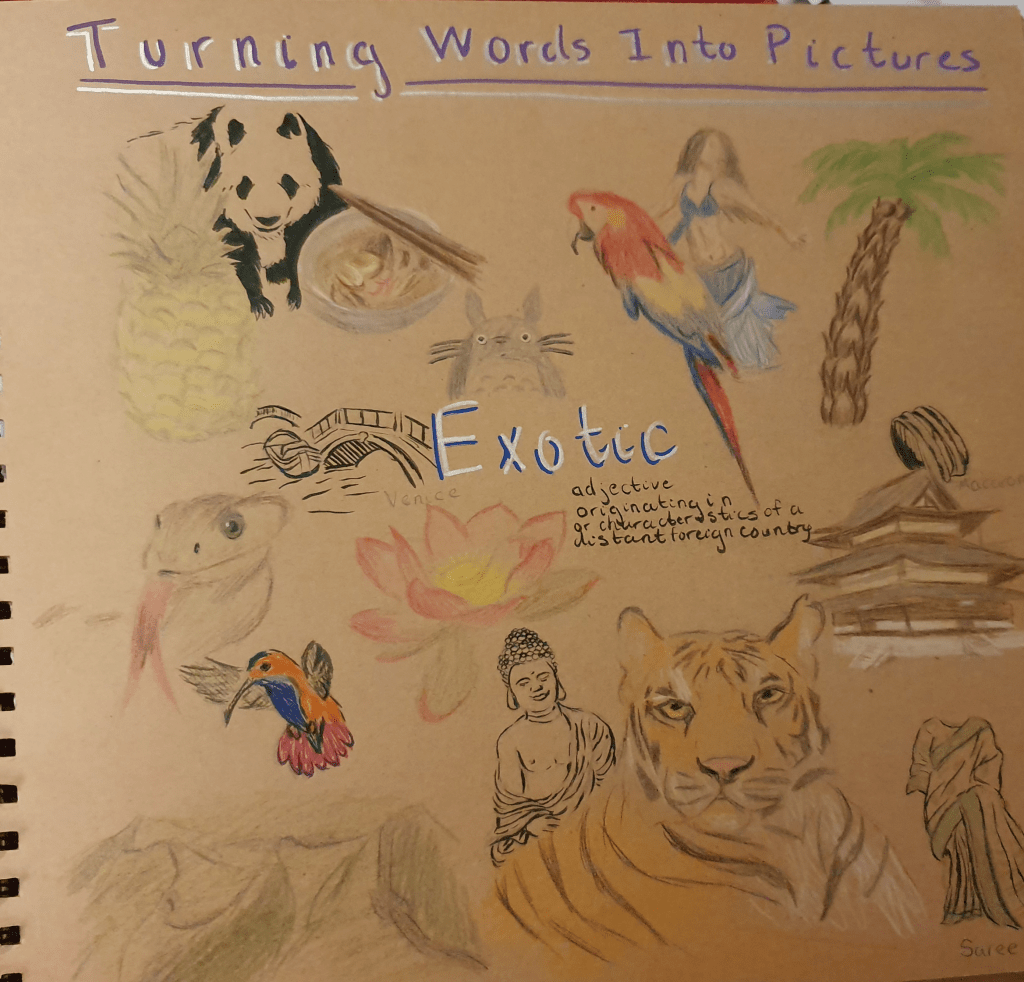
For exotic I ended up with lots of different animals. I suppose this shows how my mind prioritises things. I tried to gather lots of objects from different countries, but nothing that was too familiar as I didn’t feel that this would fit under the branch of exotic, even if the objects originated from another country. I also tried not to draw anything that was from a nearby country (the macaron being an example of my failure in this but also of my flow of thoughts). Looking back at my work I have become aware of the fact that once again I have failed to include an adjective. This is possibly the product of not really knowing how to draw an adjective and giving it a physical form (clearly, something I need to work on).
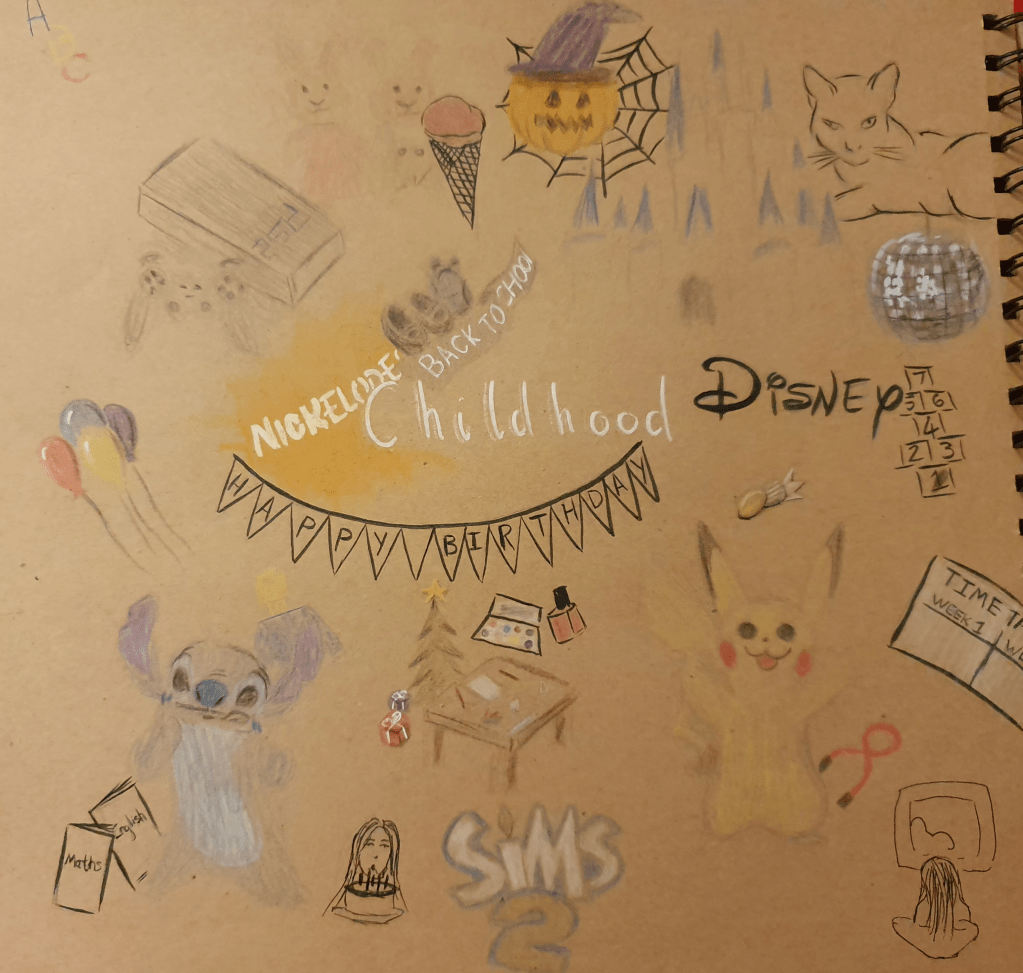
Childhood, I felt, came out a lot better. I feel that I have completed the exercise better. I guess second times the charm (I hope). That’s probably why we had to repeat the exercise, right?
I feel that this time I succeeded in making quick, rough images and I was able to make more sense of the exercise, presenting a better understanding in my work. Although I used the same word in the previous exercise I found that the results were hugely different. Yes, I started with some of the same subjects I had thought of before but eventually I came up with new thoughts and ideas. I believe this to show the difference between thinking visually and verbally.
Working on this I began to think of the toys I used to have. I remembered playing The Sims 2 with my sister and crying when my whole family drowned in the pool (I forgot to add steps) or burned in a house fire. Comparing the two pages to each other I noticed a difference in quality. Where as the exotic page is more controlled, childhood is a bit of a mess (there isn’t a huge difference but exotic seems to me, a more organised mess). The lines are looser and detail is sparser. This is something I struggle with. I hate it when my drawings don’t look all neat and refined, the reason I was glad had to do this exercise all over again. I found myself suggesting the details or skipping them completely to create the general image. Colour helped a lot with this. Where I couldn’t draw the details, adding a block (or blob) of colour conveyed what was there. To get to this point I had to set a timer for each drawing. No more than five minutes an image, for some I only allowed three. I found this got the process moving a lot quicker.
Small scenes were harder to draw. Which objects should I draw? How much detail is needed? Can I draw it quickly? Will it be legible (is that the right word?)? I was still caught up with how it would be presented, so once again the timer was very useful. I added a couple things later, whilst in a rush, and I found (god, how many times a I going to use that phrase?) that having to think quickly also helped (or at least didn’t hinder) and the subjects came out alright.
Exercise Four: Making a Moodboard
For Making a Moodboard, I chose to use travel as my subject. Reading the exercise again now, I am unsure as to whether I should have used one of the words I had already, so hopefully I did this right. Though I feel that travel isn’t too far separated from exotic, so they should tie in together (hopefully you agree).
I started the exercise by making a spider diagram of the things I think of when thinking of travel (Mickey Mouse ears anybody?). Surprisingly, I found this fairly easy and soon had the page filled with food and backpacking and (of course) different types of animals. Though lets not forget another addition, the place that holds all these things plus magic, Disneyworld! Couldn’t leave this one off the list.
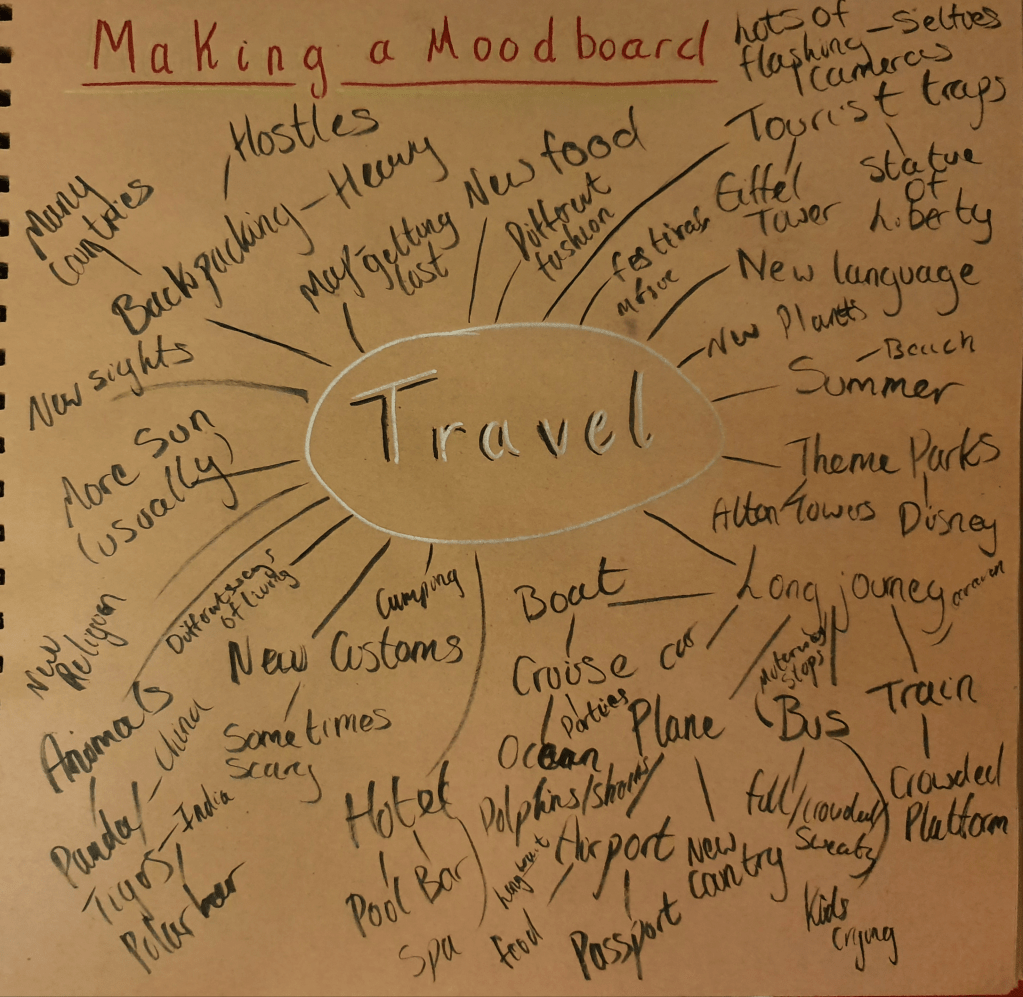
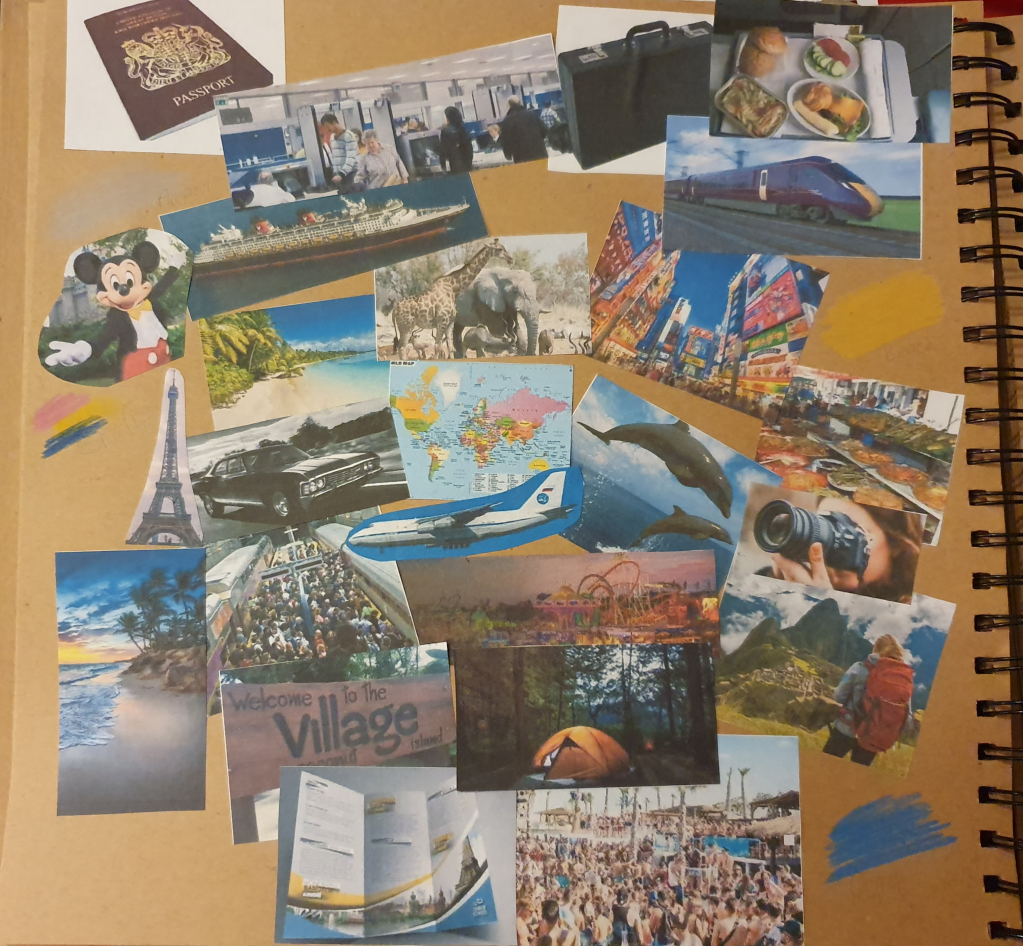
Not the best looking moodboard I’ve ever made but I believe it serves its purpose. I tried to group similar things together, though didn’t do the best job, unfortunately. Using google as my source for images (and a photo of the Eiffel tower taken on a family holiday) I managed to find all the things I wanted. During this exercise I realised just how many reasons there are that people travel. From short journeys (daily commute), to longer journeys (going abroad) there are many reasons and ways people travel. Some travel for business, whilst others for pleasure. Some even travel out of necessity, for example, needed medical attention that can only received in one place.
Not having much to work with in sense of swatches I had to create my own patches of colour using pencil. I used the colours I thought people would see fairly often when travelling, using objects such as shells and the ocean as inspiration. I used a dull grey to represent the airport.
Exercise Five: Using Reference
Using Reference was probably my favourite exercise. I’m not quite sure what made me enjoy it so much but after a while I forgot that I was actually working and not just drawing for fun. Or shopping. Using google and movies from the 1950’s as sources I collected a lot of resources for my moodboards.
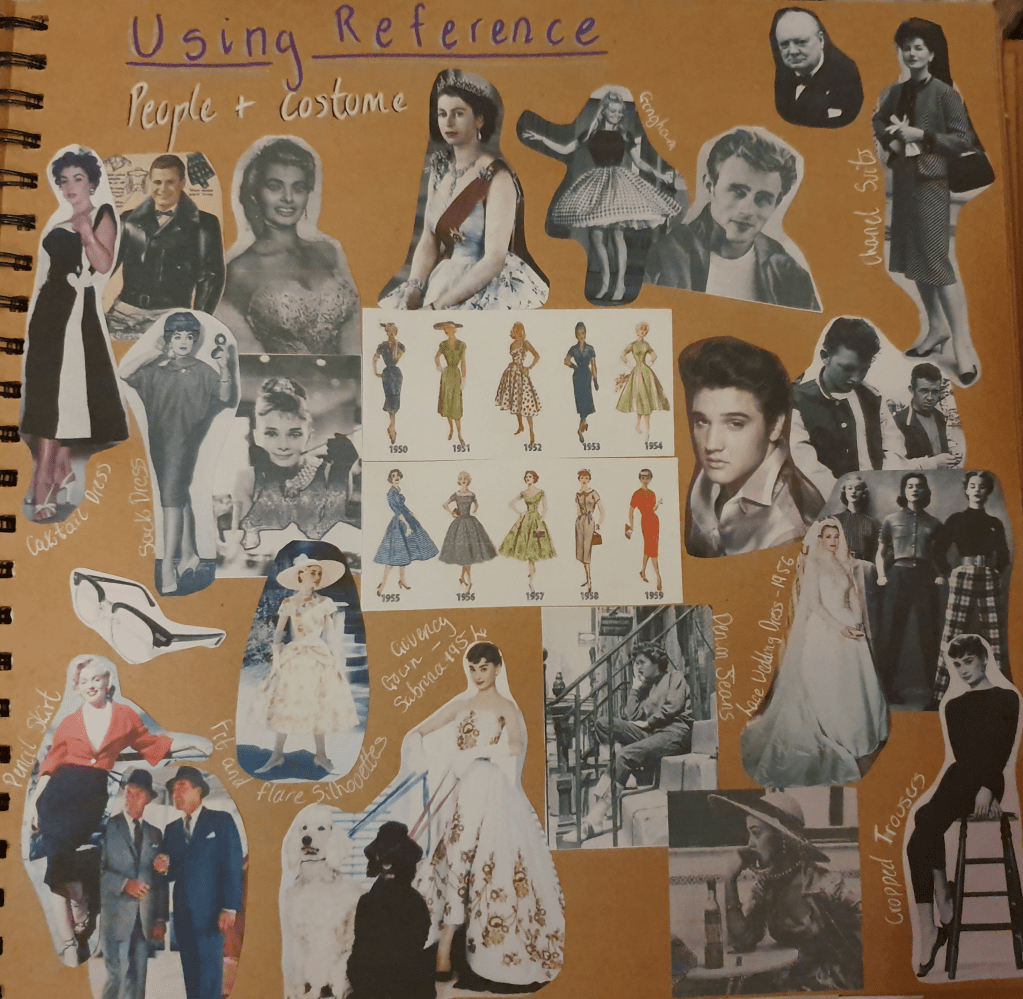
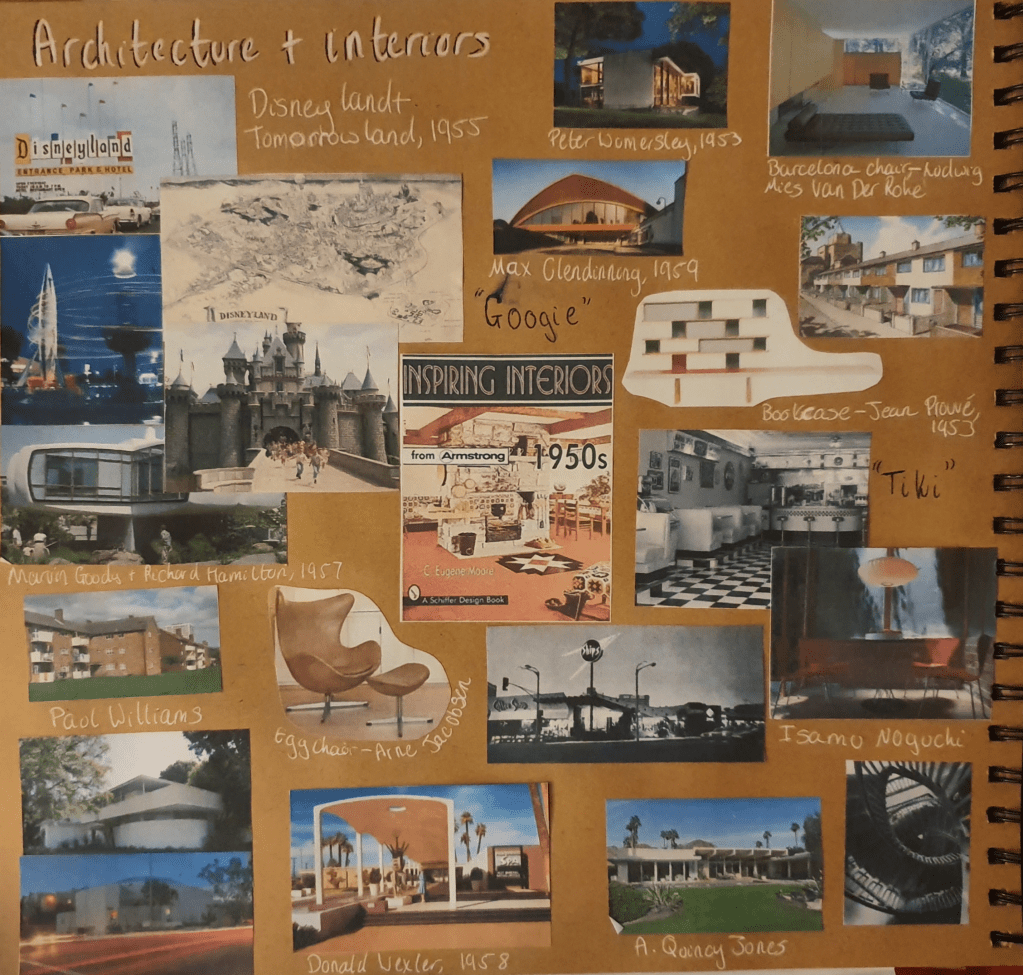
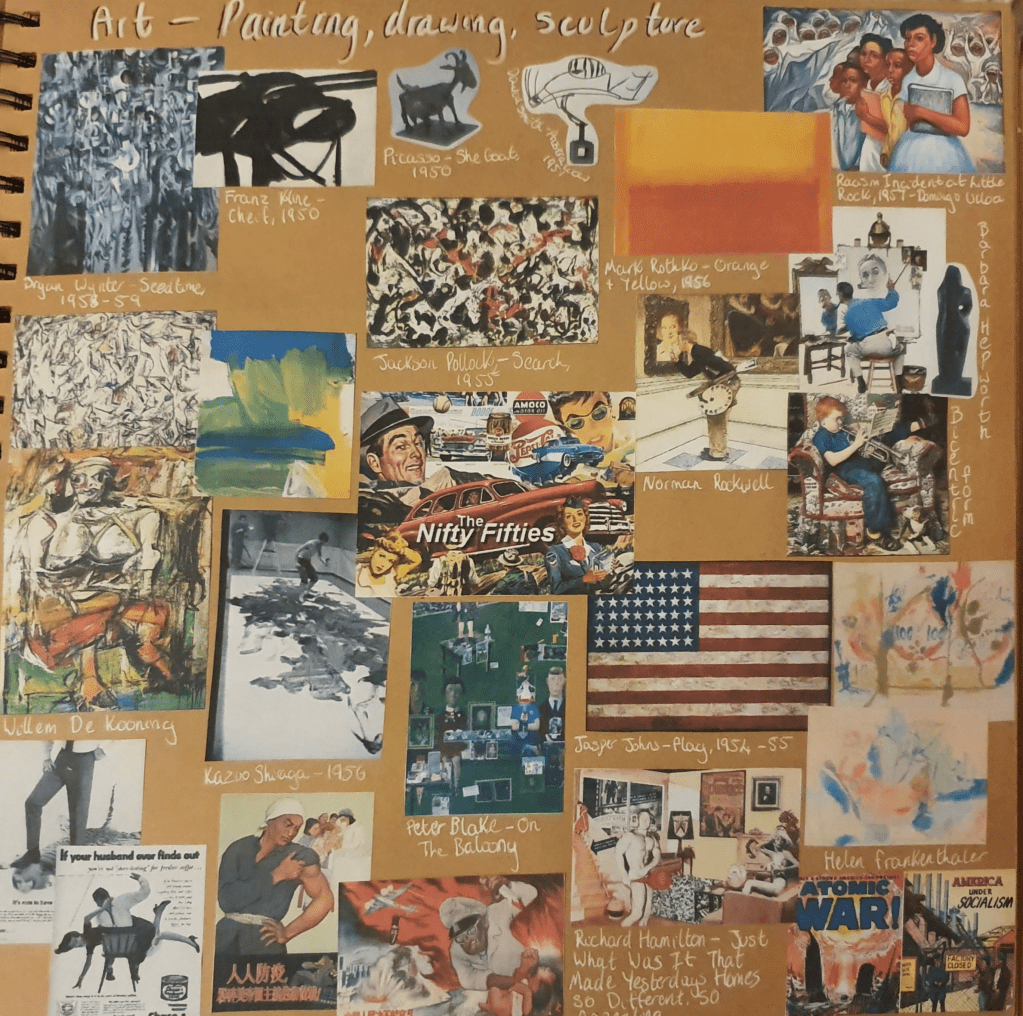
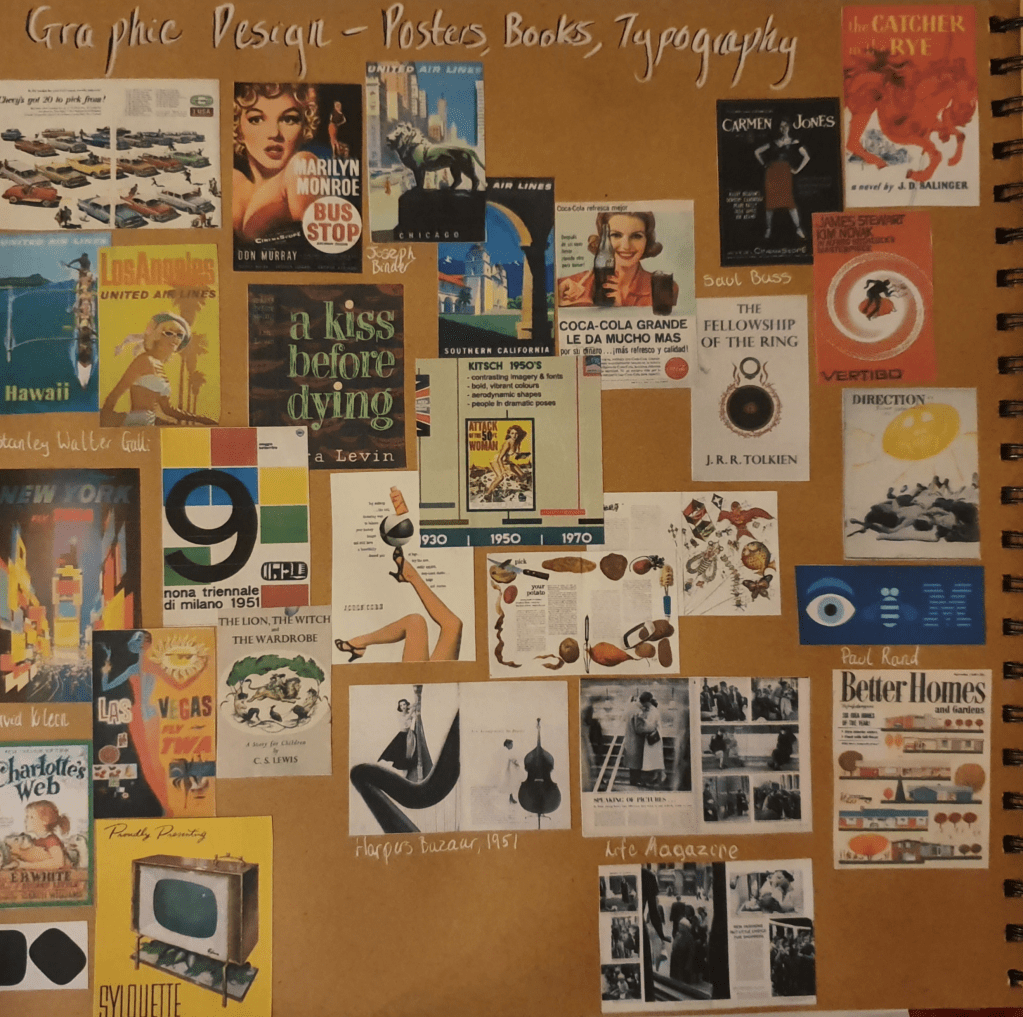
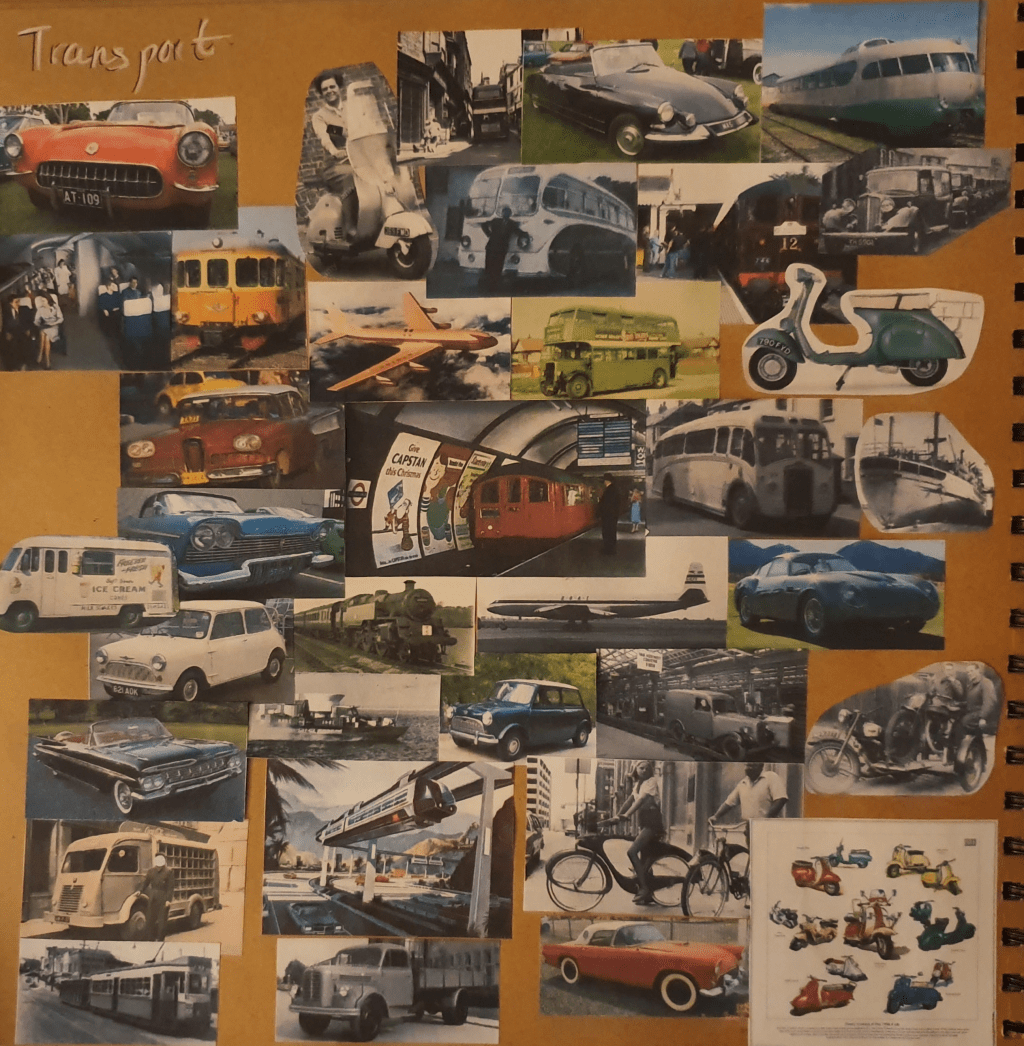
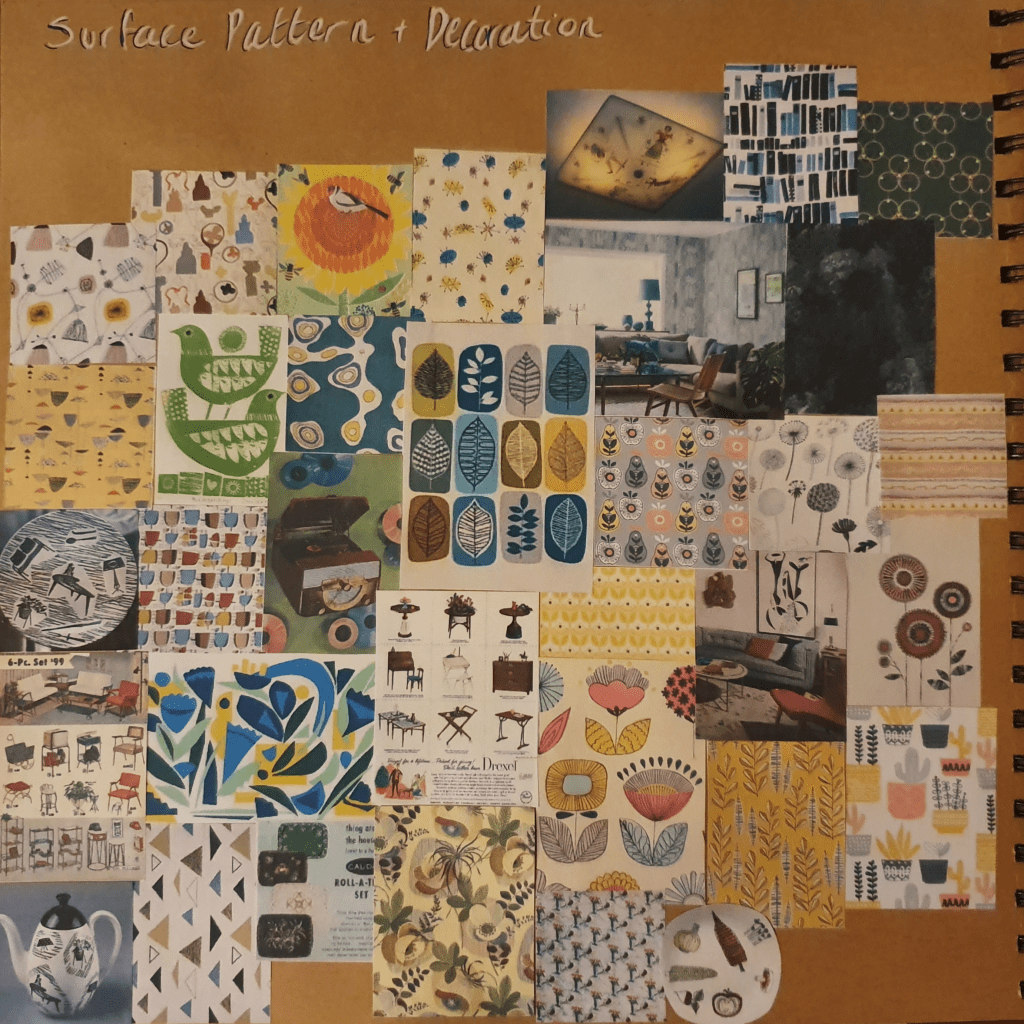
Whilst doing this I also read a little about the time. Because of this I came to a mixed conclusion. Whilst some people were bringing out brilliant inventions, some bothered me. Not only was the time full of racism and discrimination but some of the ads I saw were idiotic. The one that confused me the most was the one for Seven Up. Who suggests giving a baby lemonade to help them drink milk? I hate to think of how many babies were throwing up because of the curdled milk in their stomachs. Anyway, off topic (sorry), after the moodboards I had to write a visual review of the 50’s.
Visual Review
Judging by what I have found by completing this task, the 1950s were a time based on liberty and appearance. The decade was consumed by the relief caused by the end of the war. People were now able to do as they pleased and no longer had to worry about the effects of the war. They now had disposable income and were safe in the comfort of knowing they weren’t going to lose any more than they already had. This allowed people to focus on rebuilding their communities and making a good life for their families.
With this new found freedom people began to spend their money on things that would have been considered frivolous during the war. This began the focus on appearance. People during the 50s wished to put the war behind them and brought this feeling into their everyday lives. From clothing to advertising, the main focus was to improve everyday life and make it appear as though everyone was able to live their best lives. The decade was a time for progress and new beginnings.
Fashion of the time had been influenced by the war. No longer were people required to look like they had walked straight off the runway, comfort and practicality were the main goals. For women this came with the introduction of trousers and shorts and the lack of a need to always appear perfect. This was influenced by the lack of access to materials. However, this didn’t mean that people of the time didn’t still enjoy dressing up and looking glamorous. In fact, this was still the overall consensus of how people should dress when leaving the house. This included big skirts, big brands and big jewels. For men, as before, this meant sharp suits and expensive footwear. A more casual look common of the time, made popular by James Dean, was a white T-shirt matched with a leather jacket.
Architecture of the 50s took a whole new route, became something people had never seen before. America was heavily changed, most new architecture based around two new themes, either “Googie” or “Tiki”. With this came Futuristic and Polynesian designs. This reflected the need for escape and hopes for the future. Buildings now became sleek and bright, spreading hope and cheer with it. A well-known example of this is Walt Disney’s Disneyland in California. Built in 1955, smack dab in the middle of the decade, it represents the feel of the time. Built to both spread cheer and exhibit Walt Disney’s vision of future progress, Disneyland showcases the idealism that occupied most minds. Featuring a huge fairy-tale castle, painted in bright pinks and blues, invited people to escape their daily lives and fanaticise. On the flip side of this many were still living in the temporary homes built to provide a roof and four walls during the war. These buildings, built for functionality and speed, contrasted greatly to the new styles popping up everywhere. Whereas the new buildings were built with appearance in mind, these buildings were drab and lifeless on the outside.
Interior design during this period, much like the architecture, became smooth and more colourful. An open plan living space was introduced, contrasting the more walled in and cramped designs of previous years. The two most popular design themes were the more traditional décor and Scandinavian influenced minimalism. Bright, geometric patterns started to make its way onto family walls, often in a repeating fashion. Chrome based furniture became popular along with curved designs. Entertainment became a big influencer, inspiring home bars, outdoor furniture and barbeques. Record players where still a staple in the home, allowing people to dance to their favourite songs.
For art the 50s were a time of big changes and experimentation. The main movements of the time were abstract expressionism and pop art. These movements brought with them a freedom of expression, bright, bold colours and images people would be familiar with. With abstract expressionism, the process was considered just as important as the end result, possibly even more important as the process allowed artists to become more emotional in their pieces. I think that the action involved in making these pieces allowed artists to feel the art more than traditional methods. They were able to immerse themselves more freely than they would have been able to if they were stuck at a desk or easel. No longer were they only using their hands, this movement (at times) involved their whole bodies, which removed any constraints that may have been there before. As a result of this final pieces varied greatly. Some artists kept a more restrained look, while others let go completely, letting colour fly across the canvas. As for Pop art, this was used as a way to criticise the norm and consumerism. This involved many familiar objects, or people, as the focal piece. Probably the most well-known example of this (or at least the first piece I think of) would be Andy Warhol’s Campbell Soup. The bright colours and recognisable imagery make for an eye-catching piece, and reflected the confidence caused by the end of the war.
Graphic Design and adverts of the time depended greatly on typography. They were kept simple, allowing the slogans to do most of the selling. Today, with the invention of social media and more space for tv ads, we seem to have moved away from this a little. Subject matters focused more on, what seemed after the war, luxury products that were sure to make any person appear wealthier and make everyday life easier. Two big examples of this are holiday and car ads. If you were able to afford these things (similar to today) you would have been on good standing within the community as people would have considered worthy of more respect. Another thing that is eminent from looking through these things is the over sexualisation and misogynistic views of women. It is clear that women were viewed as inferior (made more obvious by the portrayal of women being abused), only meant to serve men to improve their social and, in turn, financial standing. In result women were hugely portrayed as weak housewives who couldn’t possibly manage anything by themselves. Unless of course, they were cleaning or cooking. I found that the time was filled with offensive media. From the clearly unacceptable degrading of overweight children to outright disgusting racism. The starting use of television as hugely influenced how products are advertised today.
Transport seemed to have an overhaul after the war. Gone were the dreary colours and in came the bright and peppy. In addition to this came the commercial use of planes. This became a huge factor in showing wealth. If someone wanted to raise their social standing all they had to do was hop on a plane. This showed a huge well of wealth as flights weren’t cheap. A huge boost in car sales was also a direct result of people wanting to show off their wealth after the war. Being able to afford a second car was the ultimate display of richness. Plastics became more widely used for interiors and partly for construction of transport.
Film and TV of the 50s enjoyed a huge boost in popularity due to the availability of TVs in homes. The TV became a staple in a home (the same attitude towards this is present today – though it may have even been ramped up by the invention of streaming services), allowing viewers to enjoy a wide range of TV movies and shows. Due to technological advances the move was made slowly from black and white to technicolour. Because of this people such as Walt Disney and Audrey Hepburn enjoyed a boost in popularity. Family values were portrayed on screen, showing people what they wanted to see. Rock n Roll began to made its way into the industry with the production of Elvis Presley’s Love Me Tender. This started a string of movies starring the musician, which often featured his music. Walt Disney’s animations became a good source of light hearted entertainment. TV also became a good way to influence a trend. Soon people wanted to dress and act like their favourite actors and actresses.
Next was to create an illustration of someone sitting in a chair surrounded by 50’s artefacts to give someone an idea of what it would’ve been like. I toyed with the idea of having a modern day person surrounded by artefacts but didn’t think it really got the point across. I started off with the outfits then moved on to design ideas.

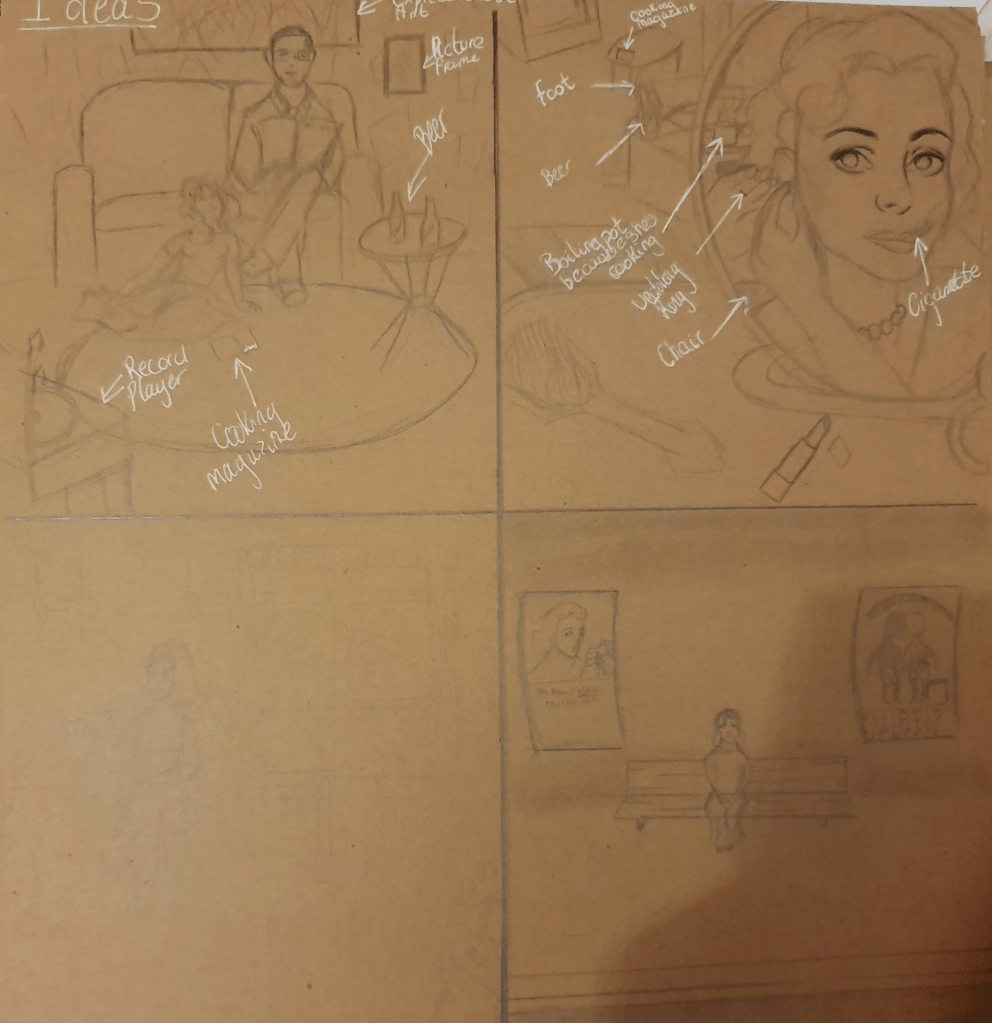
there became a running theme in each of my ideas. Sexism. The superiority men felt over women (some still do). I didn’t intend for this but it was a point from the time that got to me, so it’s not really surprising that it came through in my work. The first design shows a man relaxing on a sofa reading a newspaper, whilst his wife is forced to sit on the floor, waiting for his next demand. The second I liked the best and became my final piece. It portrays a 50’s housewife getting ready to go out. it sows how much she has to do whilst her husband sits around. The third, which didn’t come out very visible in the picture shows a woman sat in an egg chair, completely alone smoking a cigarette. You can see a car through the window, and 50’s objects around her. This one was mostly just to showcase what kind of objects a regular 50’s living room would of had. The fourth, and last, shows a woman sat on a bench in the underground. On either side of her are typical ads of the time. One showing a woman with a bottle and the words “Even a woman can open?” the word woman underlined. The second ad is a racist ad of two black men. It’s a paint ad. It shows one of the men painting the other white, showcasing it’s quality. The ad was for Elliott’s White Veneer and is absolutely disgusting. The point of this design was to show how discriminating and horrible people attitudes towards this were back then. I did’t pick this one because I didn’t think that I could do the issue justice.
My Final piece:
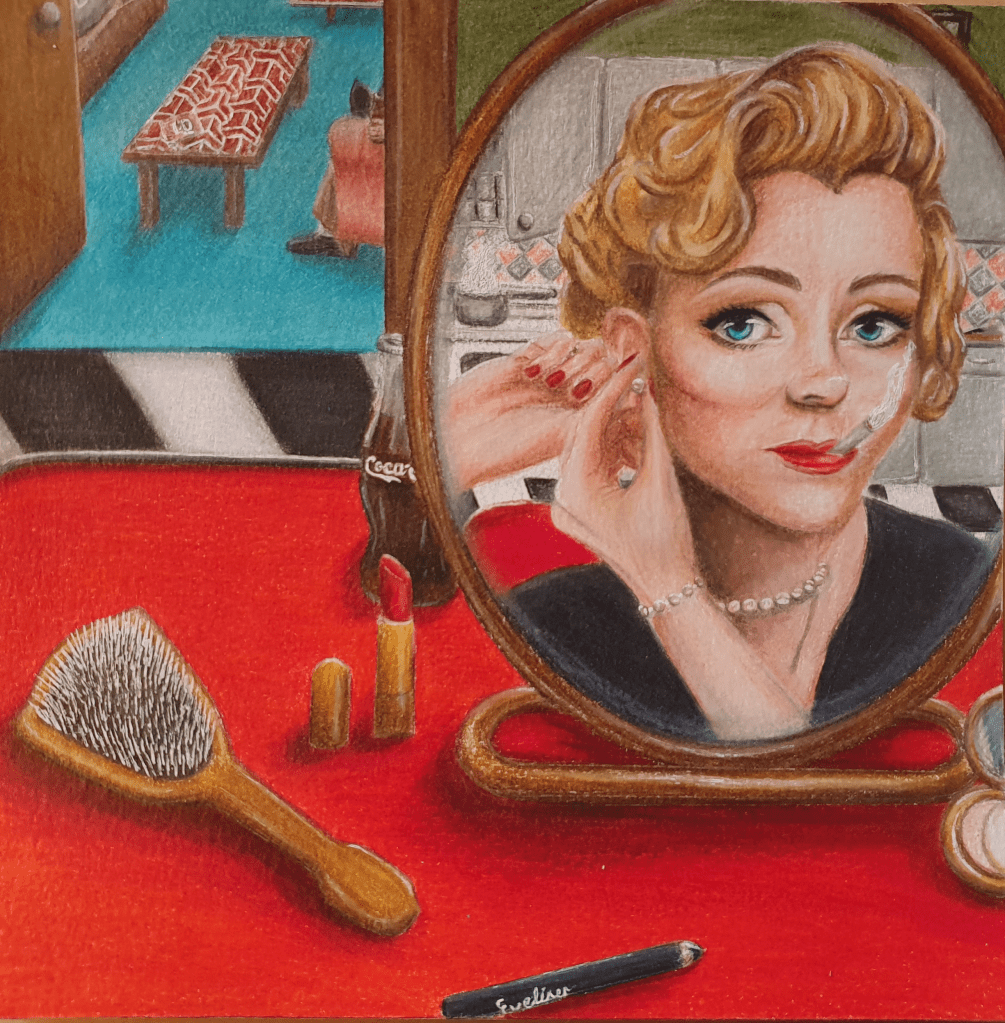
This piece portrays a 50’s housewife getting ready to go out whilst simultaneously cooking dinner and cleaning. It shows how she’s expected to look perfect and take care of the house and her husband at the same time. It show the expectations put upon women in the 50’s to always be perfect and never show a blemish, whether it be in her appearance or her house. Thinking about it now, instead of her perfect hair she could have had curlers in. Maybe this would have been better to get the point across. She has several makeup products around her, emphasising the work women had to put in to make their husbands happy, whilst he just sits drinking beer and watching TV or reading, as shown in the corner.
I decided to use this angle as I didn’t want to use a boring, over used position. I liked the idea of a mirror as it also allows you to see behind her, giving me more to work with. I’m pretty pleased with how this image turned out. I believe the strongest pint to be the women, probably due to how I usually draw portraits. Her eyes are slightly too big but I think that would be the only I would change about her. The powder compact of to the side would be made bigger if I were to draw this again as I drew it too small. I’m petty pleased with the hairbrush but don’t believe I quite got the angle right. This was one of the things I found hardest in this drawing. I tried to imagine the angle as if I was there, using images on google to help but I still don’t think it’s quite right. The same with the living room. I don’t think I manage to angle the furniture well enough, though this was because I was trying to show each element clearly.
Over all I feel that I did well on this illustration, with only a few things I would change. I think that I managed to decorate and furnish the hoe authentically, although the TV might be a small stretch, depending on how much the husband earns. I did, however, make sure to make it a back and white TV as technicolor was only just beginning to come into use. I like the expression I managed to catch on the woman’s face too. She looks slightly worried, as though she’s running out of time and isn’t sure if she’ll be able to get everything finished in time, or maybe her husband isn’t the best guy around.
Edit:
While researching this exercise I found many similarities and differences to the style of the response to the war between the USA and UK. The initial post war responses differed by the fact that America wanted to act like nothing had happed and put a glossy shine over things where as Britain had a slower, less obvious, response. This is most likely due to the differing financial standing of each country.
These responses were reflected in the progress these countries were able to make. The USA was able to move on and build a blossoming society full of luxury goods and family values. This time of US history was full of glamour. They had expensive cars, Hollywood, a high employment rate and Marilyn Monroe. This contrasts greatly to how the British were living at this time. Here, people were still living off rations and bomb sites lined the streets, debt was high and rebuilding was slow. The time was made worse by the loss of the country’s King George in 1952, although this also led to a time of hope and change through the coronation of Queen Elizabeth II in 1953. This event alone had a huge impact on the country. Broadcasting the event showed the technological advances the country was making and brought a sense of hope and unity to the nation through the ability to view the coronation through the tv.
Technology, at this time, went through a major overhaul. It doesn’t seem as though any part of life was untouched by the advancements made in the field. Many of the tech made during this time is still used today in one form or another, whether very close to the original or incorporated into new tech. The decade had a huge impact on the future course of the field. Everyday life was made simpler by the introduction of washing machines (though very expensive), fridges and blenders. Even existing tech, like the radio, found new life with the invention of transistors, making smaller, more portable versions possible. This also allowed kids to annoy their parents by playing the music they didn’t like, Rock n Roll. The biggest difference made in homes were the introduction of affordable TVs. These became a regular sight in US homes, with many new shows, such as “I Love Lucy” and “The Twilight Zone”. Later on, focus began to move to the children of the decade, introducing show like “The Mickey Mouse Club”. TVs at this time, however, were a much rarer sight in UK homes, where efforts were still being made to recover from the war.
Later in the decade came the advancement of communication devices. This included the installment of the first transatlantic cable line along the bottom of the ocean. This was sponsored by the USA, Canada and the British Post Office. This had a huge impact on life at that time, and continues to do so today, as it allowed overseas phone calls for the first time. People were now able to communicate almost instantaneously from country to country, when they had been limited to their own before. Pagers were also invented, the first form of texting ever made. Improvements were also made on less obvious forms of communication, like TV. In 1954, the first “colourcast”, coloured broadcasting, was made coast to coast from Pasadena.
Businesses were also benefitting from all the new inventions. The most obvious would be the introduction of computers. Although not available to the public for a few more years, computers were made available to businesses and branded as big calculators, making life easier for employees in places such as banks. This later changed, of course, with newer tech and ideas. The invention of computers, however, was met with fear and scepticism. People were afraid that they would take over the world as seen in 1955s “The Desk Set”. This, along with the price (though way more affordable than before), put many people off buying a computer. This however, doesn’t seem to have been a problem as they soon became very popular. TV studios also benefitted from the continuing ingenuity as kinescopes, along with magnetic tape, allowed them to retape and edit their shows before being broadcast, allowing for any mistakes to be omitted and a sleeker style of show. Another notable change would be in the field of animation. With the invention of copying machine and wide screen cinema came a new era of animation, just at the time that it seemed the art would die out. The introduction of copier machines in a studio saved artists lots of time as they were able to copy the drawings instead of redrawing them many times. This machine was also capable of copying straight onto film, saving a lot more time. Later, with the introduction of colour to the process, time was lessened again, though this did lead to a loss of jobs as ink and painters were no longer needed as much, later eradicating the department completely.
Many other inventions from this time have had an impact on our lives now, including: the beginning development of video games, optical fibres, barcodes, microchips and the solar cell invented in 1954.
In Britain, new inventions were celebrated by the holding of the Festival of Britain. This was held in 1951. Scientists and inventors from across the country were able to showcase their inventions to the delight of visitors. The planning of this event had begun in 1947 as a way to celebrate the centennial of Prince Albert’s Great Exhibition, held in the Crystal Palace, in 1851. The festival came at a time that the country needed to heal and this celebration was the perfect way to bring people together to do this. The whole event had a budget of £12 million. A huge sum, especially with the post war financial standing. The event focused on the successes of the British community. The festival showcased and promoted the best of British science, technology, industrial design, architecture and arts. The centerpiece of the festival was held on the bank of the Thames; however, it was spread throughout the country, all the way up to Scotland, making a country wide affair.
Politics were banned at the event so that the sole focus would be on the achievements made by the country. This was the country’s way of bringing new hope to the people and dealing with the trauma of the war. This is a hugely different approach evidenced in America, where they seemed intent on erasing any evidence of the tragedy.
Style of the time differed between countries. Britain seemed to focus more on practicality, whereas the USA based their styles around comfort and entertainment. This could be seen in the designs from clothing to homes. The war influenced style by limiting the materials available. This however, wasn’t a problem for very long (in America at least) as new materials began to get used. These materials include the unconventional, like curtain materials and the new, like plastics. As far as fashion is concerned both countries were similar in wanting to go back to looking trendy. The routes they took to this, however, are very different. The US went with a more glamourous style: evening dresses and sleek designs, whereas the UK kept things simple, influenced by wartime fashion. Both seems to meld together when it came to the younger fashions, largely helped by TV and radio. Rock n roll was a big part of this as fans were now able to see and hear their favourite artists whenever they liked. Big styles of the time were teddy boys, sweater girls and rockabilly. Big influences other fashion in this period of time were: Christian Dior, Coco Chanel and the (then current) Duke and Duchess of Windsor.
The influence of the USA seemed to leak its way through to the UK in more ways than just one. From tail finned cars to geometric patters you could see the influence reflected in British homes. Many similarities can be seen, such as: open plan living and bright, boastful colours. While this is true the two countries also had their own, unique styles. A huge influence over British design, and still is, was Terence Conran. His work was debuted at the festival of Britain. In 1964 he started his own company, Habitat, which would later be sold to and work under Ikea and then Sainsburys. Before this he had already made a name for himself with his european furniture designs and work with Mary Quant. He took influence from the west coast, France, spain and Italy. He took a practical approach to his designs “I’ve always thought that design was ninety-eight per cent common sense and two per cent aesthetics”. He also took inspiration from the works of William Morris and Bauhaus. Other influencers of the time were Robin Day, Robert Welch and Lucienne Day. These designers brought modern, abstract designs to Britain. Expense was also an influence on British design. Reproduceable products became popular as it saved on money and time. Bright colours were a popular choice to drown out the dreary effects of war.
Concern around nuclear war and the launch of Sputnik became ever present in the minds of Americans. This leaked into the designs of artists, who filled homes with futuristic design. Although more popular in the US these influences could also be seen in the UK. Such influence didn’t stay confined to just interior design either. It could be seen in architecture as well as fashion. The most obviously space influenced designs would be the architectural Googie style, used to attract people on the roadside. An area hugely influenced by this would be Roswell, New Mexico, because of the stories of aliens and ufos having been seen there.
Most of the style in Britain seems to have been influenced by the USA. I believe this to have been because of the profitable position the country had been in compared to the UK. The USA had done a good job of covering up the scars left by the war and the British were hoping to be able to do the same to move on.
Along with the extra research I also had a look back at what I had done to answer some questions.
Did you consider using your own research to mind map ideas?
No I didn’t. I though that sketching my ideas would work better.
Do you believe you shared an aspect of the social climate of the time?
I do, however I am no longer convinced that I did this well. I tried to make what was expected of a woman during that time clear but looking at the work again I can see how this wouldn’t come across to a viewer. I don’t feel that I have added enough information to the image. Maybe I could have added some empty plates to the table, or maybe a child in the living room, playing with some toys?
Would your illustration communicate an impression of a 50s household?
I believe that it does but not as well as I had hoped.
Is it clear it’s the 50s? Is it clear that she clean and cooked? What would help with this?
I wouldn’t say that it is clear to school age children. I believe that the image is too subtle and maybe doesn’t hold the right information for young children to understand what I was trying to show. I should have made the woman look more tired, making it clearer that she has been busy. Maybe some big bags under her eyes. Maybe a half eaten plate of food instead of a simmering pan in the background. I also feel that the living room should be more in view to give the viewer some more information.
Along with this I also bought the book Sketchbooks: The Hidden Art of Designers by Richard Brereton which recommended by my tutor.
Exercise Six: Exploring Drawing and Painting
Exploring drawing and painting took me a little while to get threw as I was enjoying experimenting with different materials and techniques. The aim of the exercise was to end up with a sketchbook made up of different papers and materials. I starting this exercise wrong to begin with as I read the wrong part of the text (which as stupid) so I have a few other example of mark making to show along with my sketch book. I was unsure as to whether I should include them or not but since I spent time on them I figured I may as well.
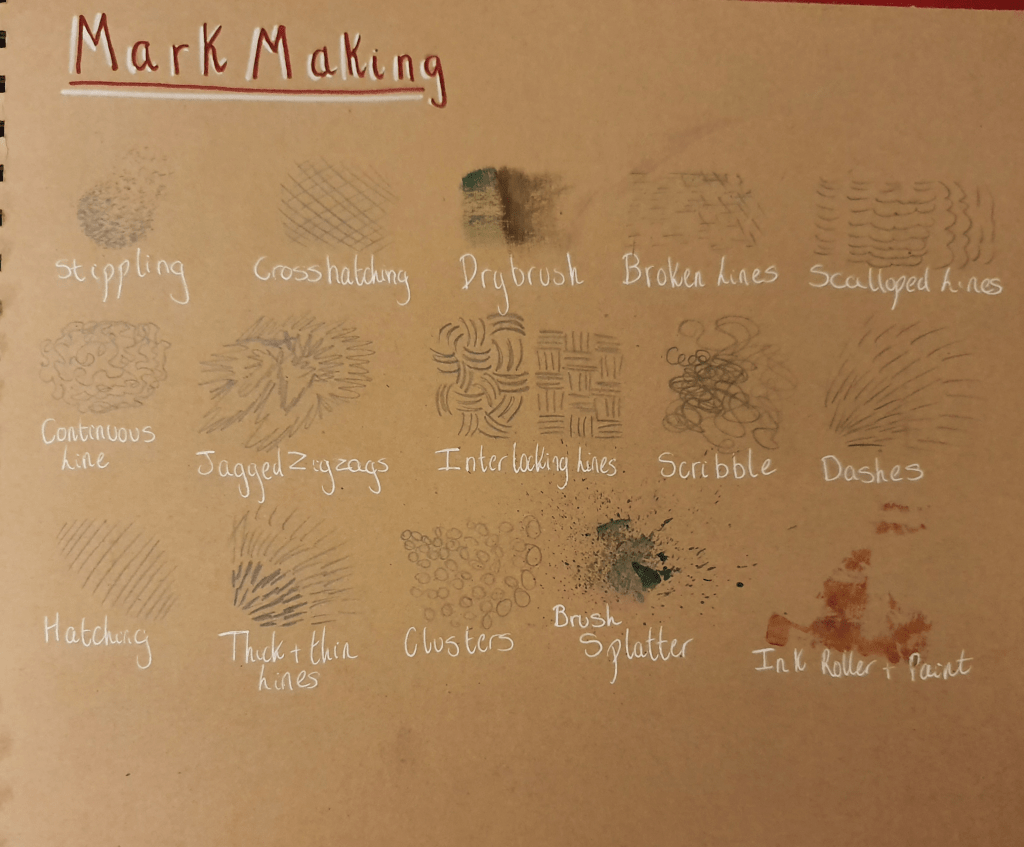
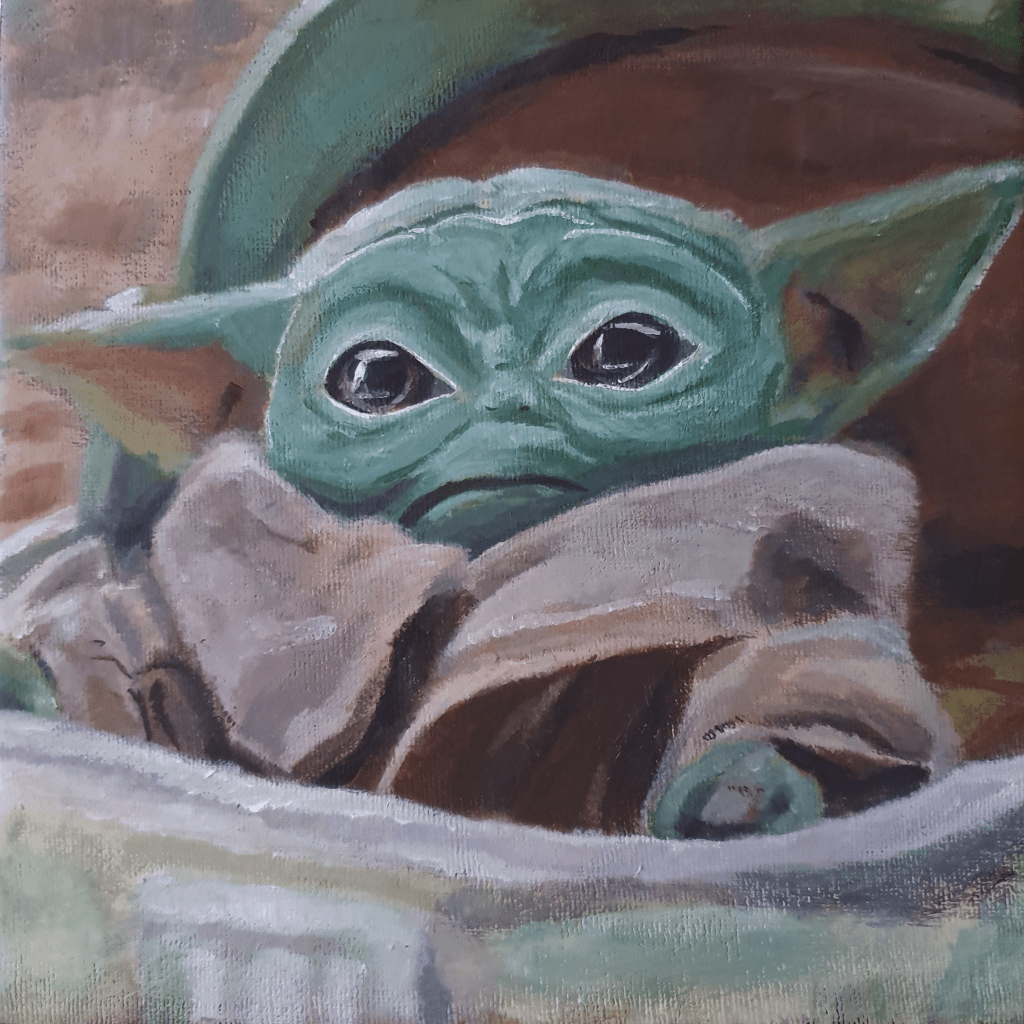
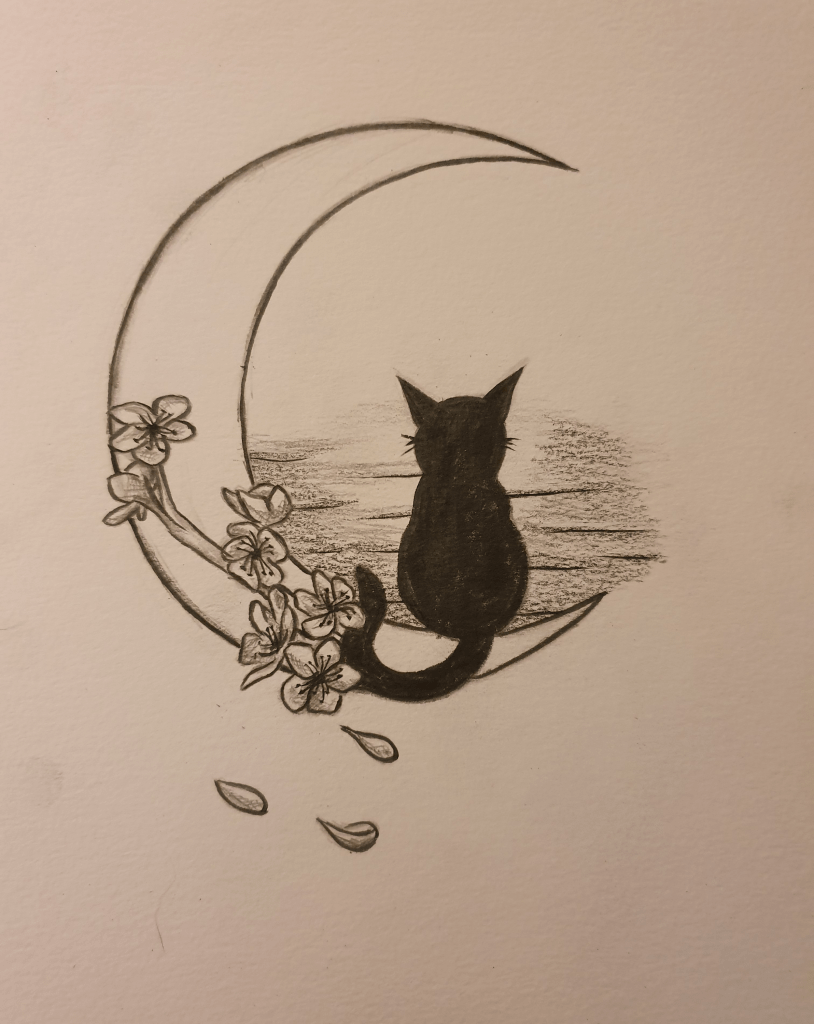
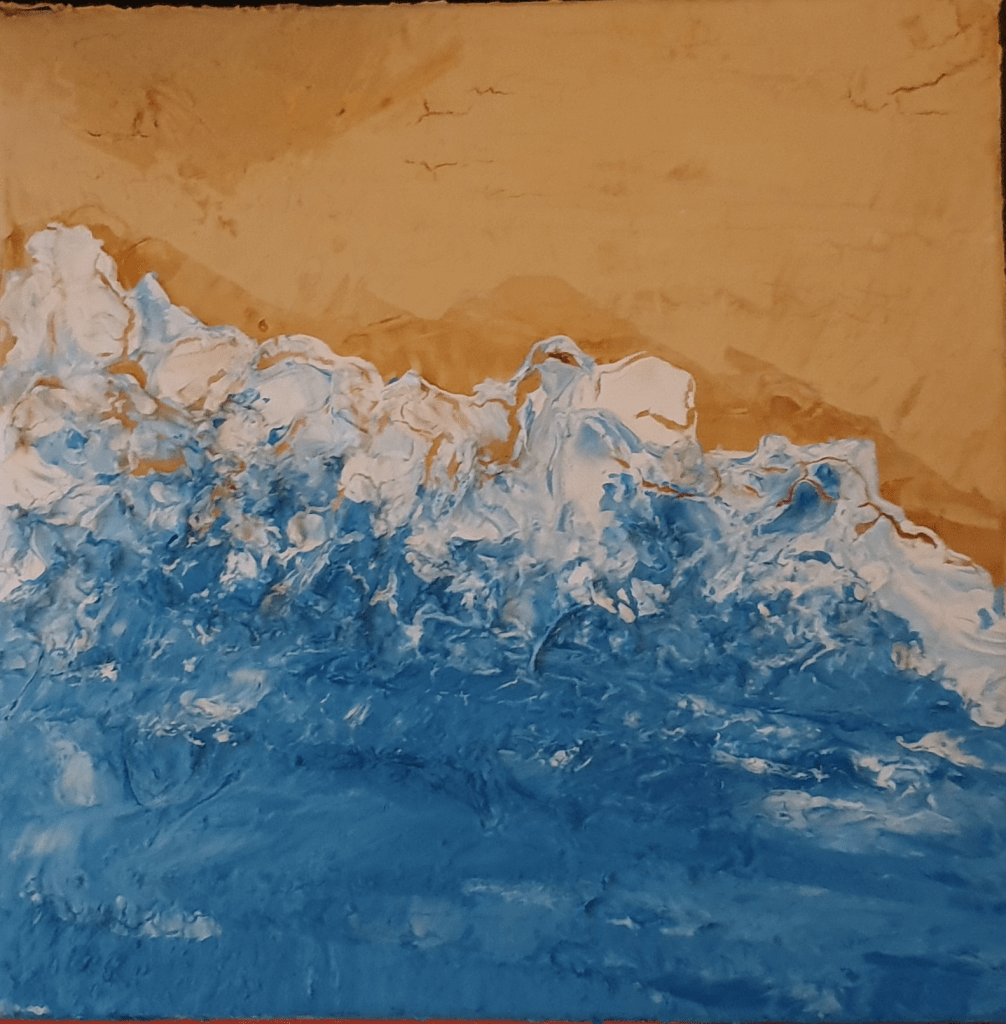
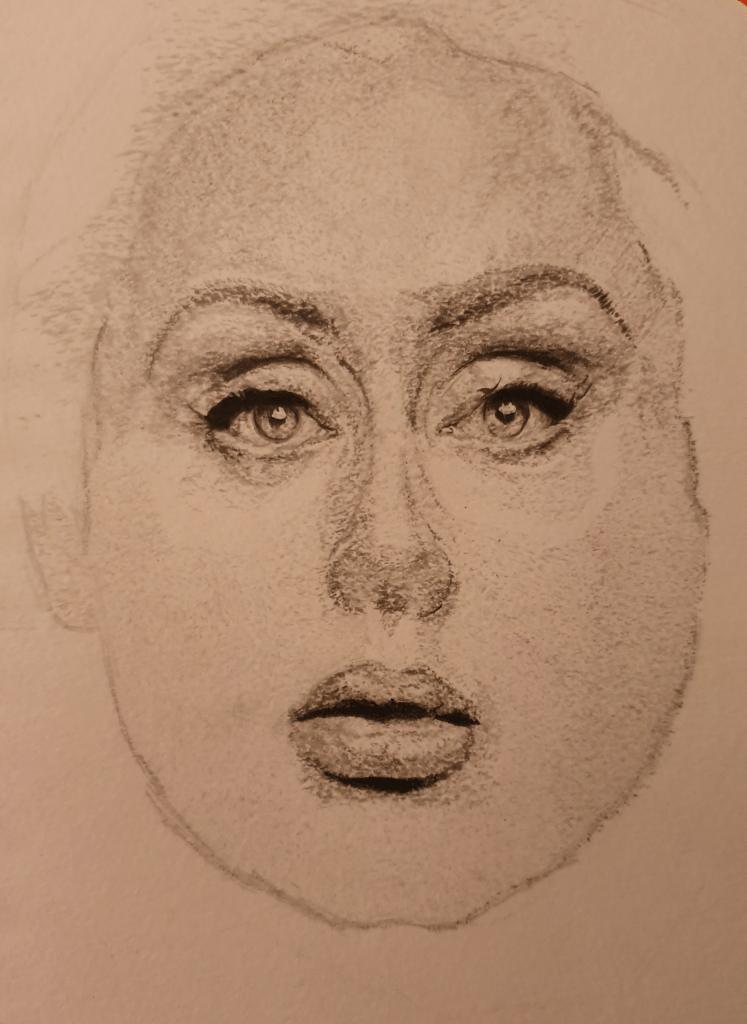
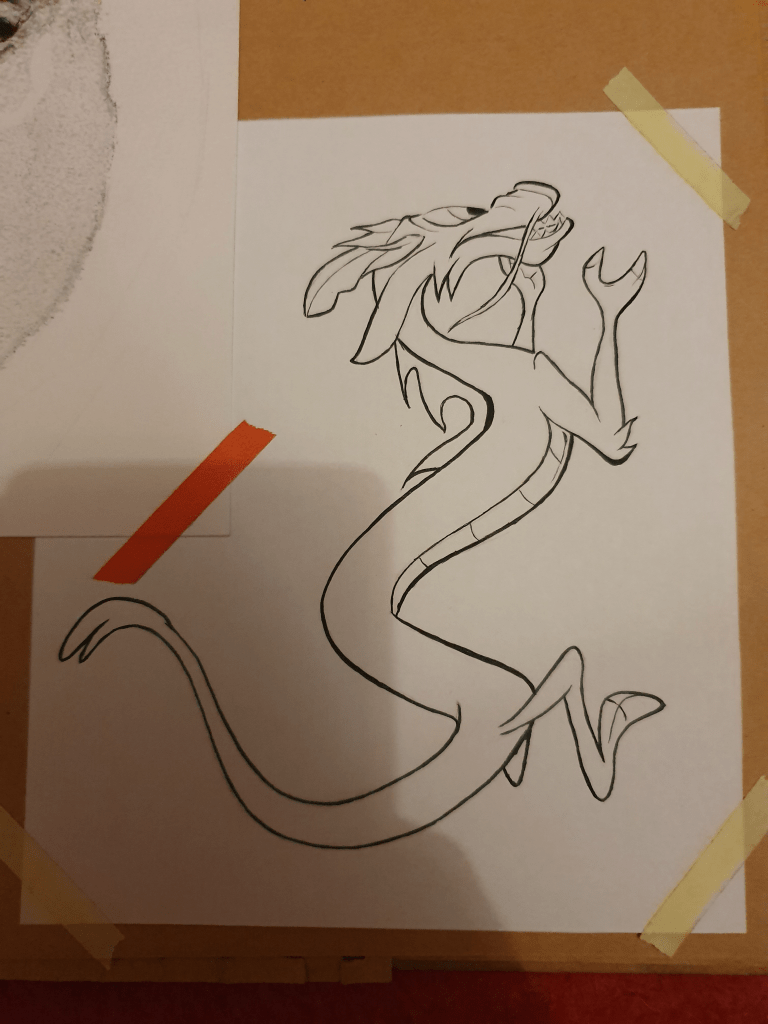
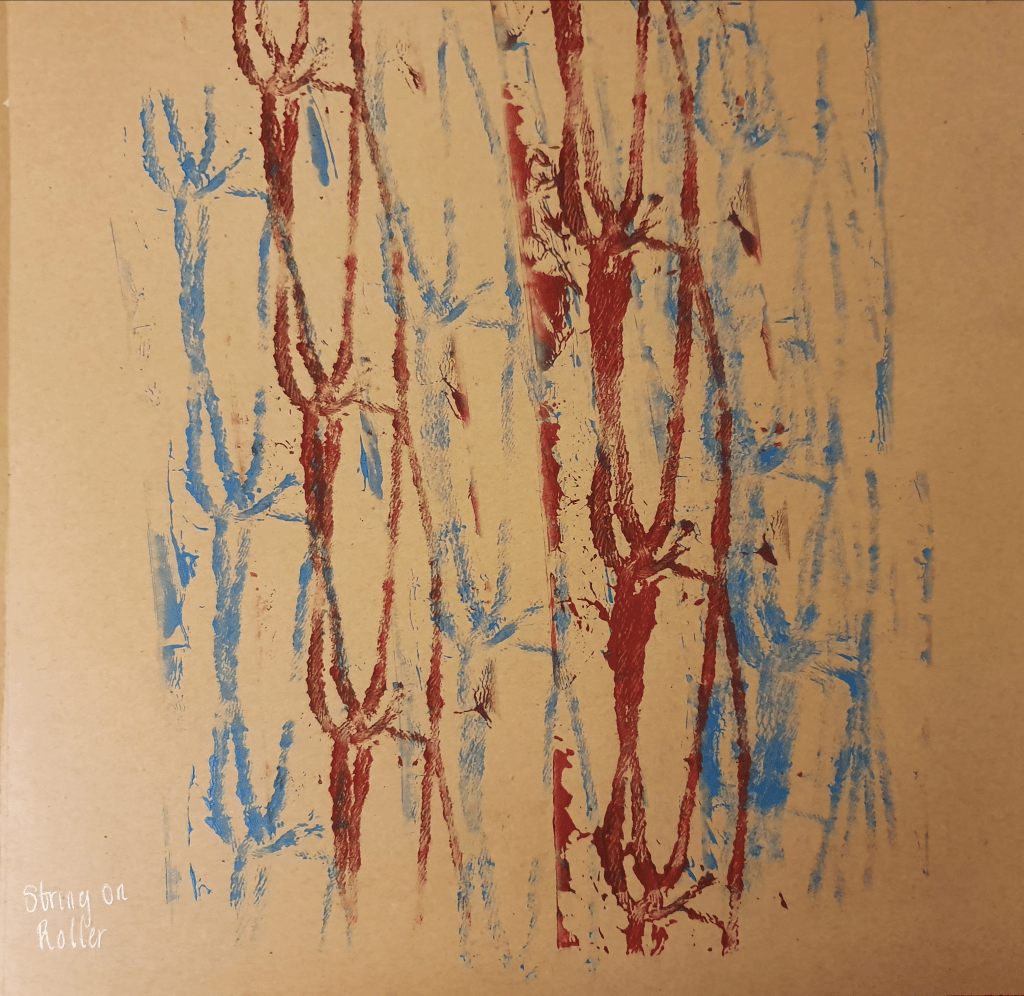
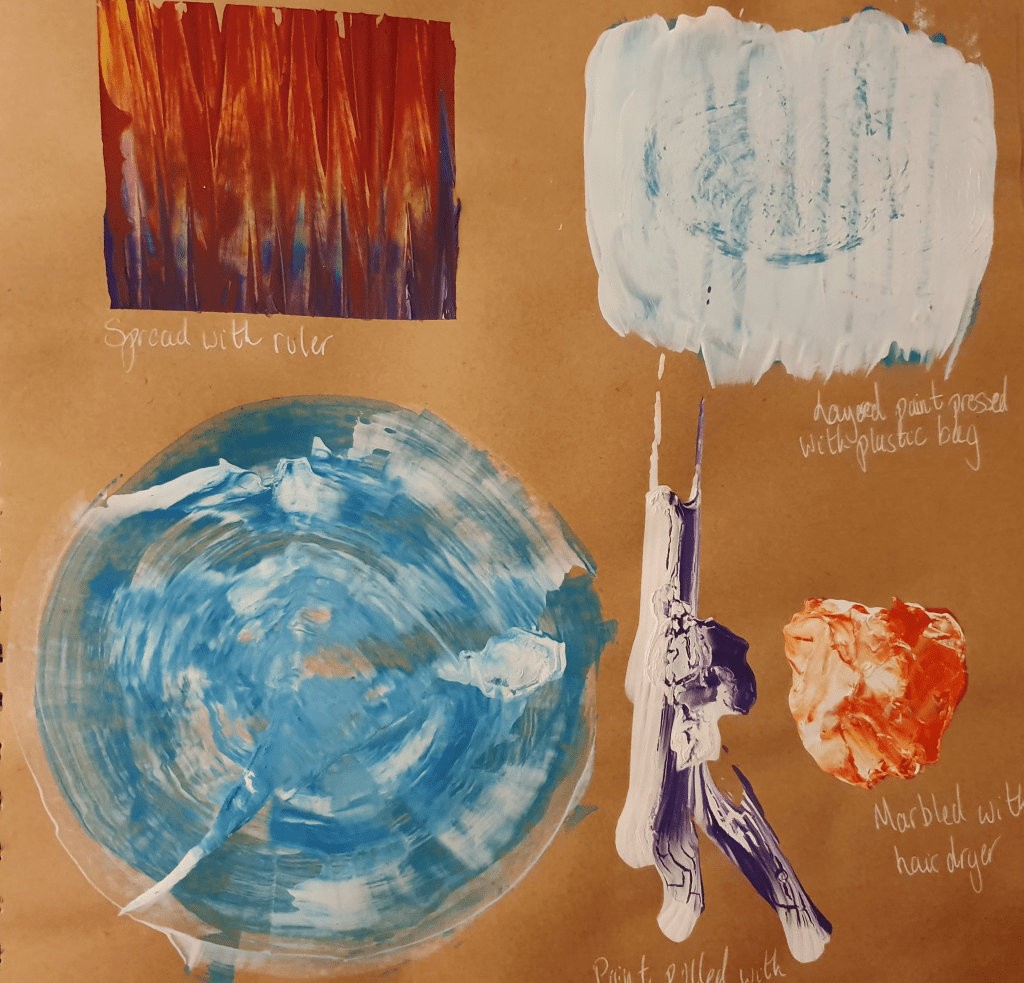
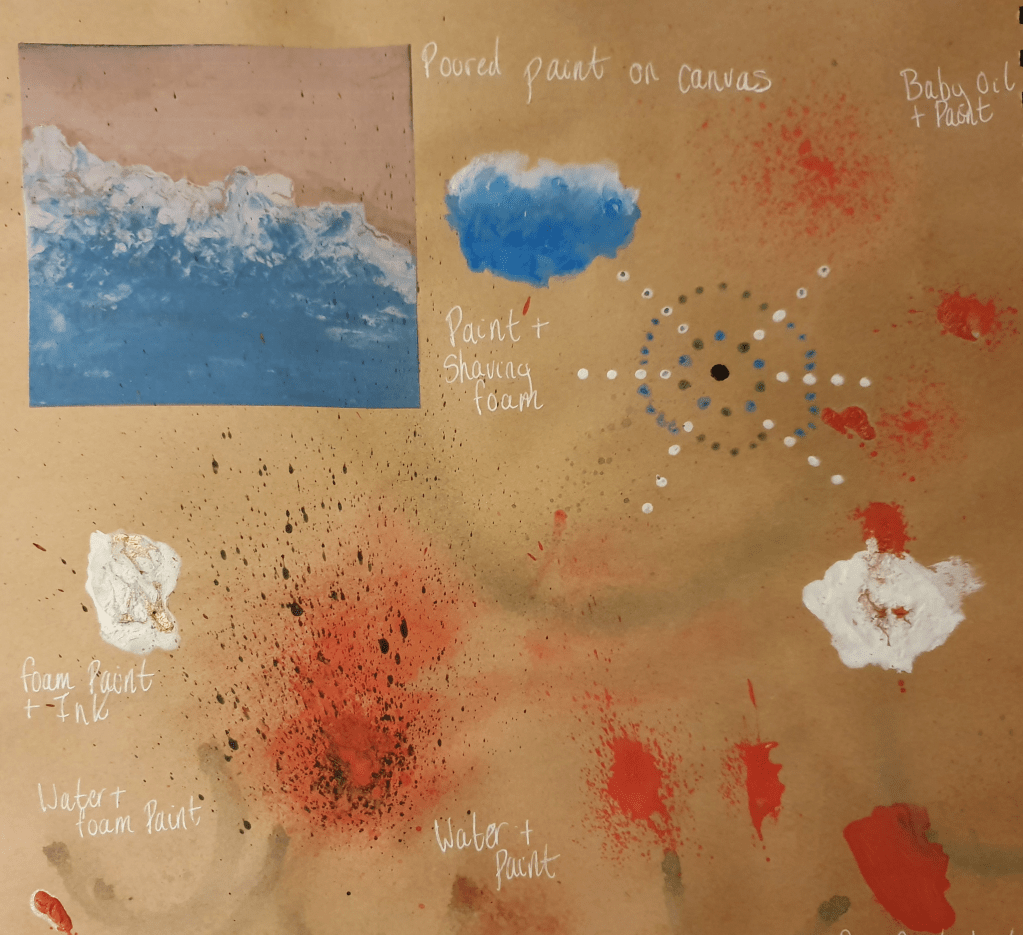
I started off by making sample of each technique I used on the first page then experimented with different techniques and materials. Then, once I realised I was an idiot, I started on the sketchbook. To make this I used printer paper, thicker paper, baking paper, thinner paper, tissue paper, extra thick paper, thick brown paper and canvas paper. My subject was a cupcake.
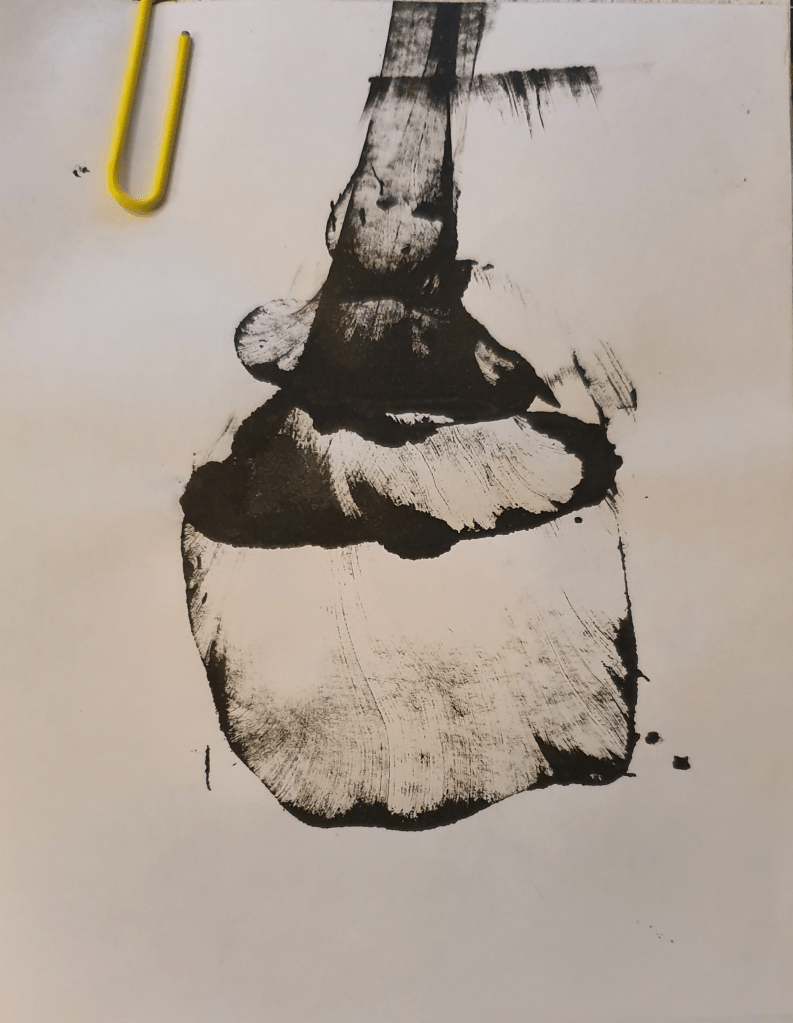
For this image I used printer paper, ink and string. I placed the paper and ink covered string between a book, after carefully placing the string for the shape and pulled. It came out looking more like a tulip.
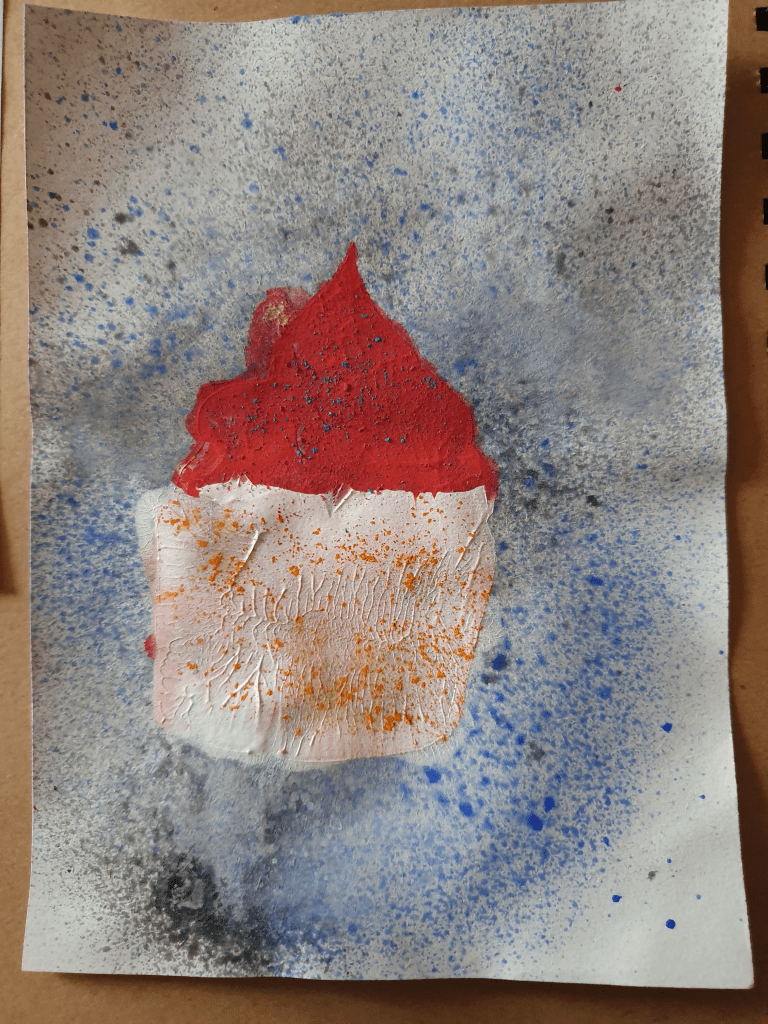
This was acrylic and acrylic mixed with water, squirted through a little bottle.
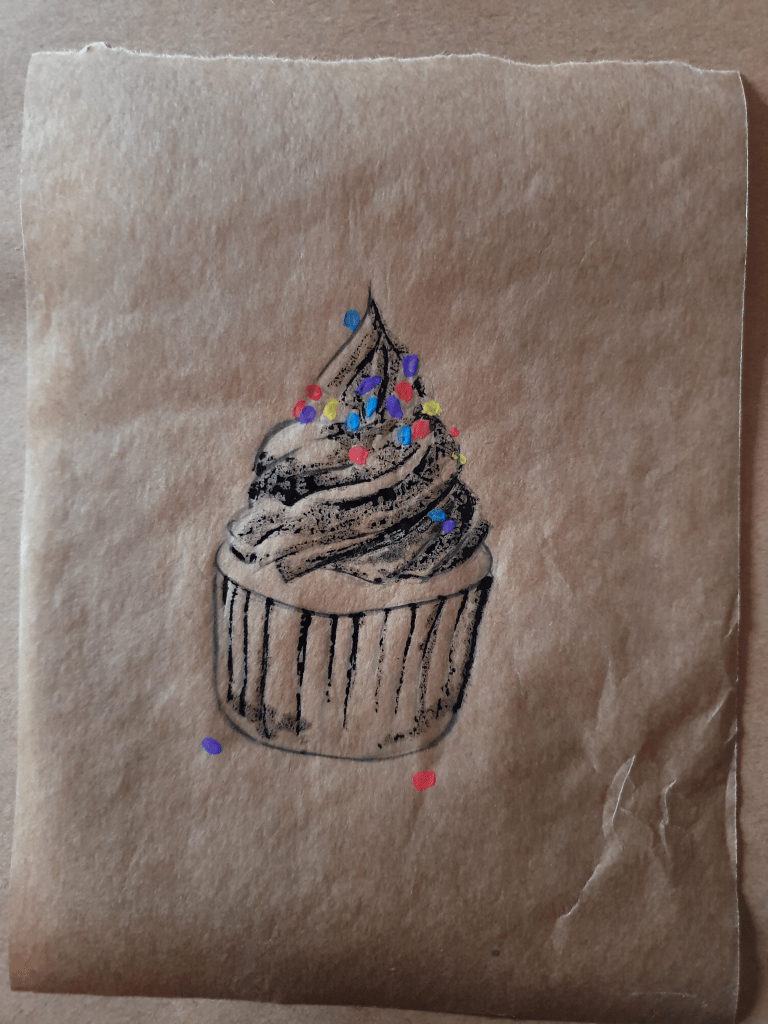
Ink on baking paper with acrylic mixed with shaving foam to make it puffy.
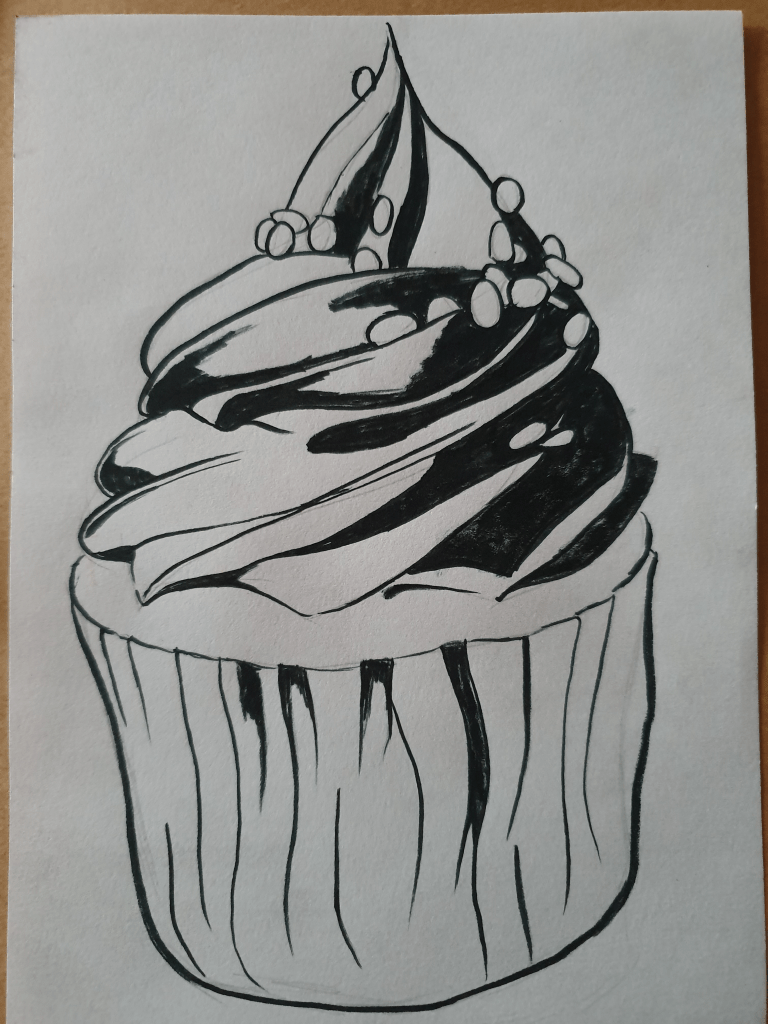
Pen on thin paper.
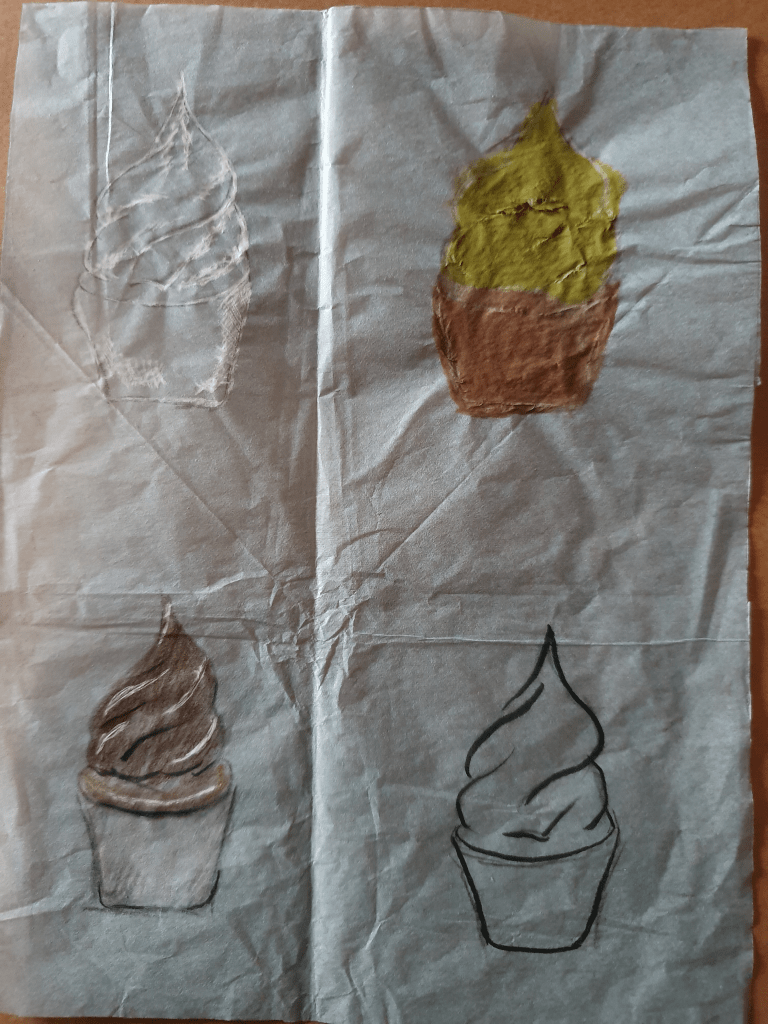
Different inks, paint and pencil on tissue paper.
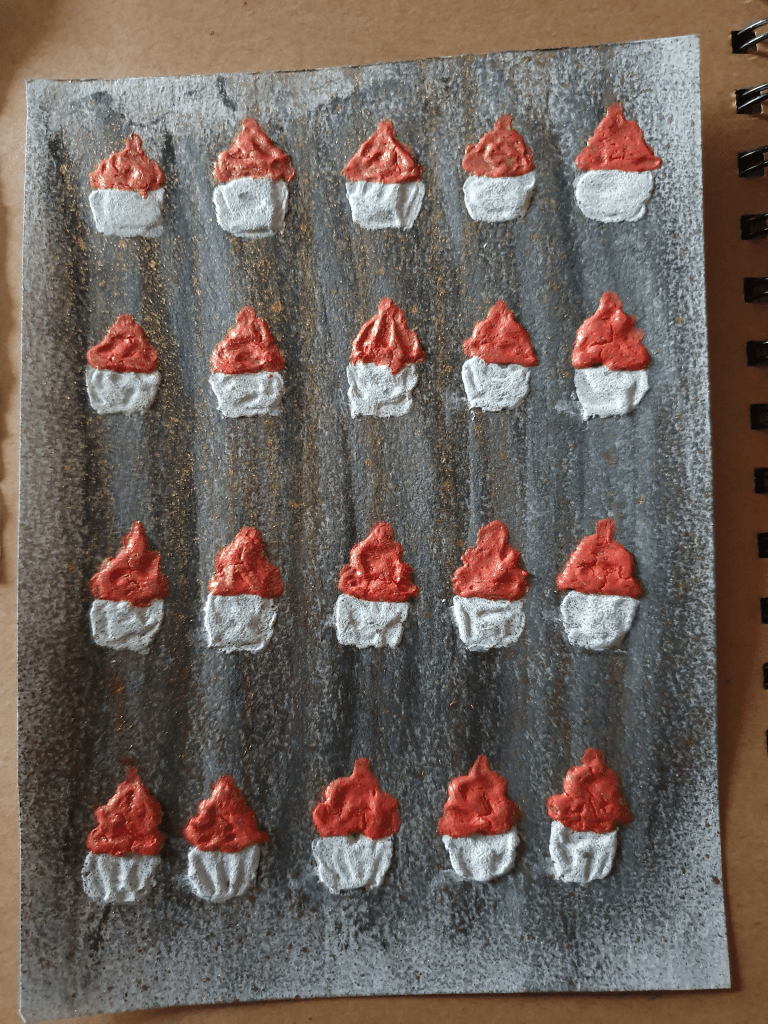
Charcoal, shaving foam puffy paint, dripped water and gold ink mixed with water squirted on.
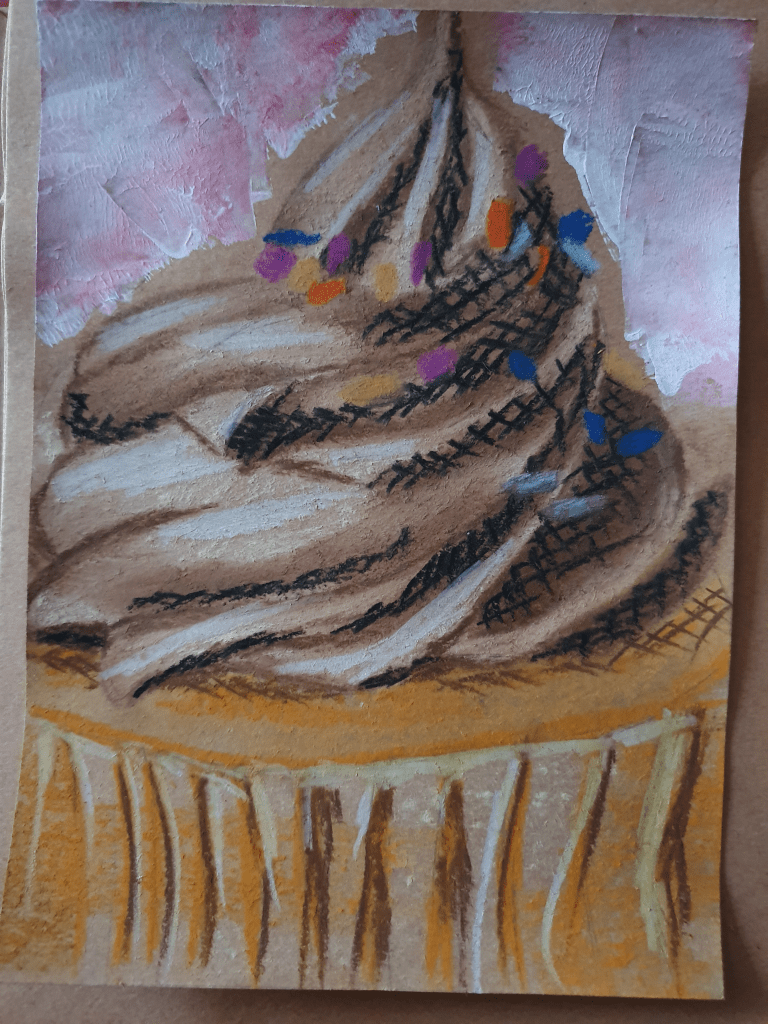
Pencil, pastel and drybrush on brown paper.
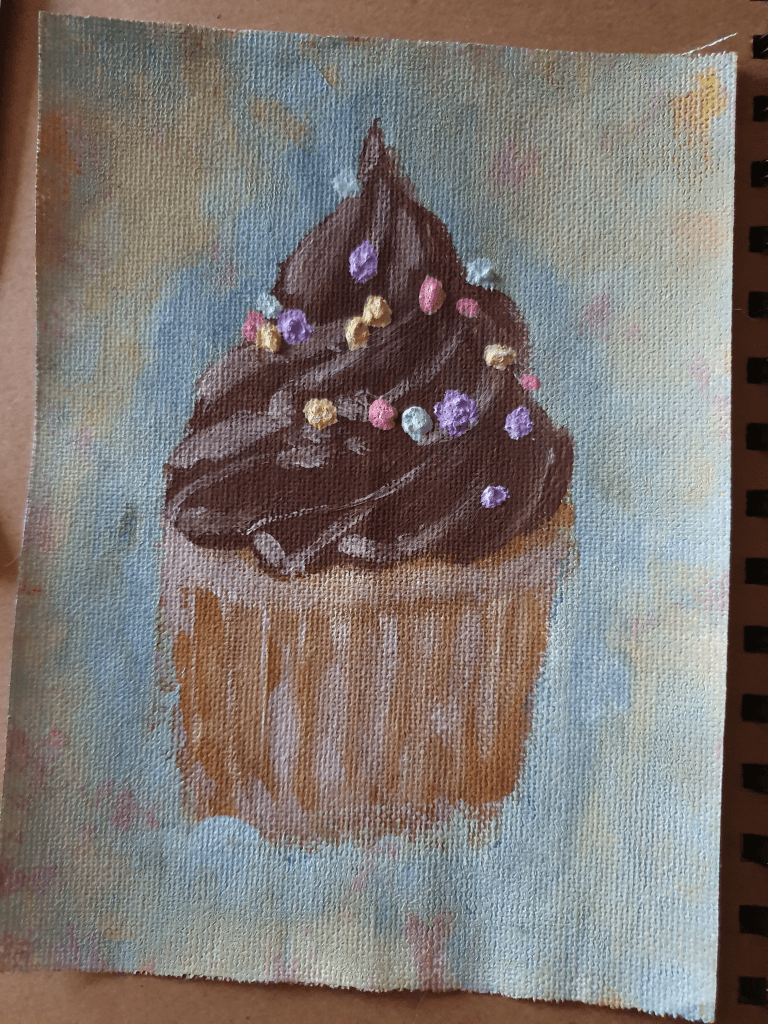
Acrylic on canvas paper with puffy paint.
Doing this I found that some materials didn’t take to the paper as well as expected. Baking paper rejected ink, causing it to rest on top and shrink. Paint doesn’t take too well to tissue paper, causing a tear. The shaving foam and paint didn’t work as well as I expected, as I thought it would puff up more than it did, though I did still partly achieve the effect I expected. Once dry it become slightly spongy. Some things I tried turned out as well as I expected, like the sprayed paint. My favourite technique I tried was the string covered in ink as it’s hard to predict how exactly it will turn out. I also really enjoyed the poured paint technique, though it created quite a mess. I also found that drawing an image completely by stippling takes forever but I like the effect. Dry brush turned out pretty much as expected, with a slightly rougher look. I also liked the effect created by pouring water on top of charcoal. I felt that it would be a good technique for rain on a window. I’m not super keen on cross hatching but feel it would work better the smaller it is done.
Exercise Seven: An Objective Drawing
For this exercise I had to choose an item from the list: shoe, umbrella, trousers, glasses or hat, then draw it objectively (meaning I had to draw it as I saw it). I chose my glasses.
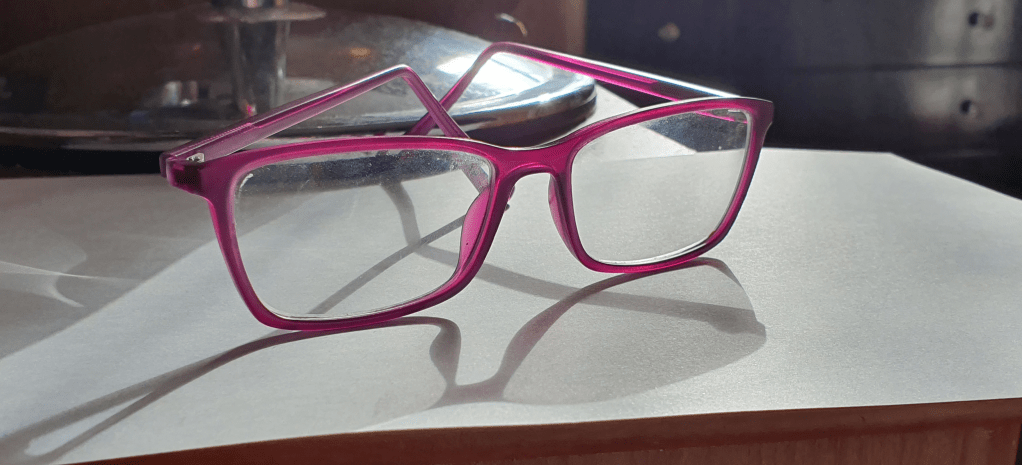
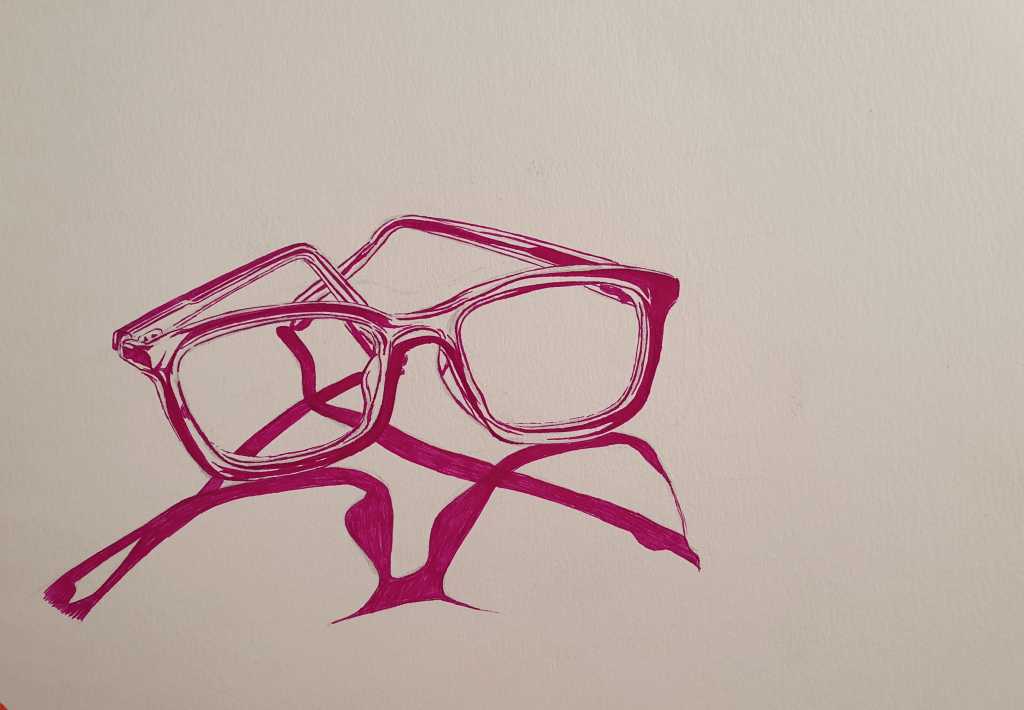
I started off by drawing the pair with pencil, then went over them with fine liner. My choice in fine line colour may seem a little strange, however I picked it as it matched the colour of my glasses. I had to work off of a photo I took as the lighting in the room seemed to change constantly and I never seemed to look at them at the same angle.
I tried to convey the smoothness of the glasses by filling them in with pen except for the parts I left empty to show where the light hits and reflects on them. I didn’t do a good job of drawing the image central, even though I tried a few time, so I guess this is something else I should practice. I have included the photo of my glasses so that you can compare the images.
Exercise Eight: A Subjective Drawing
This was a follow on from the previous exercise. This time I had to pick another object from the list and draw it subjectively (meaning the image should be influenced by feelings and opinions). For this I chose to draw a pair of boots I own. I chose these as I wear them almost everyday and felt this would make the image more personal.
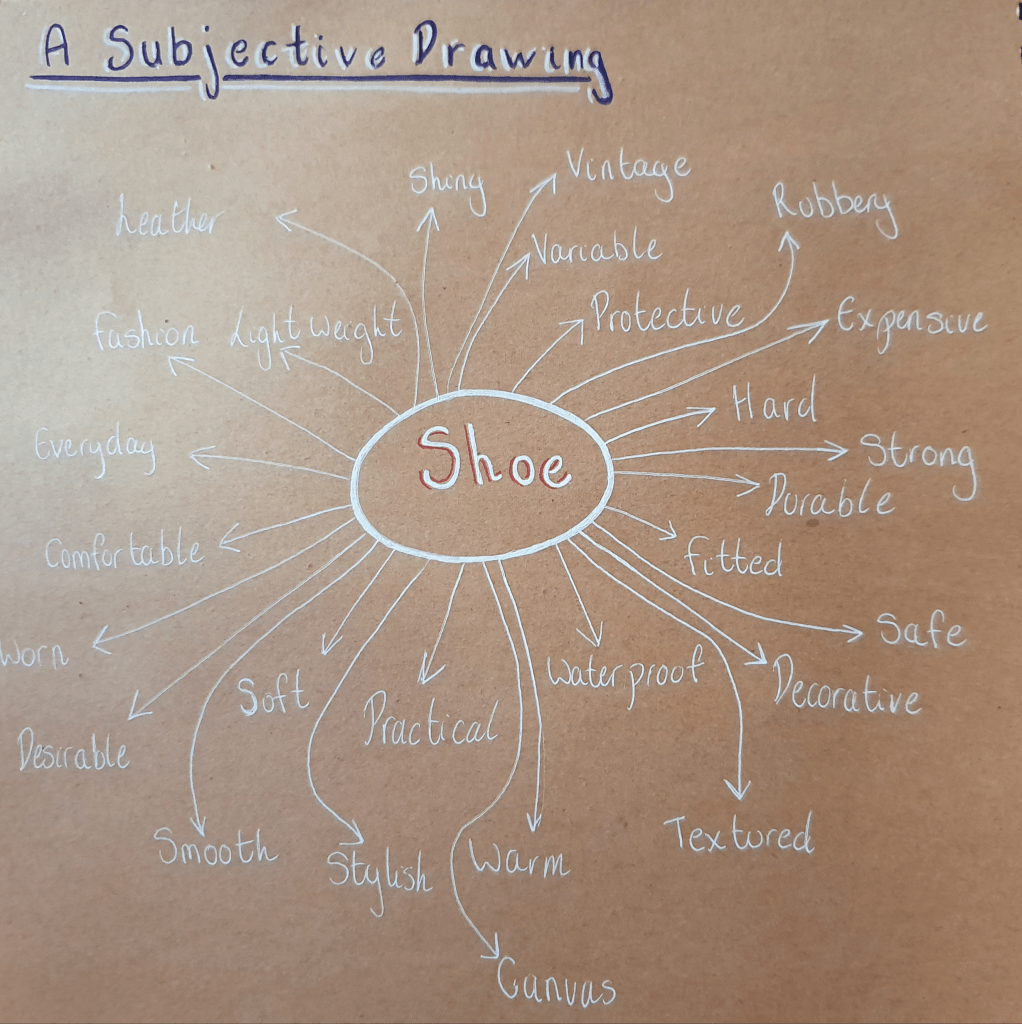
I started with a spider diagram to create a list of words that could describe shoes. I tried to think practically and more abstractly about this. I thought about the function of shoes and the material they are made from. I came to the conclusion that shoes were made for protection and comfort. I then thought about how to some people the practicality of shoes have become a second priority to fashion. I also thought about how some designs are timeless, contributing to the creation of vintage shoes and the passing on from generation to generation. Ultimately I decided the main function was for protection, therefore they had to durable. Durability means good quality materials and a good fit.
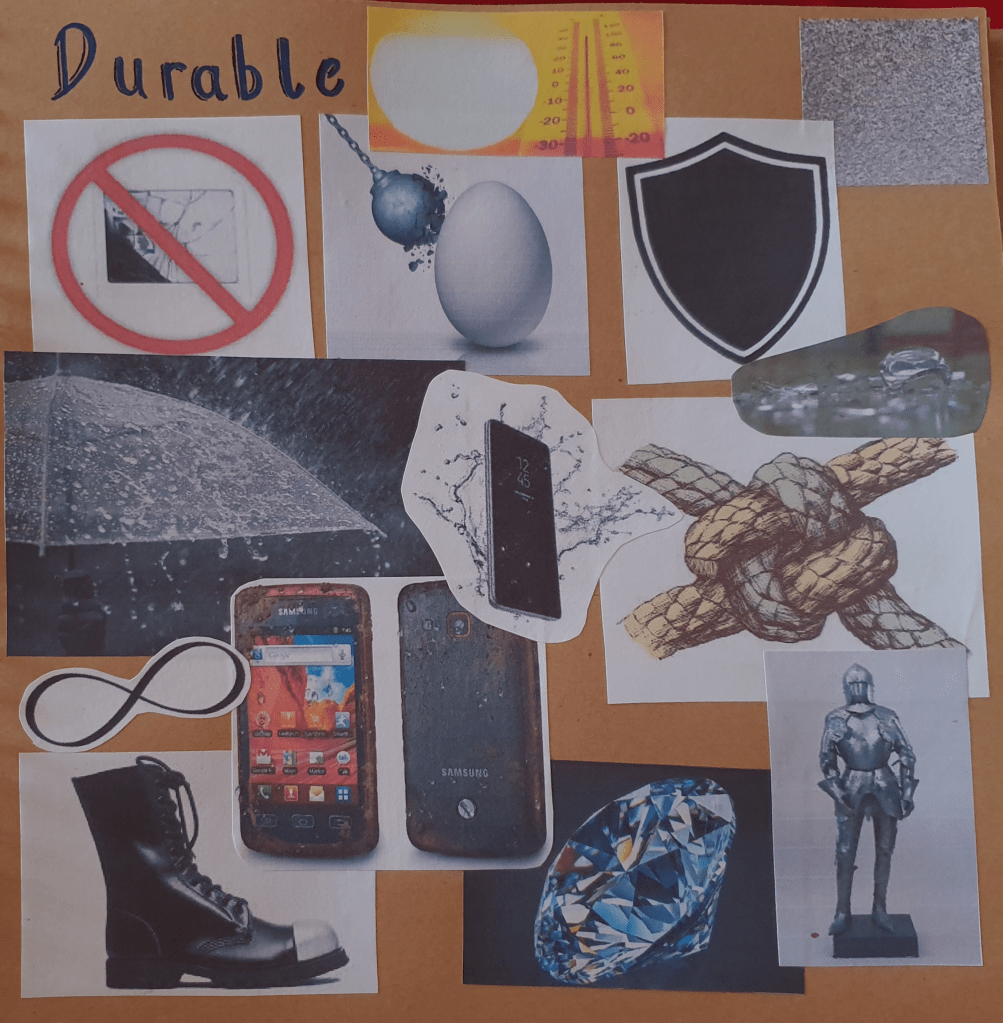
Thinking about durability I began to think of objects that can withstand excessive force like diamonds (or vibranium, but that’s not real so wasn’t included). I tried to get a visual representation of strong materials, which is where the phone and suit of armour came in. I felt that the steel capped boots were a good representation of protective shoes and the tied knot was good for the unforgiving and unyielding nature shoes need to prevent the ground from cutting into your feet. I also tried to collect things that could harm and you need the protection from.
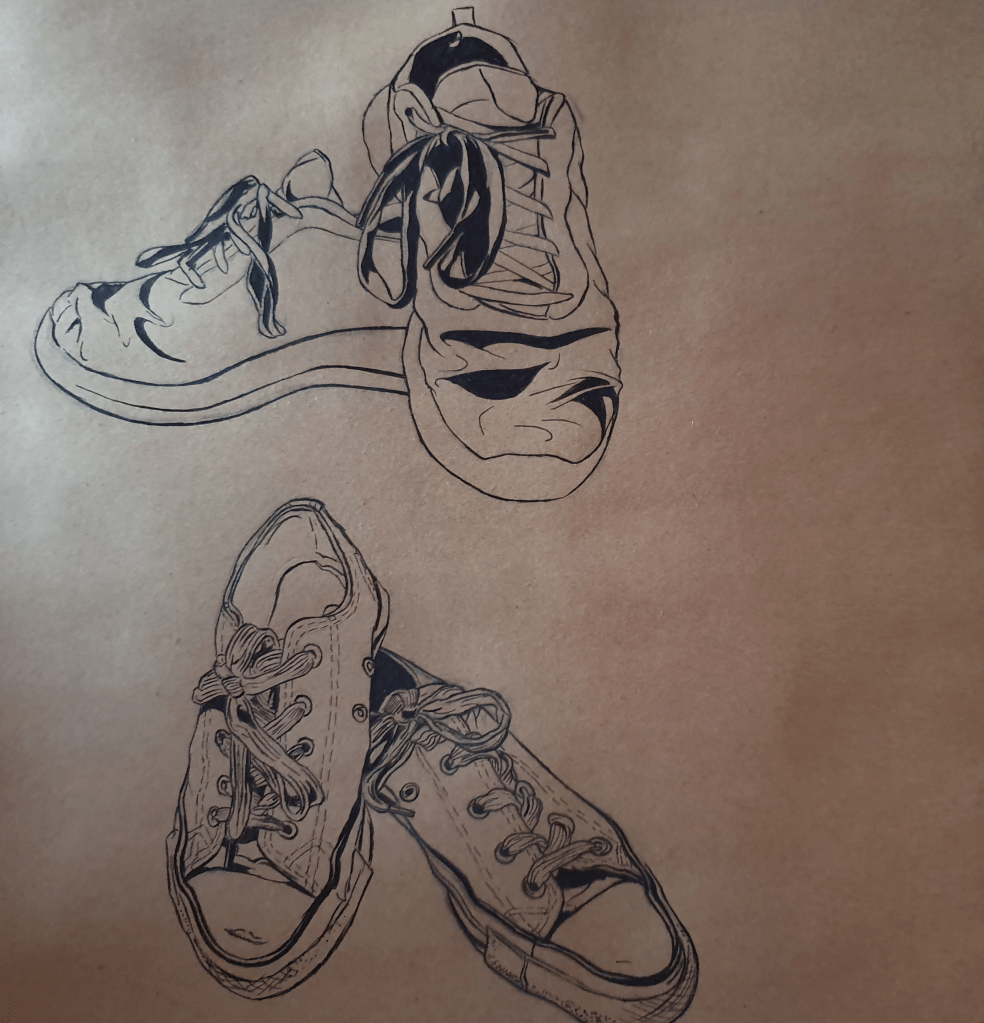
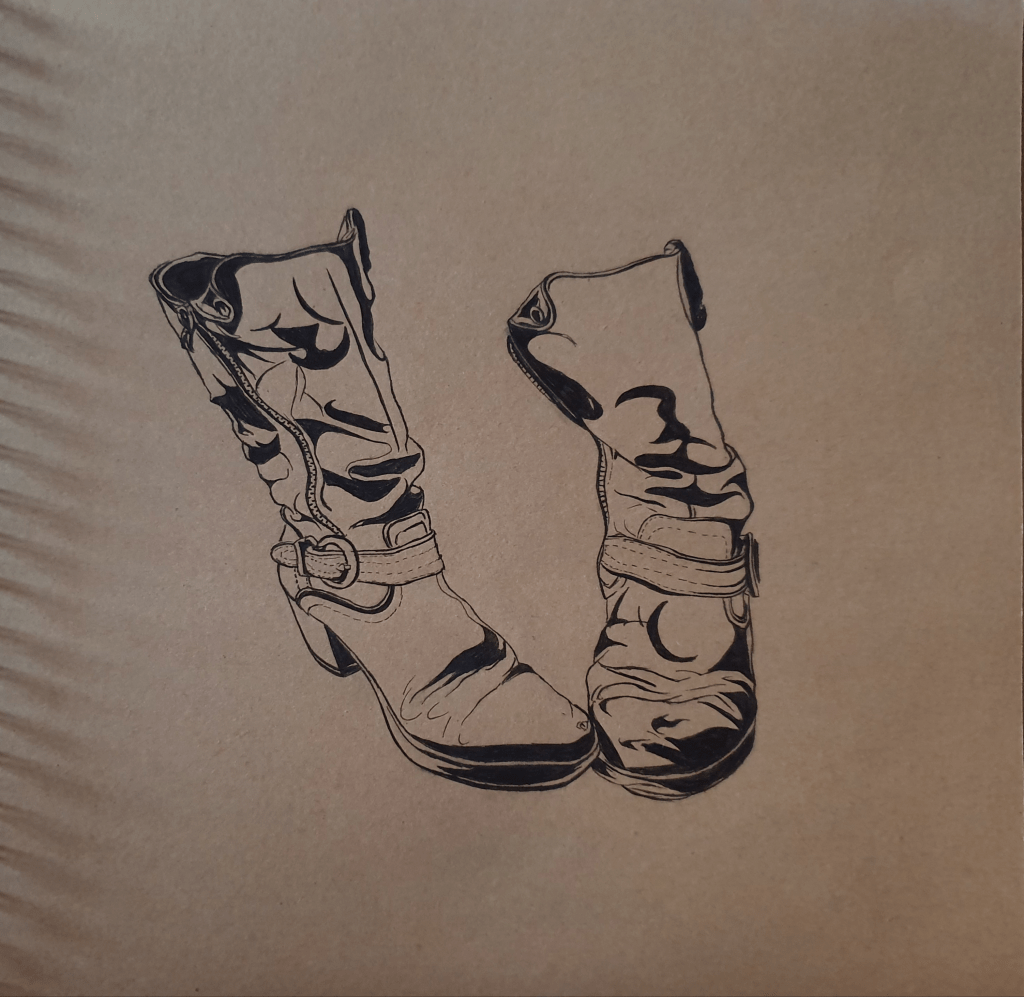
Before deciding on my boots I drew a few pair of my shoes I was considering to help me pick the right pair.
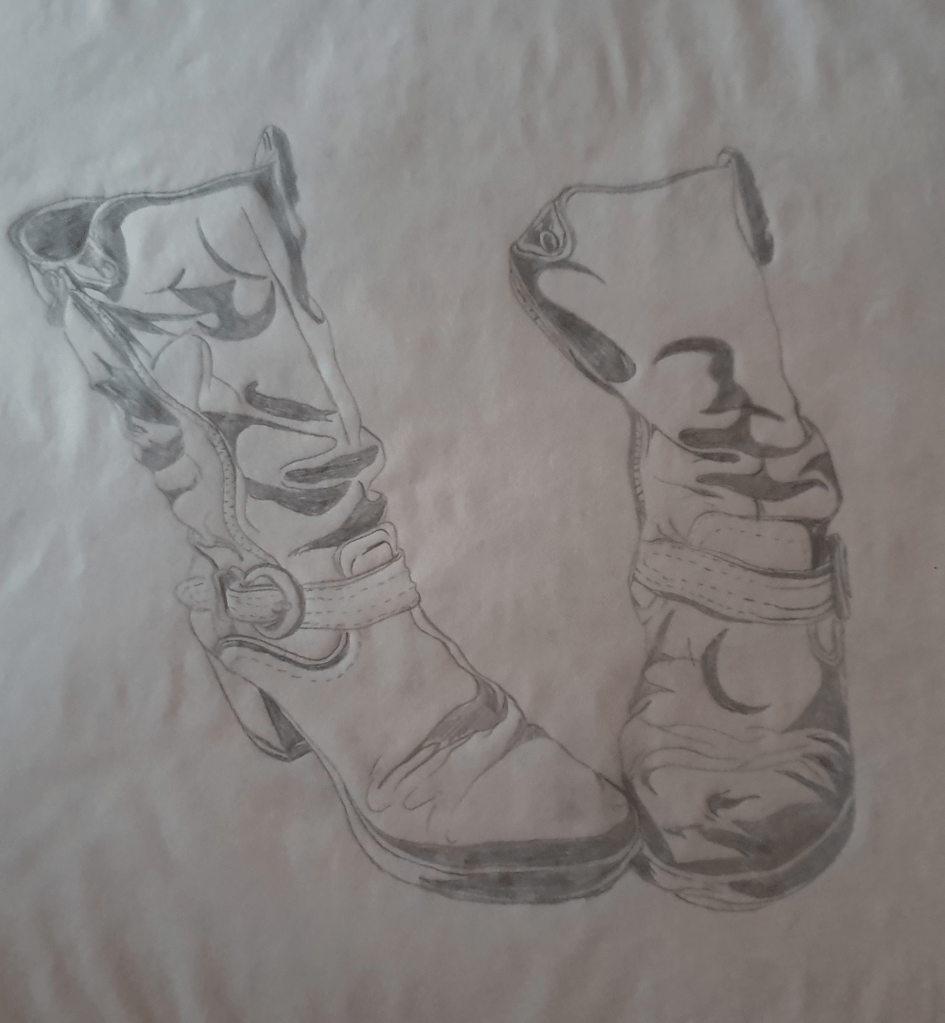
I then traced the pair I chose.
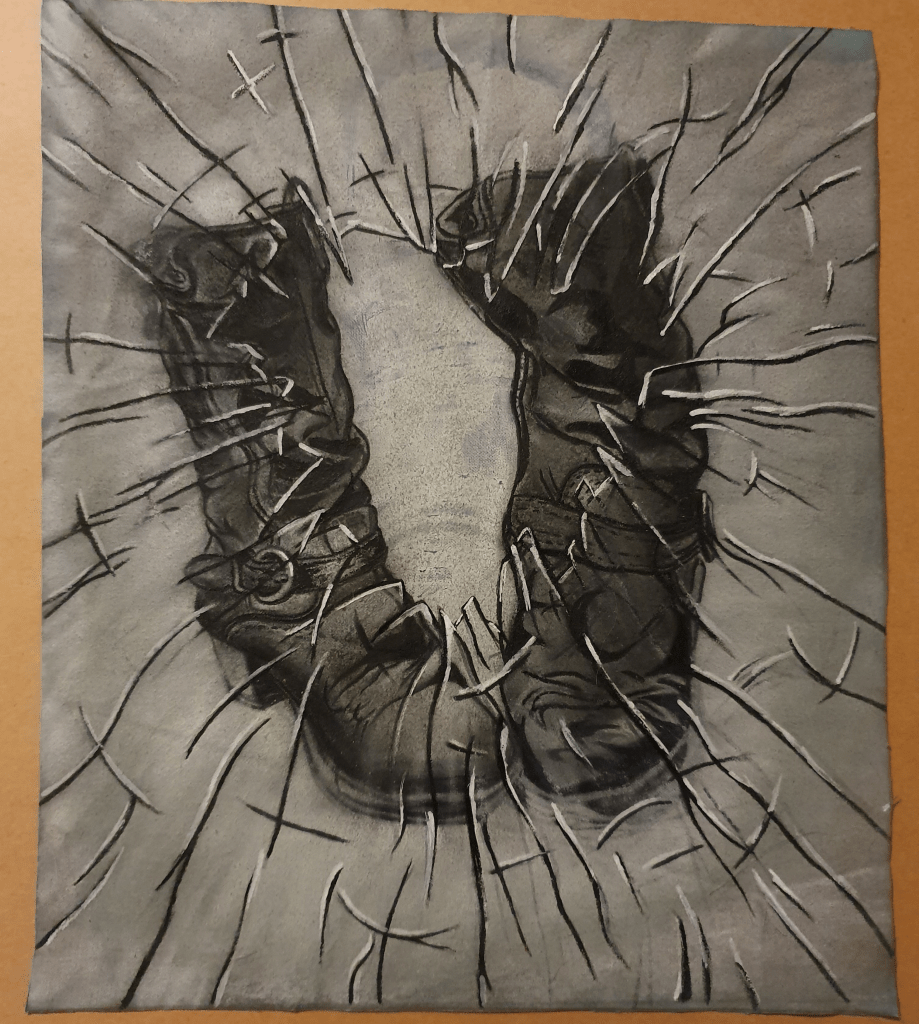
For the final image I decided on using a piece of fabric I had instead of paper since it could withstand more force. I tried to show every wrinkle and blemish on the boots as I tough it would convey the fact that they have have lasted a while and survived the everyday use. I have placed them behind a pane of broken glass to show how they don’t break when meeting sharp objects. The break is formed into the shape of a vague diamond because of it’s association with being one of the hardest materials to break. I felt that making the glass look frosted made it look tougher and harder to break. I felt that using colour would counteract the point I was trying to get across. I used a mix of charcoal, ink and pastel. As I was trying to convey the practicality of shoes I felt that a more straight forward, objective portrayal of the boots would be a better fit.
Exercise Nine: Using Black and White
For using black and white I was first tasked with creating a line visual for any of the words: sea, extraordinary, building and journey. I assumed this meant a spider diagram and proceeded with the word sea. I later realised it meant I should draw some things that could be associated with the word and I could use. This I did anyway as my next step.
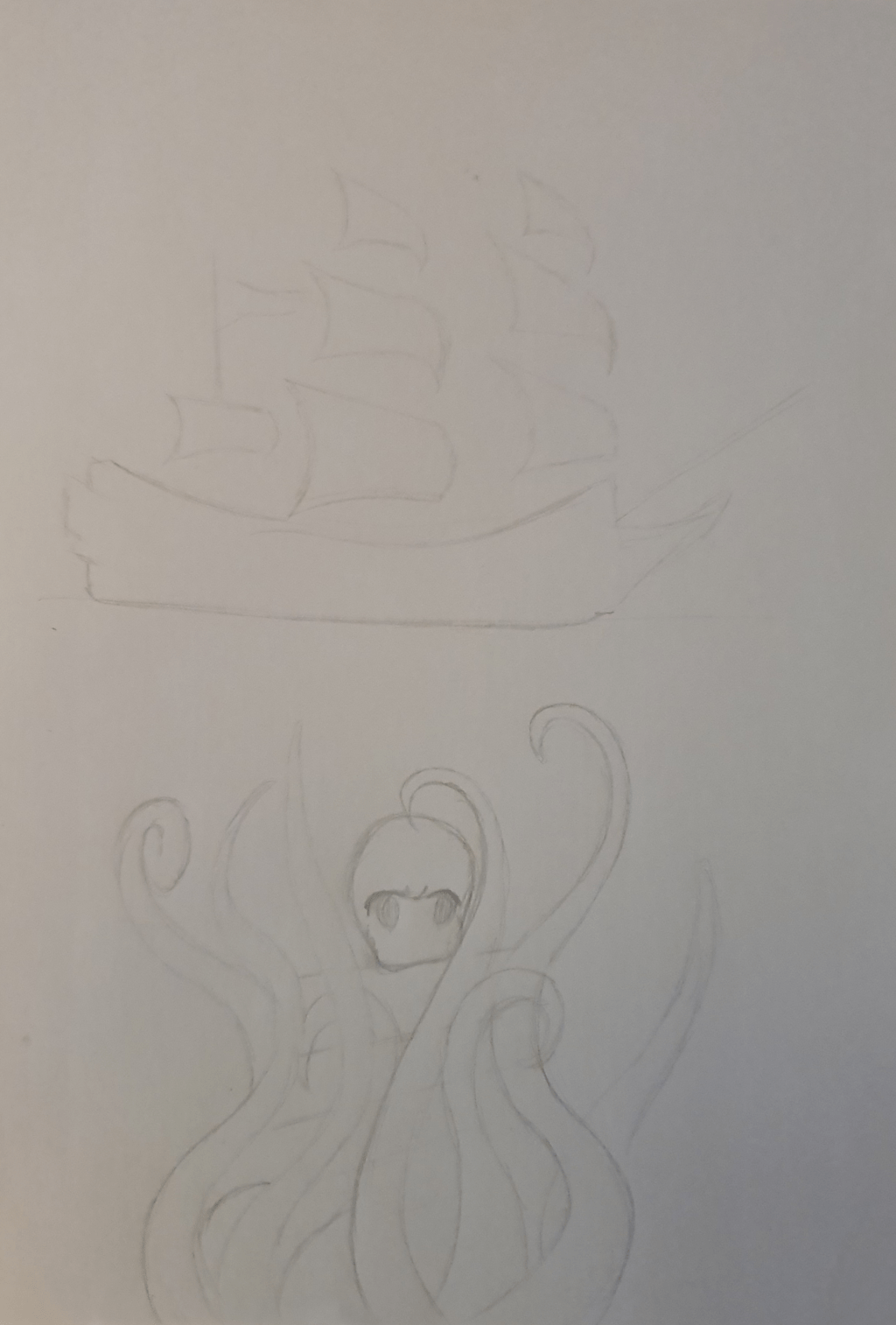
I tried to think of things that could be turned into something interesting. I started with the obvious which slowly morphed into the more mythical.
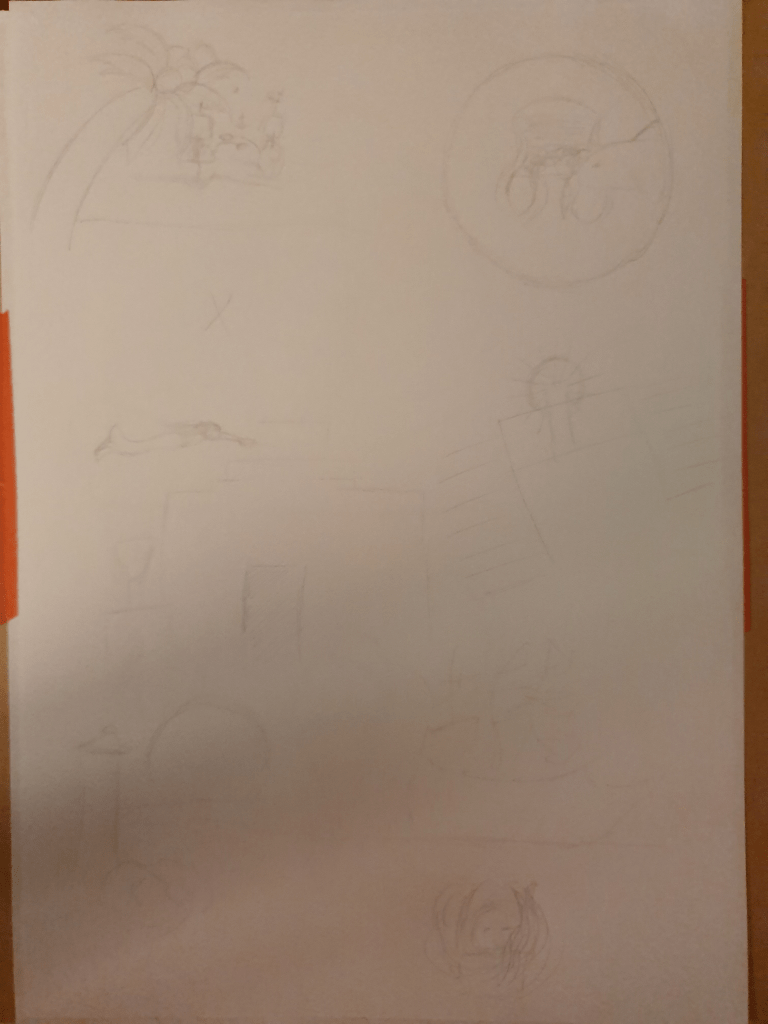
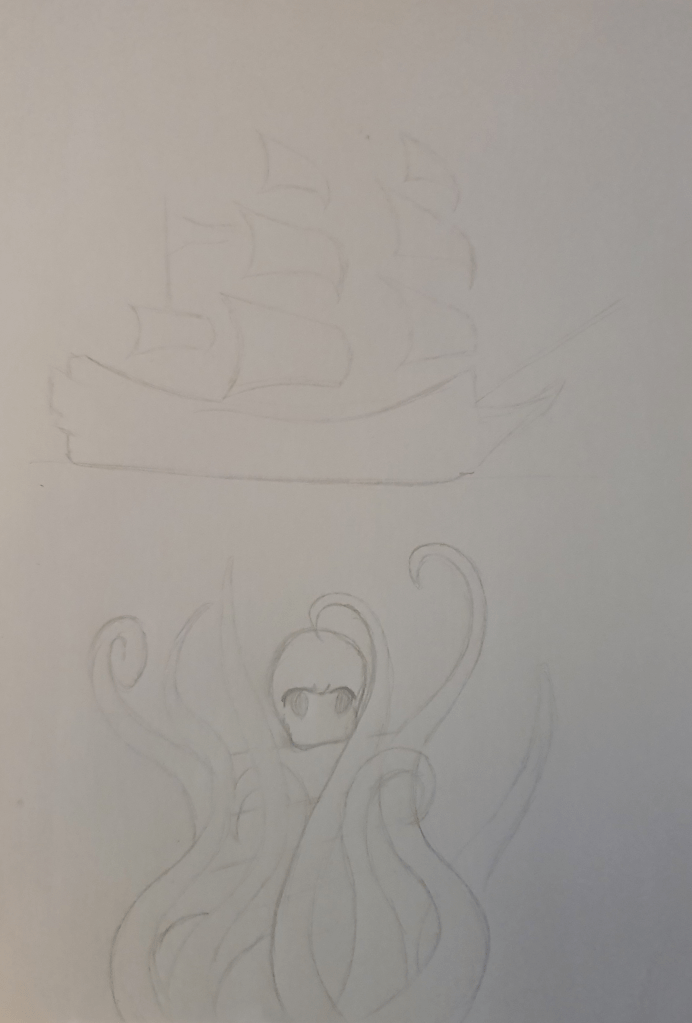
I then sketched a some ideas I thought may come in useful (sorry for the poor quality photo). The octopus under a ship is something I considered to begin with but seeing it in a bigger format I decided I didn’t like it and eventually decided on something completely different.
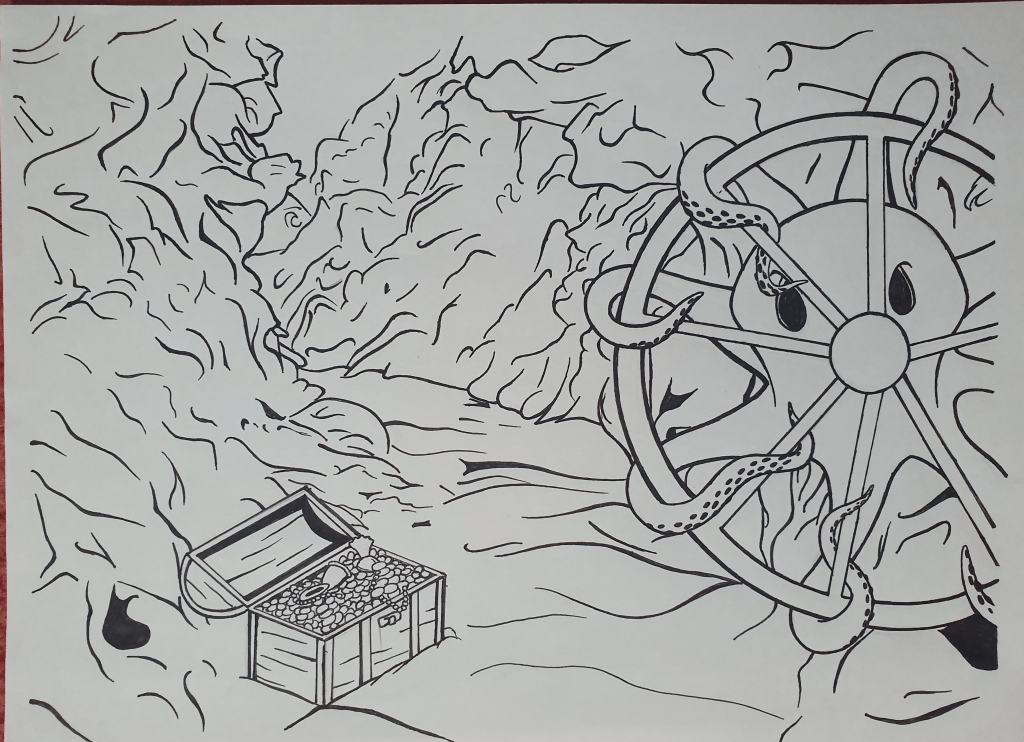
I decided to create a narrative, using a selection of images as reference. From the ship idea I got the image of an octopus at the wheel in my head this then formed into the image above, where an octopus has found the remains of a shipwreck and stole away with the wheel. He then takes the wheel back to a treasury filled with lost and shipwrecked items. He has just began the descent through the entrance. I tried to ad texture to the image with varying line weight.
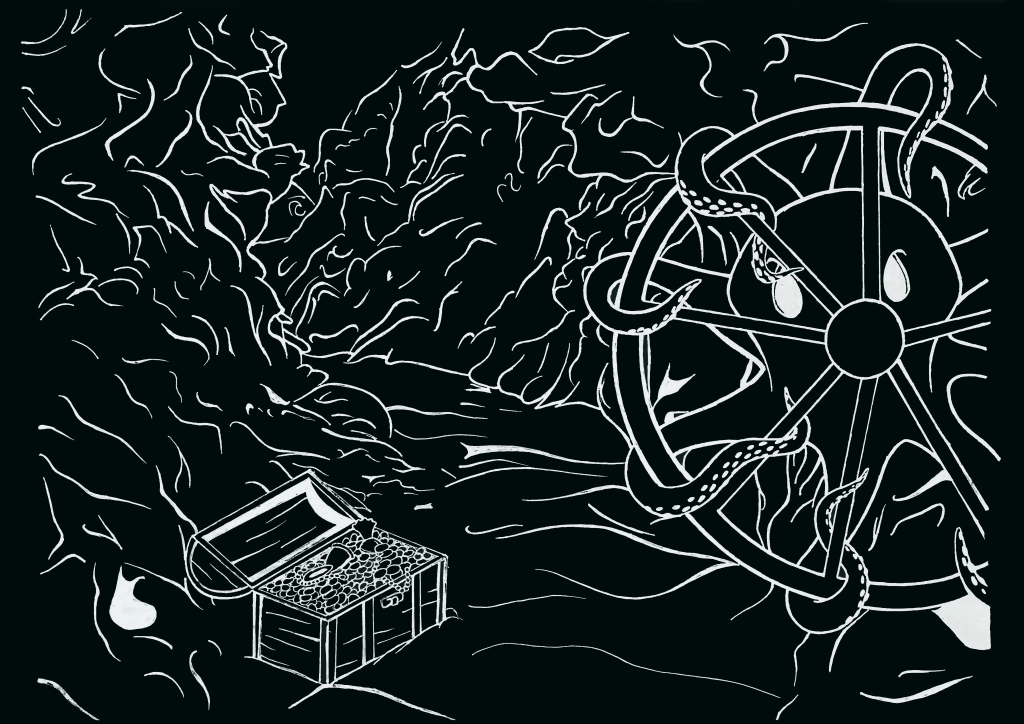
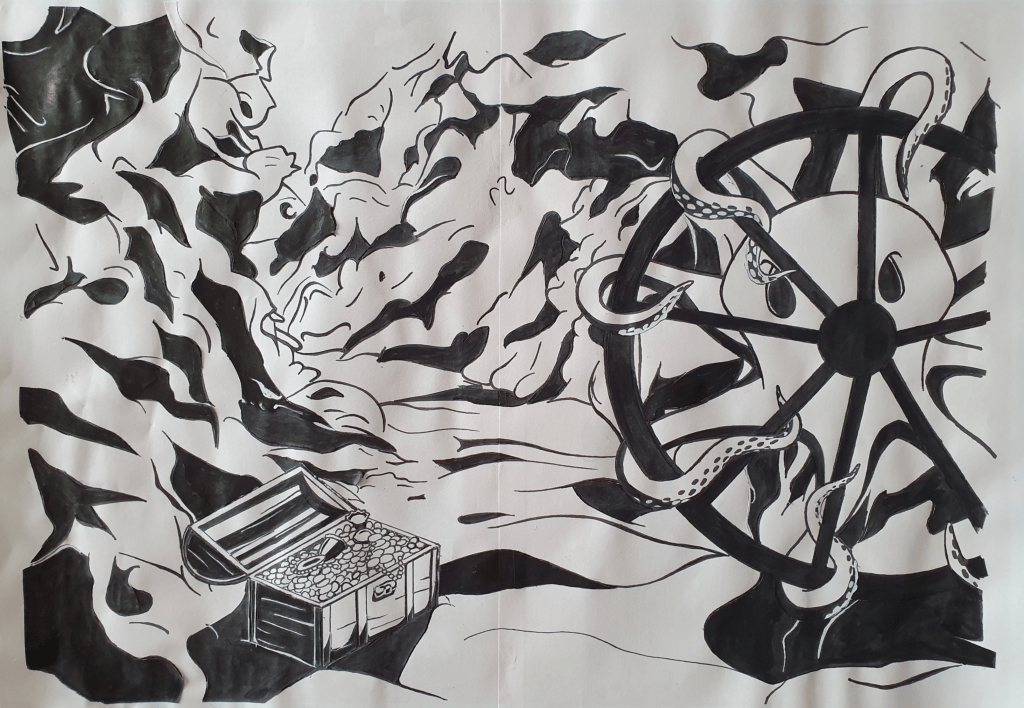
Next I scanned the image and printed it A3, though I had to do this on two sheets of A4 as my printer doesn’t print any bigger. I then lined them two pieces up and stuck them together. The main point of this exercise was to practice with the use of only black and white. To do this I had to also print out a reversed version of this image and cut parts out to stick on the original A3.
Looking at the two images side by side I’m not so sure I have done such a good job. My intention was to add shadow and make the octopus stand out against the background. The light was meant to be coming through the gap between the sea walls, however I don’t think I managed to translate this very well. I feel as though there is light coming from all around the image even though I tried to think practically about which areas would be naturally shadowed from the juts in the walls and which would be shadowed by the light source. Having tried to communicate this with the black areas I see that trying this whilst only using only black and white was not a good idea as at least one more shade was needed in between.
In trying to bring the octopus to the forefront of the image I believe I only succeeded in blending it in more and that it worked better in the original image. Once again, my practical thinking got in the way of the effect I wanted. The shadowing I added behind the octopus only managed to add to the octopus’ obscurity. I should have either left this area as it was or made the octopus darker. By making the wheel dark I thought it would draw attention to the octopus, which it did until I added the rest of the black. Thinking about it now that it’s done, I should have left it white to make a frame around the octopus.
The parts I am pleased with are the treasure chest and the end of the tentacles. I believe I did a good job of adding shading to them whilst also keeping the details of the first image. However, saying this I am not convinced I have managed to fully meet the brief or that I fully understood it as rereading it I noticed a line telling me to leave no lines. At this point I had already begun adding the black to the image and felt I had gotten too far to throw it out and start a simpler image without so much detail. Keeping this in mind I tried to erase as many lines as possible with my cutting and sticking but thought that adding any more would erase the whole image, which might not have been so bad if all I wanted was to display the octopus. This however, was not my intention, which is how I ended up with the image I have.
Exercise Ten: Choosing Content
In choosing content I had to use an excerpt from The Daffodil Affair to create a character. The first task was to make notes about the excerpt, whilst also answering questions. This is what I wrote:
If this were to be made into a film what would the main character be like?
- Bald?
- Stern
- Tired
- Angry
- 45-65 years old
- Paranoid – mix of job and war
- Driven
- Lonely
What clothes would the character be wearing?
A suit and tie.
What furniture is in the main area in which the main action takes place?
- Fairly sparse
- Chair – not necessarily in the best condition
- Sterile white room? Possibly dingy?
- Tall room
- Desk
- Police papers
- Maybe a sofa
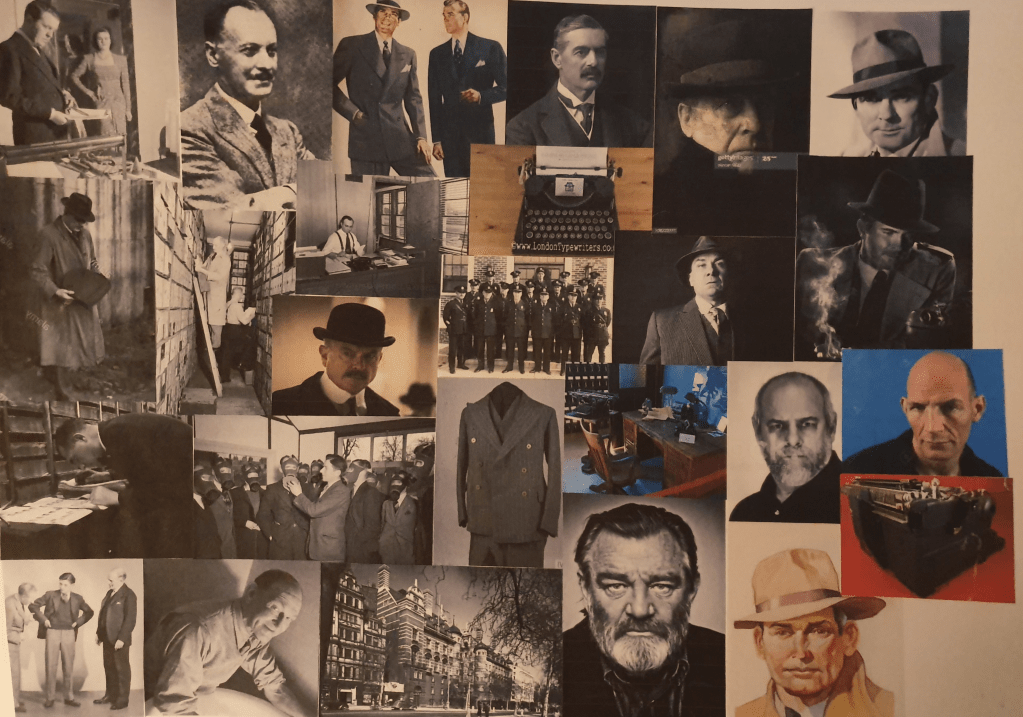
Next I had to collect visual references to pair with my notes so I created a moodboard.
Whilst doing this I also researched the era a little to try and get a feel of the time and how living in it felt. For this I looked at homes, clothes and rationing. Reading a first hand account was helpful.
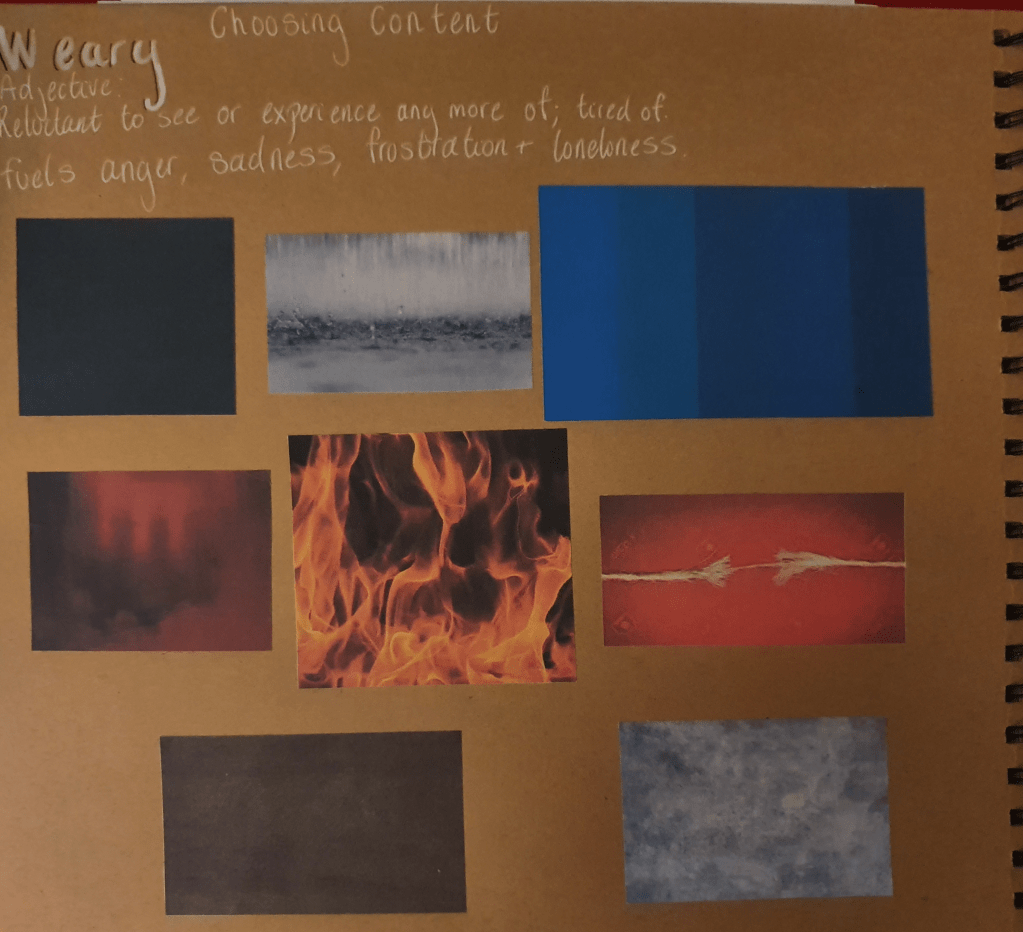
After this I was to collect colour and textural references based on the mood I would like to convey in my drawing.
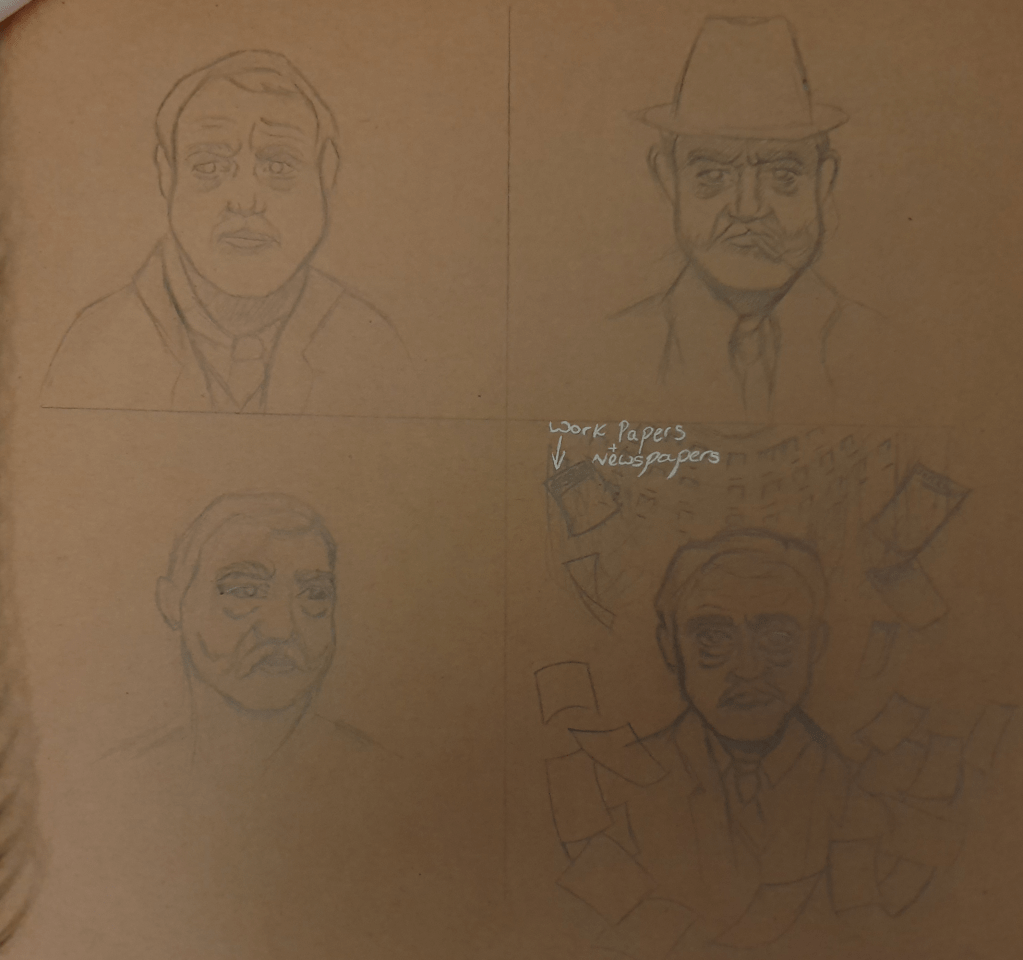
Finally, I had to draw the character. I started with a few sketches. Once these were completed I realised that most of them came out looking like Bobby Singer from Supernatural. The word I picked was weary so I thought making the man look tired was a good way of showing this. I also decided this wasn’t enough to get the whole feeling across and decided that it needed more. Every one of the men are wearing a suit and tie as I found that this is what most men wore during the second world war. This time wasn’t specified in the excerpt but I came to the conclusion that it was this war as New Scotland Yard wasn’t formed until then, before that it was just Scotland Yard. I thought that the background needed something and played around with the idea of placing a London building behind him, setting the location, and having reports and newspapers falling around him, showing the pressure and work load he is under.
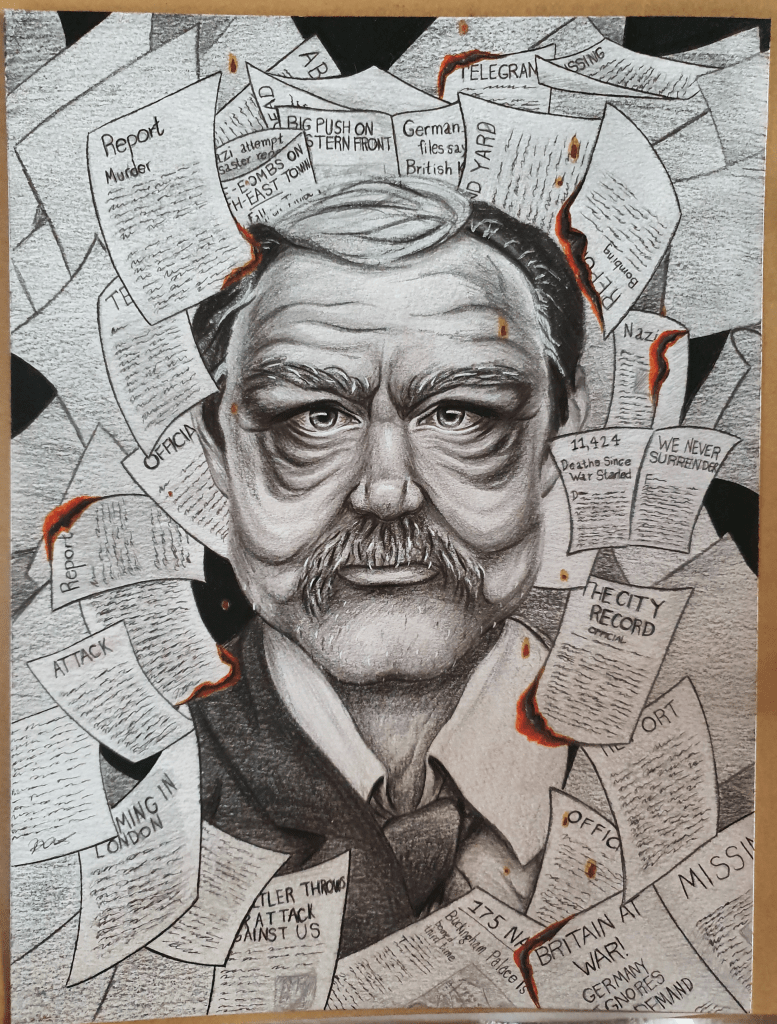
My final piece for this exercise holds a balding man, caused by age and stress, surrounded by burning newspapers and official documents. I evolved this from my final sketch, feeling that the building was in the way of the images effectiveness. I tried to create an authentic looking 40’s detective, which is why he is wearing a suit and tie and has a moustache. I felt that the newspapers and documents would show what he has to deal with in his job, emphasising the stress he is under. I used real newspapers and documents as a reference, even featuring real articles in the piece to add authenticity. They are burning to represent the fact that he is in the middle of the war so is surrounded in bombings. It doubles as a way to show how done he is with the whole situation. There is ash floating around to add legitimacy to the bombing idea. I only added detail to the papers in the forefront so that they would stand out. I felt that detailing them all would draw away from the effectiveness. I made most of the drawing black and white so that the areas I did add colour too would stand out. These areas are the eyes and flames. I’m guessing the reason behind the flames don’t need any more explanation, however I coloured around the eyes with pink so that he would look more tired and so that attention would be drawn to the eyes, as well as all the detail around him.
I am pleased with how this drawing turned out. I feel that I managed to draw a fairly realistic and well proportioned man using the references I collected earlier, although I didn’t quite get the nose right. It’s a little wonky and pointy. I’m not too pleased with the hair either as it looks too simple and cartoon like. I didn’t manage to make it realistic enough, though I suppose this isn’t always a bad thing. Some of the papers didn’t come out very well, but overall I think they look alright. I didn’t smooth the pencil on his face because I felt that it gave him a rougher look, more worn down.
Exercise Eleven: Visual Metaphors
This exercise was about visual metaphors.
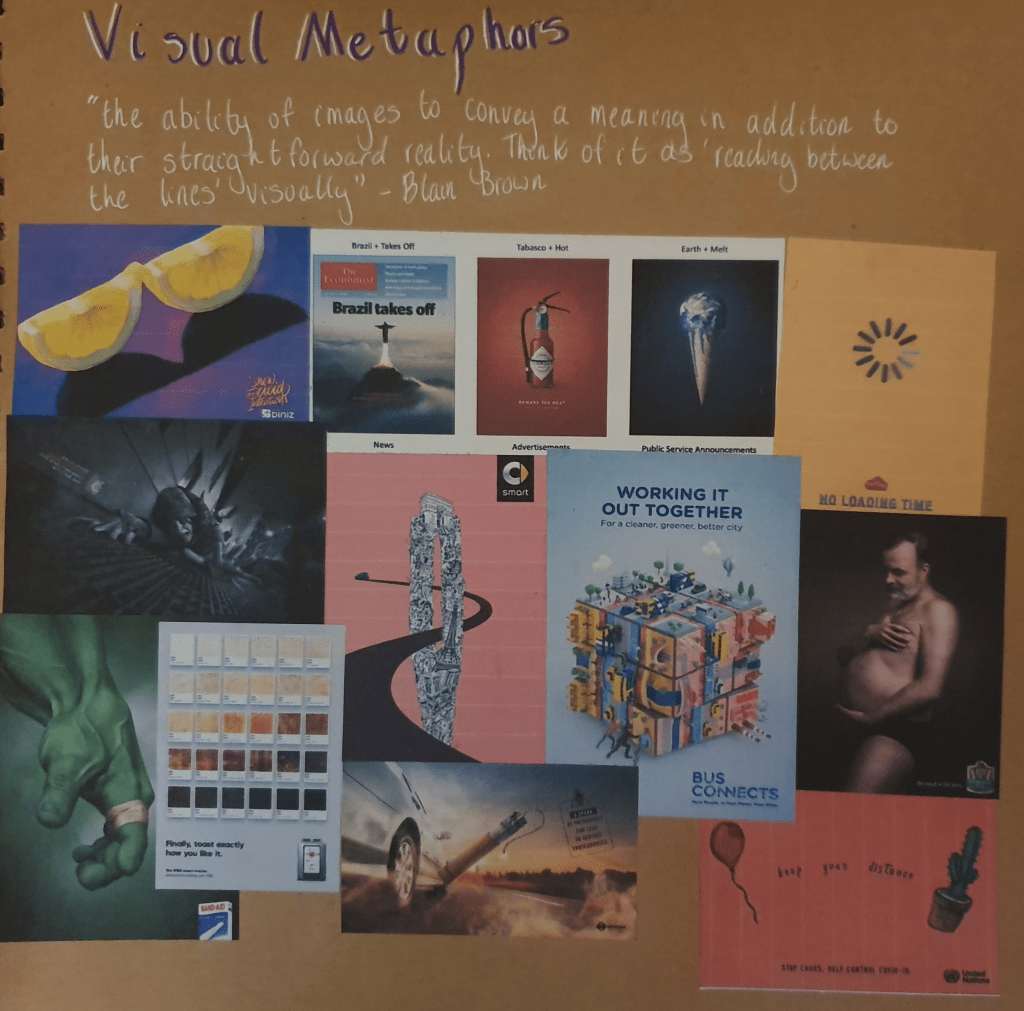
I first had to collect lots of examples of them. I found this interesting because a metaphor is a hard thing to draw and seeing how other artists have managed to do so was helpful, though didn’t fill me with confidence that I would be able to. Or do a good job of doing so.
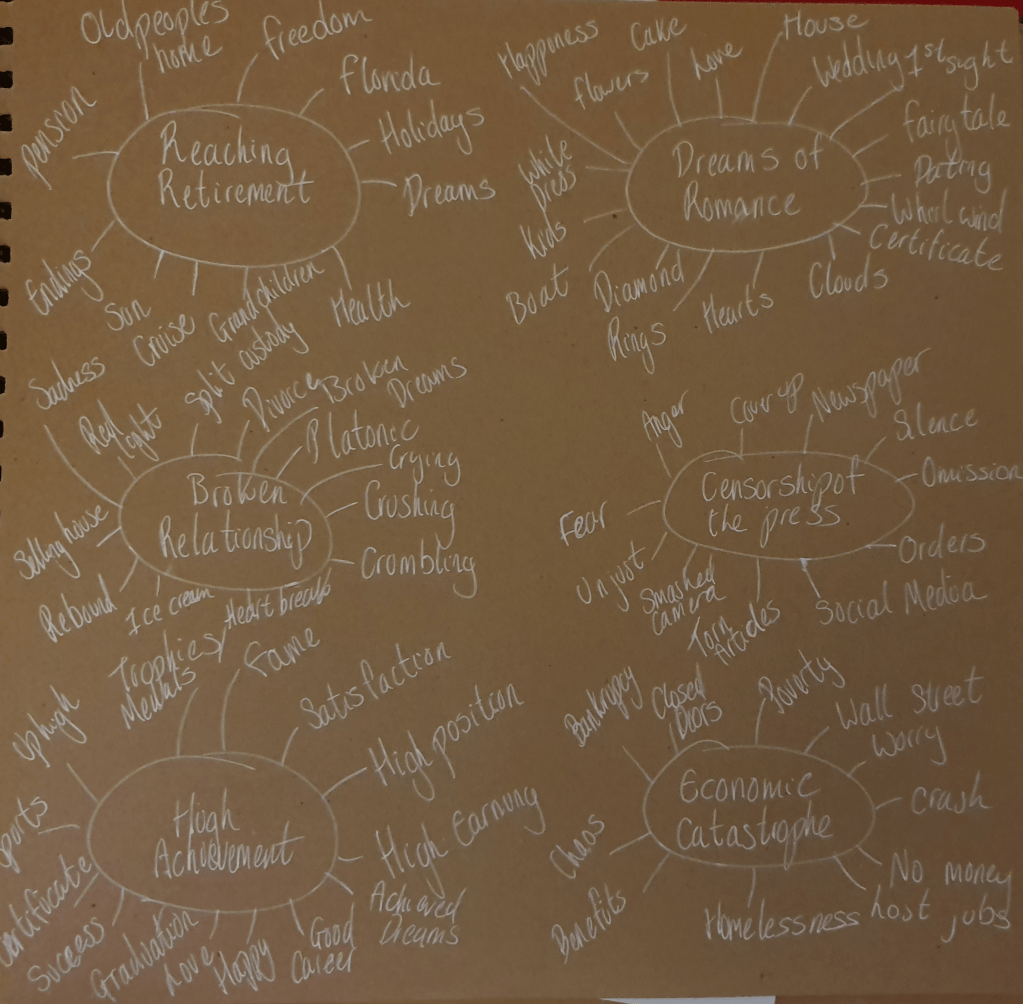
Next I was to choose a theme as inspiration from a list. These themes were: reaching retirement, dreams of romance, broken relationship, censorship of the press, high achievement and economic catastrophe. Not sure of which theme to choose and not confident in my ability to draw a metaphor I started by doing spider diagrams of each theme.
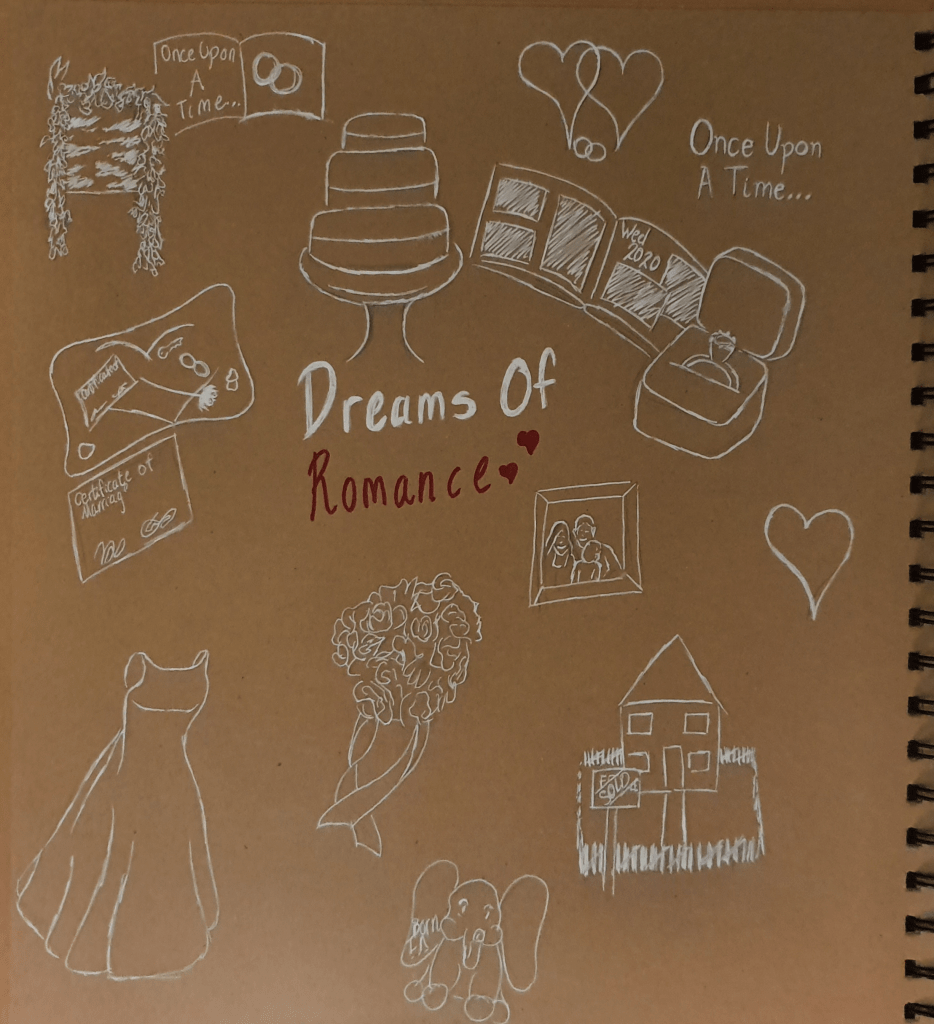
In the end I picked dream of romance as that was the one I felt most confident to fill. This however doesn’t mean that I m happy with how I did. It feels as though all I did was draw a collection of objects that come to mind when thinking of romance, not like I managed to draw some metaphors. Anyway, I believe that the ideas behind most of the objects are fairly obvious and don’t need explaining. This seemed to be the case when showing them to other people.
Assignment Two: Point Of Sale Display
The aim of this assignment was to create two point of sale displays. One for summer and one for autumn. Both had to be focused on fruit or veg and show the quality of the produce. Working in a supermarket, I am surrounded by point of sale displays most days. This however, doesn’t mean I pay much attention to them. When starting this assignment though I made a point of looking at them and was a little dissapointed by them. They looked as though someone had just bundled a bunch of produce together and taken a photo without much thought out into them.
My first thought of a point of sale display was a free standing cardboard cut out that would stand either by the product, within the aisle, or by the checkout. When thinking of the practicality of the dimensions given and how they would be converted into a real display I realised that this would not be a practical idea as it would be too small and get lost within the aisle. Although it could still be displayed on the checkout. I then shifted my attention to what gets displayed on the wall or above the aisle.
The first thing I did in preparation was to create a list of fruits for each season. I decided early on that I would prefer to draw fruit rather than vegetables.
Summer fruits included: berries, cherries (are these technically berries? I have no idea), kiwi, pineapple, mango, watermelon, melon, grapes, peach and plums.
Autumn fruits included: figs, plums, pomegranates, pears, apples, pumpkins and cranberries.
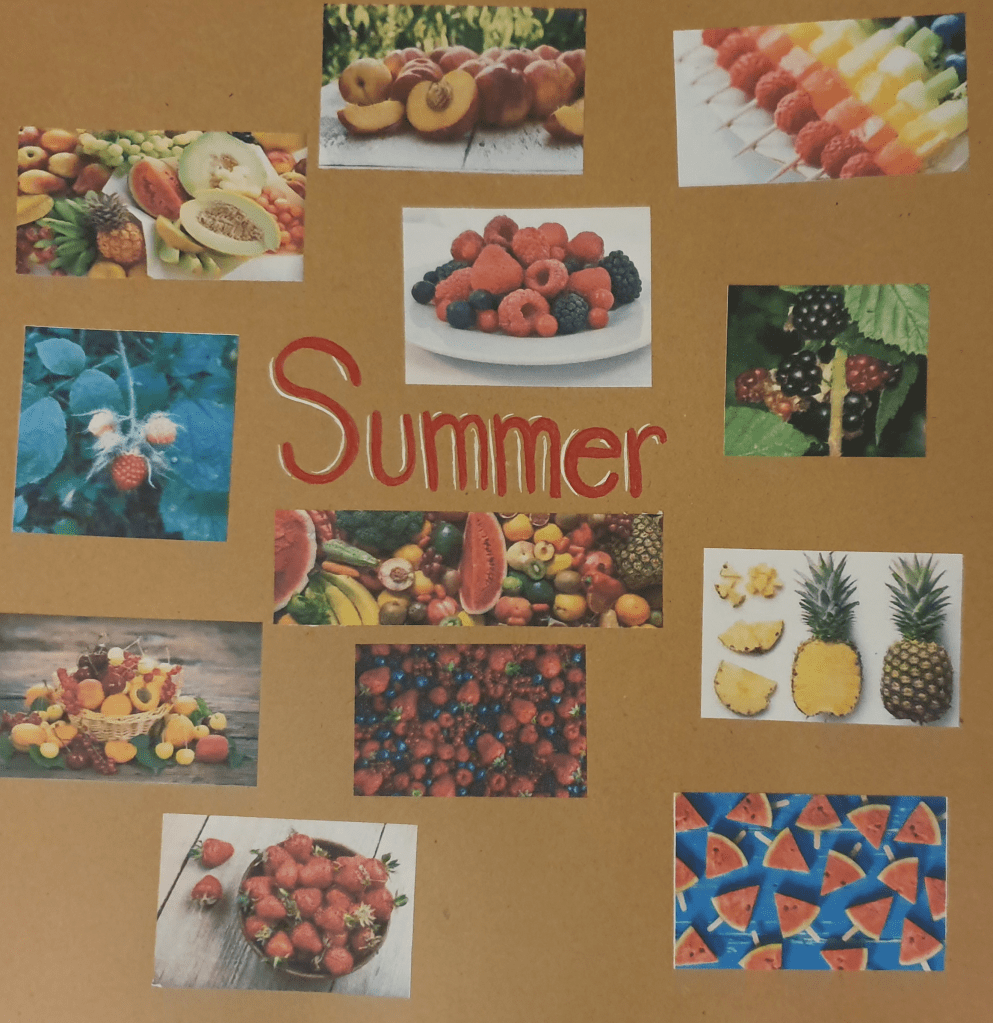
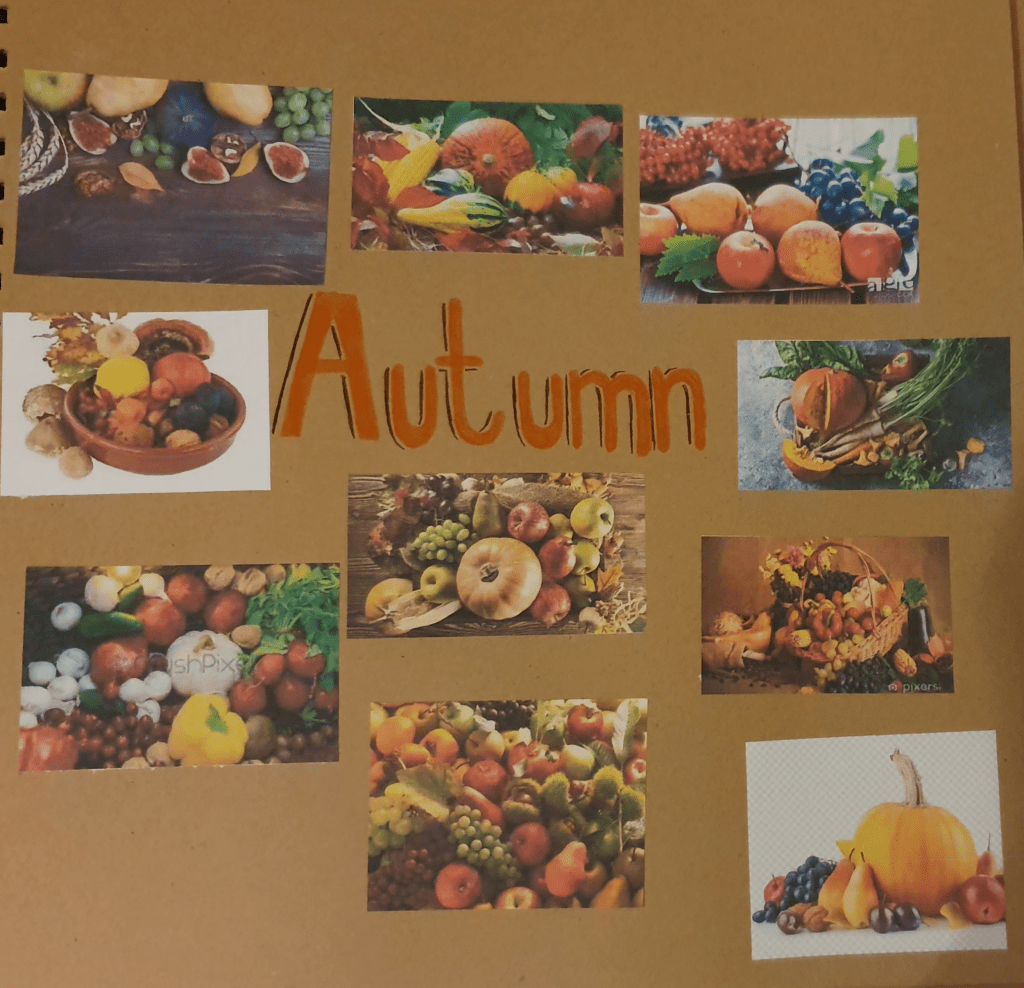
I then created moodboards for each season, giving me resources to draw from for my images.
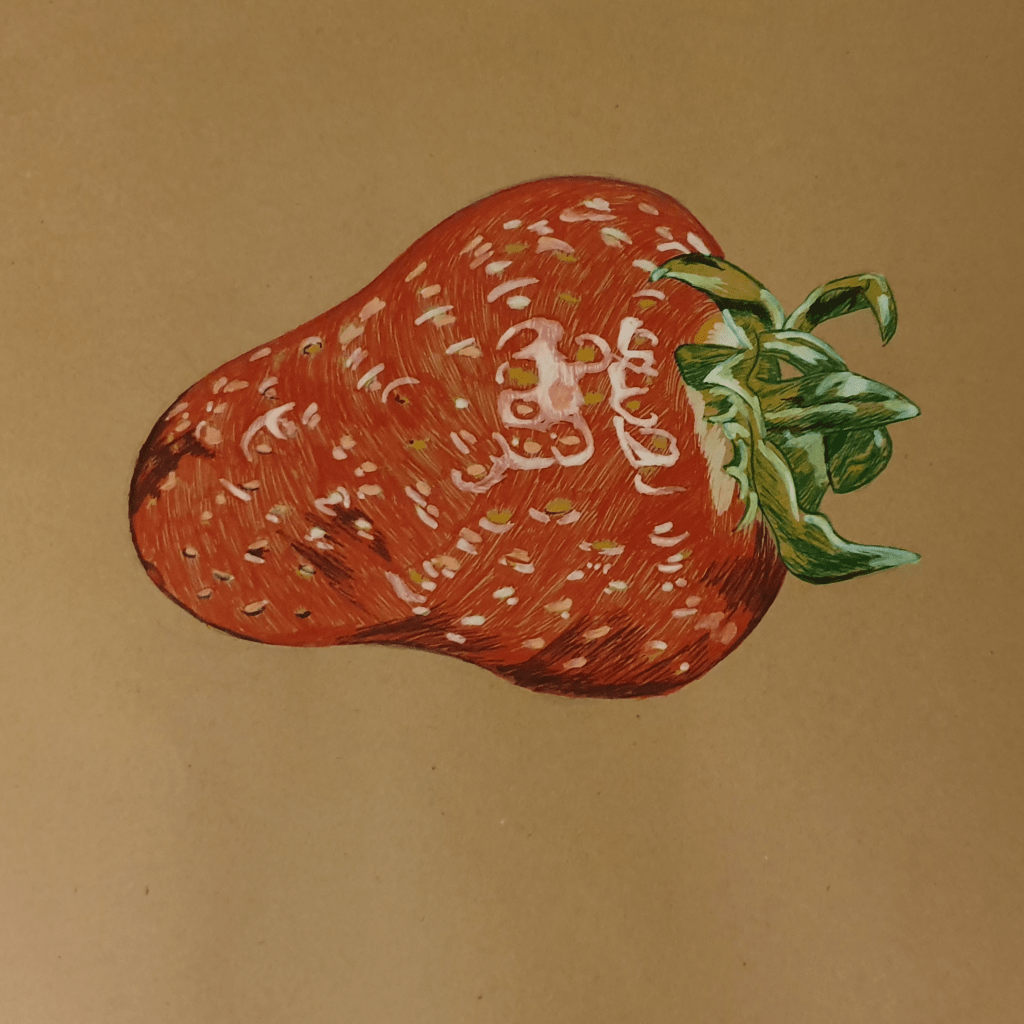
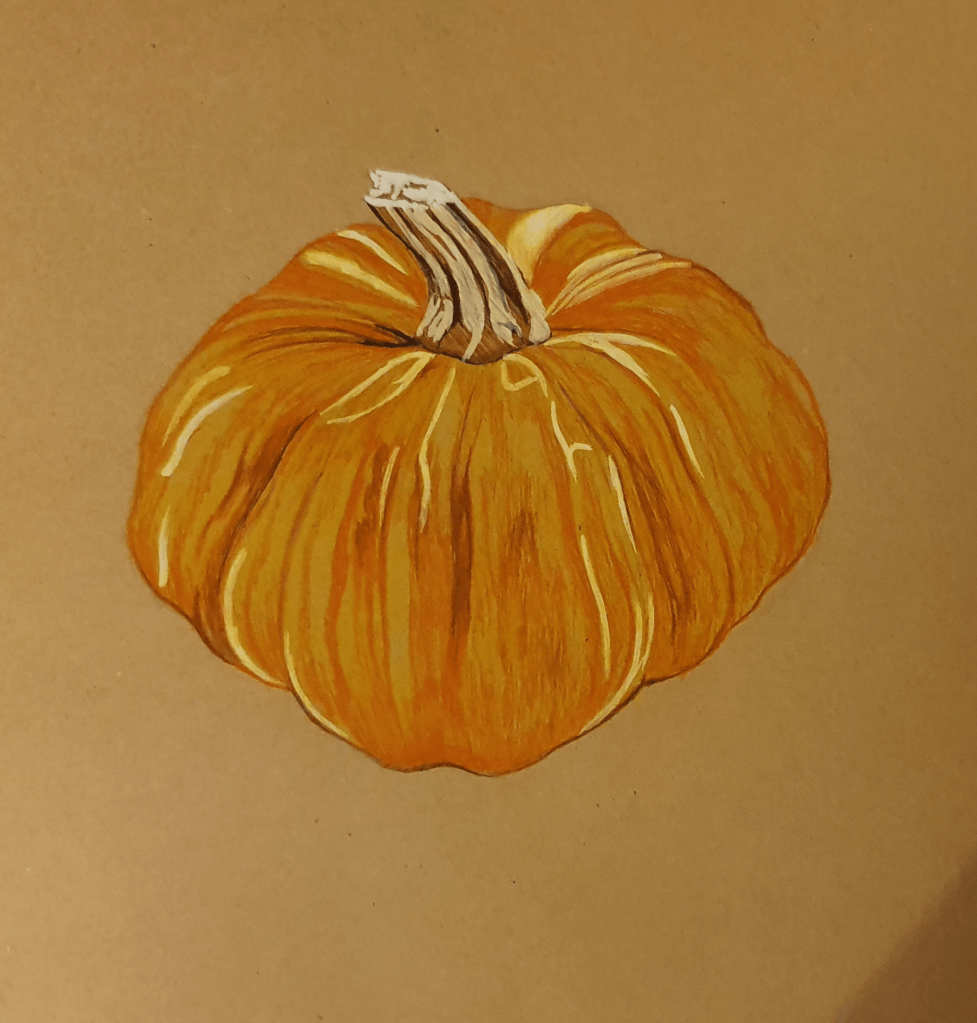
Next I drew observational drawings of one fruit from each season, though I feel that I picked the most obvious for each. I’m not sure if this is helps strengthen the final images or not. I am pleased with the final products. I used only fine liner and white ink. Not using fine liner as often as I do pencil I feel that these images turned out well.
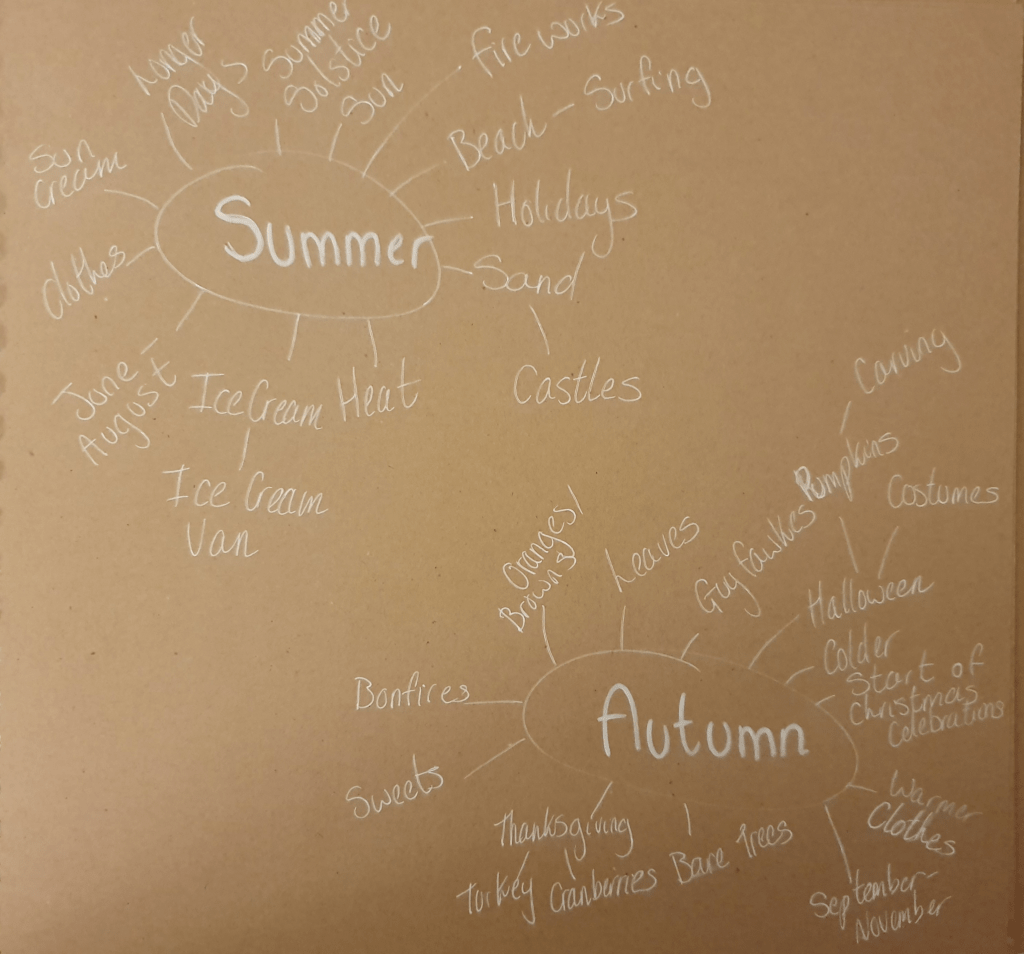
Before doing any sketches I made a spider diagram fro each season, filled with anything I thought of that could be used in my final pieces.
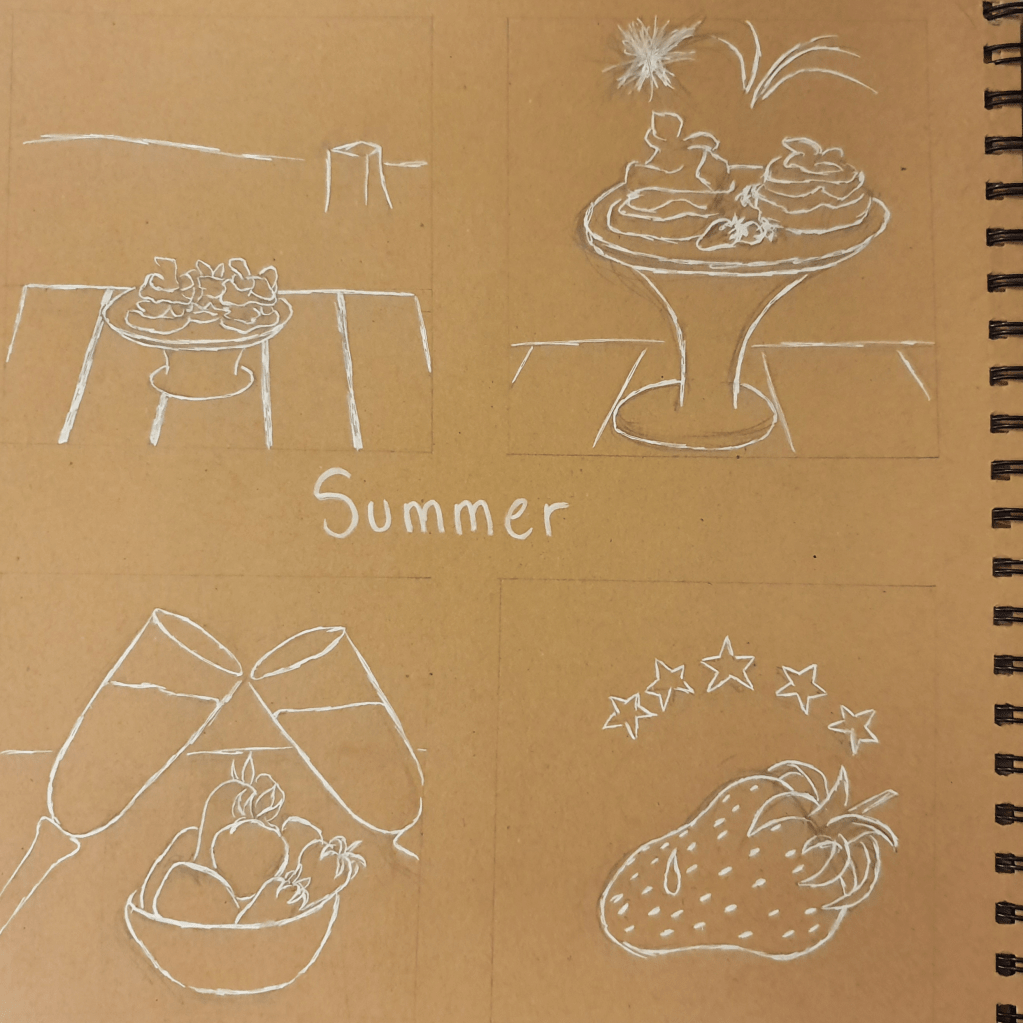
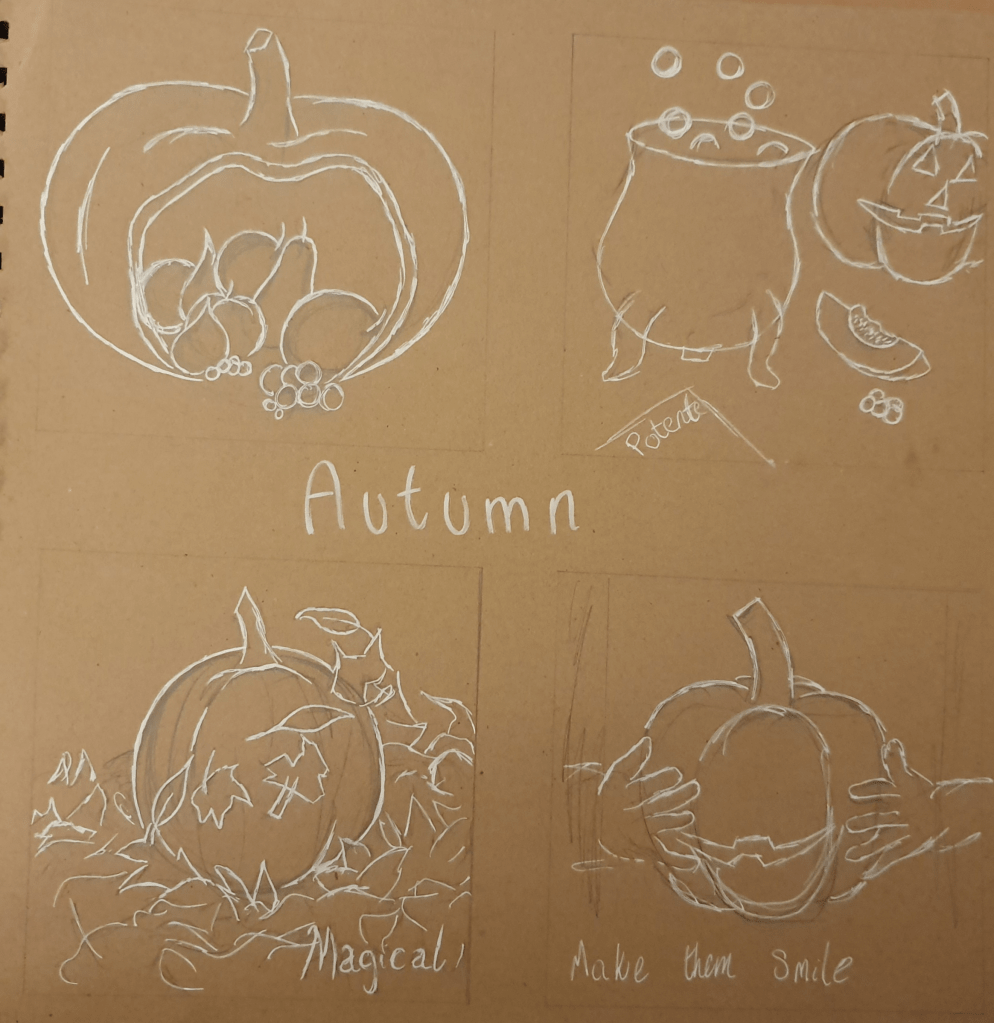
The next step, of course, was to come up with some designs. For this I tried to draw on activities you would do for each of the seasons. Summer is a very outdoorsy season, so I placed most of my designs outside. For autumn I thought of Halloween and falling leaves. I thought about having fruit shaped cutouts, or using other shapes, but wasn’t sure how much wiggle room I had with the dimensions. I didn’t think having a pumpkin shaped cutout, with its rounded edges, would full fill the dimensions given in the brief.
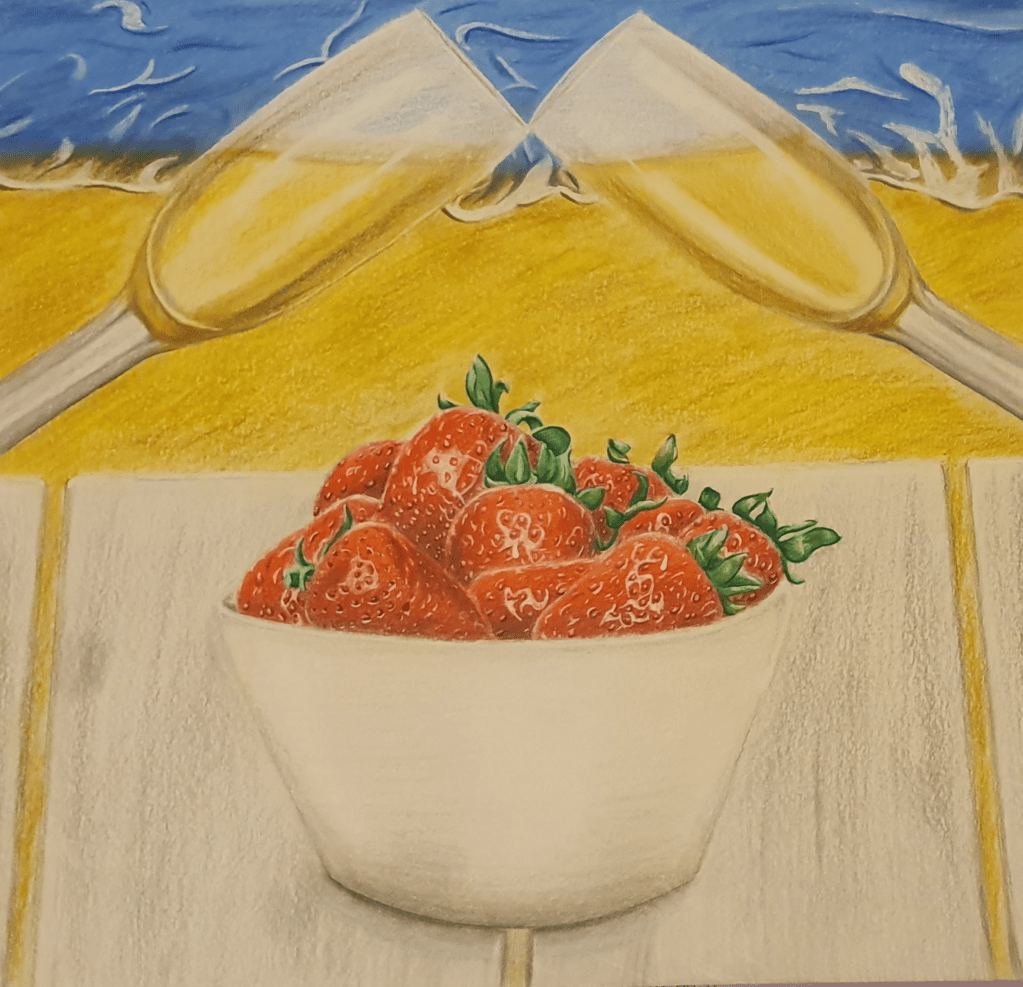
Eventually, I made it to the final pieces. It felt like a long journey, let me tell you, but I feel that it was worth it. Hopefully you will too. As the food is the main focus in these pictures they were the first things I did before anything else. I spent way too much time making these look good. In each of the pictures I used a mix of pencil, fine liner and ink.
The idea behind the summer piece was that people go the the beach. It’s one of the most common things for people to do in the summer. They want to relax whilst catching a tan and be able to cool down if they want to, in the ocean. The secondary focus of this brief, was to showcase the quality of the produce. I tried to do this, and believe I succeeded (at least mostly), by making the strawberries look good. I then felt that adding champagne would add a bit of class to the image, making the strawberries seem of high standard to be paired with such a drink. I used the flutes to make an arch, framing the strawberries. I thought that having the champagne line be in level with the sea line would be more aesthetically pleasing and less messy. I also tried not to add too much detail, but not too little, so as not to draw the attention away from the strawberries.
I felt that the limited colour palettes of a beach would be good to work with and help draw attention straight to the strawberries. I’m not so sure I succeeded in this as my eyes don’t always go straight to the berries, though I have looked at it a lot. I added a table to the image as I didn’t think that people who drink champagne would eat sat in the sand. Having a paler colour also helped bring the red out of the picture.
I’m not completely happy with the water as I feel that doesn’t look good enough. I should have spent some more time on it but I didn’t want to add too much detail and draw the attention there instead. I like how the grain of the paper added to the texture of the sand and the wooden table. I am not pleased with the angle of the table though. The ends of the wood should have been thinner, giving the table more depth and a better perspective. I added the water drops at the end to try and make the strawberries look more appealing. During hot weather, liquid is always more appetising. I’m not sure about how I left them white though. I did this to make them stand out but think that I should have maybe added colour and detail so that they would look better. Doing this would have made them blend in though.
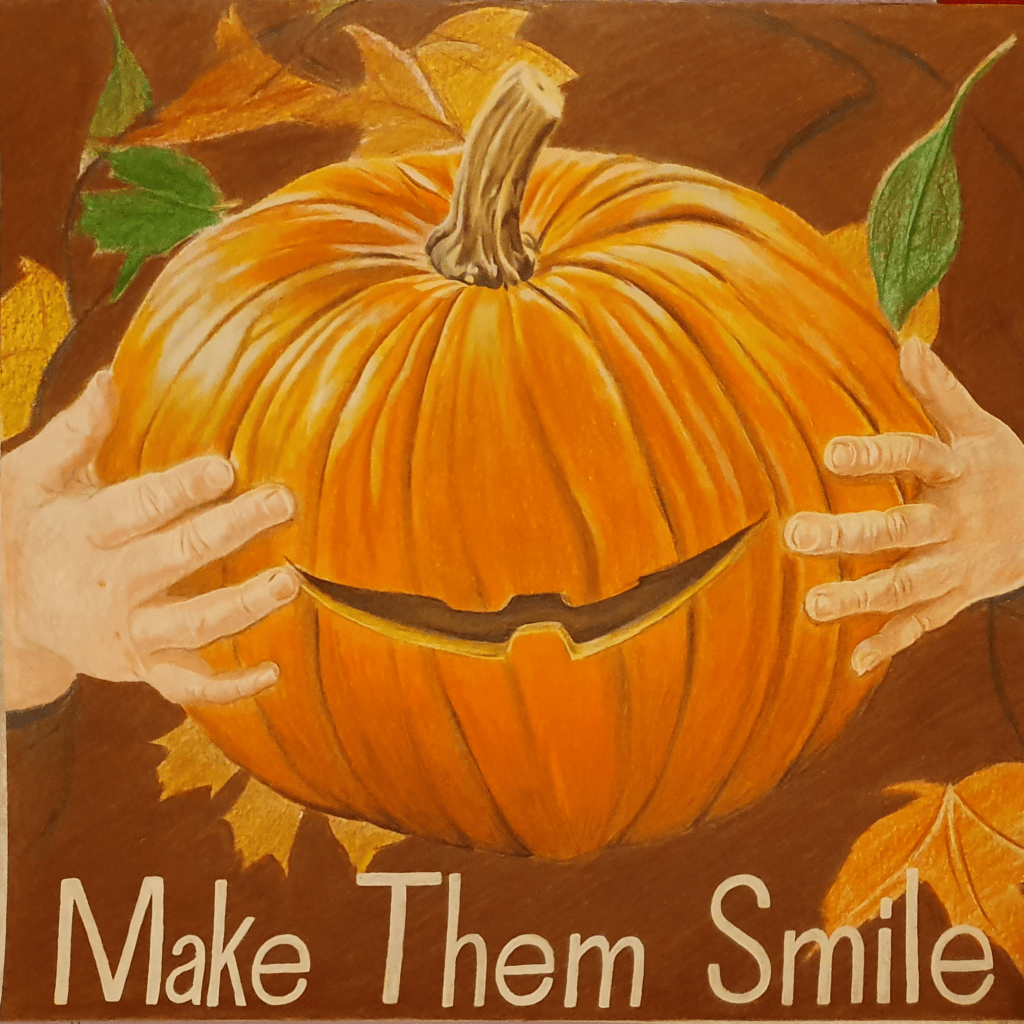
The second piece, autumn, is my favourite of the two. The idea behind this one was more family oriented. I felt that this would draw people more as it played on their emotions, even if subconsciously. After all pumpkin carving with little ones is a family affair.
Once again my starting point, and main focus, was the produce, in this case, the pumpkin. I wanted it to look smooth, but at the same time solid. The mouth cut helped with this, as it allowed me to show how thick the pumpkin is. At the same time, it can’t be too thick as people want the insides to make things like pumpkin pie, so it needs to have plenty of that. It also needs to be sturdy enough to carve and not collapse. The middle ended up a little wonky but I feel that this adds to its charm. I needed the pumpkin to be shiny, so that it looks new and ripe, not dull and rotting. The bright colours help with this.
The smile paired with the words “Make Them Smile” I thought would be a good idea as it refers to the carving, but also to making kids smile. Something every good parent wants to do. I made the inside maybe a little darker than it would realistically be, but this was too draw attention and make it stand out. Before I did this it just blended in with the orange. This was also the reason behind the decision to leave out the eyes and nose.
The hands needed to be a childs. The whole idea wouldn’t have worked else. I wanted detail, but not too much. I also wanted them to be smooth, though they may have come out a bit rougher than I aimed for. The background was the challenge in this piece. I though of having the body behind it but though that was too boring. A park didn’t seem to fit either. This is how I came up with the idea of just suggesting the body and having some leaves falling. It gives you the information you should have but keeps it simple too. I added the leaves sparsely and not too detailed so as not to draw attention from the pumpkin. They just fade into the background, while at the same time creating a frame around the pumpkin.
I am happy with how I did the background, but at the same time I’m not 100% certain it was the right choice. It feels like there is something else out there that would have fit better. A simple white font was used as it is clean, crisp and doesn’t get in the way of the image. Overall I am happy with the final results.
Bibliography
Smallbusiness. Publish date unknown. [online] Available at: <www.smallbusiness.chron.com/caused-advertising-industry-boom-1950s-69115.html>
Web Design | Small Business | Marketing | Roundpeg. 2017. Advertising in the 1950s Had No Chill | Ad Trends | Roundpeg. [online] Available at: <https://roundpeg.biz/2017/03/advertising-1950s/>
Ad Age. 2003. History: 1950s. [online] Available at: <https://adage.com/article/adage-encyclopedia/history-1950s/98701>
Scott, K., Publish date unknown. History of Advertising: 1950s. [online] Mascola.com. Available at: <https://mascola.com/insights/history-of-advertising-1950s/>
Business Insider. 2011. 26 Shockingly Offensive Vintage Ads. [online] Available at: <https://www.businessinsider.com/vintage-sexist-and-racist-ads-2011-6>
Pinterest.com. 2019. [online] Available at: <https://www.pinterest.com/psnell17/1950s-advertising/>
Baker, R., 2019. ‘Adverts of Britain’s Yesteryear’ – The 1950s – Flashbak. [online] Flashbak. Available at: <https://flashbak.com/adverts-of-britains-yesteryear-the-1950s-422273/>
Advertisingarchives.co.uk. Publish date unknown. Sample of 1950s collection. [online] Available at: <https://www.advertisingarchives.co.uk/en/category/show_content_page.html?category=8>
Science and Media Museum. Publish date unknown. [online] Available at: <www.blog.scienceandmediamuseum.org.uk/short-history-british-television-advertising/
Youtube.com. 2014. Advertising in America The 1950s (USEM 1570). [online] Available at: <https://www.youtube.com/watch?v=4BR5B39vA-c>
Wing, E., Publish date unknown. Checkout These Nostalgic COMFORT Ads (1950’s & 60’s) – Airline Ratings. [online] Airline Ratings. Available at: <https://www.airlineratings.com/photo-gallery/advertisements-focused-comfort/>
Time. 2015. Get Nostalgic With 18 Christmas-Themed Magazine Ads From the 1950s. [online] Available at: <https://time.com/4146438/1950s-christmas-ads/>
Popova, M., Publish date unknown. The Modernist Nerd: Vintage Science Ads from the 1950s-1960s. [online] The Marginalian. Available at: <https://www.themarginalian.org/2011/12/16/vintage-science-ads-1950s-1960s/>
Vintageadbrowser.com. Publish date unknown. Vintage Clothes/ Fashion Ads of the 1950s (Page 5). [online] Available at: <https://www.vintageadbrowser.com/clothes-ads-1950s/5>
Widewalls. Publish date unknown [online] Available at: <www.widewalls.ch/1950s-art/
Tate. 2020. Walk Through British Art – Display at Tate Britain | Tate. [online] Available at: <https://www.tate.org.uk/visit/tate-britain/display/walk-through-british-art>
Lane, J., 2017. 1950s Art. [online] Art-now-and-then.blogspot.com. Available at: <https://art-now-and-then.blogspot.com/2017/10/1950s-art.html>
Newyorkartworld.com. Publish date unknown. Rebels: Painters and Poets of the 1950s. [online] Available at: <https://www.newyorkartworld.com/commentary/RebelPainters.html>
Creative Bloq. 2016. Pop Art: 8 artists every designer should know. [online] Available at: <https://www.creativebloq.com/art/pop-art-8133921>
Art History Teaching Resources. Publish date unknown. Art Since 1950 (Part I). [online] Available at: <https://arthistoryteachingresources.org/lessons/art-since-1950-part-i/>
prezi.com. 2014. An art movement that began in the U.S. in the 1950s was ever. [online] Available at: <https://prezi.com/mrvb3i90ohub/an-art-movement-that-began-in-the-us-in-the-1950s-was-ever/>
Frankenthalerfoundation. Publish date unkown. [online] Available at: <www.frankenthalerfoundation.org/artworks/paintings/1950and39s>
Smashing Magazine. 2010. 51 Powerful Propaganda Posters And The People Behind — Smashing Magazine. [online] Available at: <https://www.smashingmagazine.com/2010/06/100-years-of-propaganda-the-good-the-bad-and-the-ugly/>
Dailymail. 2014. [online] Available at: <www.dailymail.co.uk/news/article-3318841/Shocking-posters-1950s-60s-sexist-racist-campaigns-seen-acceptable.html>
Inspiredology. Publish date unknown. [online] available at: <www.inspiredology.com/graphinc-design-through-the-decades-series-the-50s/
Chicago Center for the Print. Publish date unknown. The Golden Age of Graphic Design 1950’s- 60’s – Chicago Center for the Print. [online] Available at: <http://www.prints-posters.com/the-golden-age-of-graphic-design-1950s-60s/>
Webdesignmash.com. Publish date unknown. [online] Available at: <www.webdesignmash.com/design/stunning-graphic-design-styles-1950-to-2000-inspired-designs/>
Literary Hub. 2018. A Century of Reading: The 10 Books That Defined the 1950s. [online] Available at: <https://lithub.com/a-century-of-reading-the-10-books-that-defined-the-1950s/>
Graphic Design History. Publish date unknown. Mid-century. [online] Available at: <https://visualartsdepartment.wordpress.com/midcentury-modern/>
Aiga.org. Publish date unknown. [online] Available at: <www.aiga.org/medalist-cipepineles/>
Graphéine – Agence de communication Paris Lyon. 2019. Paul Rand, everything is design!. [online] Available at: <https://www.grapheine.com/en/history-of-graphic-design/paul-rand-everything-is-design>
99designs. 2012. Saul Bass: The man who changed graphic design. [online] Available at: <https://99designs.com/blog/famous-design/saul-bass-graphic-designer-of-a-century/>
Fabrik Brands. Publish date unknown. From Vintage To Modern: The Future, Present & History Of Graphic Design. [online] Available at: <https://fabrikbrands.com/the-history-of-graphic-design/>
Encyclopedia Britannica. Publish date unknown. graphic design – Postwar graphic design in Japan. [online] Available at: <https://www.britannica.com/art/graphic-design/Postwar-graphic-design-in-Japan>
Filmsite.org. Publish date unknown. Film History of the 1950s. [online] Available at: <https://www.filmsite.org/50sintro.html>
Paste Magazine. Publish date unknown. [online] Available at: <www.pastemagazine.com/movies/1950s/the-100-best-films-of-the-1950s>
The Telegraph. 2017. A decade packed with surprises. [online] Available at: <https://www.telegraph.co.uk/films/classic-british/uk-movies-fifties/>
IMDb. 2011. The Best Movies of the 1950s – IMDb. [online] Available at: <https://www.imdb.com/list/ls000098012/>
Retrowaste.com. Publish date unknown. 1950s TV Shows: What Did People Watch?. [online] Available at: <https://www.retrowaste.com/1950s/tv-shows-in-the-1950s/>
Sandberg Wallpaper. Publish date unknown. Dagmar Lodén – 1950s designs. [online] Available at: <https://sandbergwallpaper.com/the-story-behind-our-designs/dagmar-loden-1950s-designs/>
Tate. Publish date unknown. ‘Untitled’, Guy Bourdin, c.1950s | Tate. [online] Available at: <https://www.tate.org.uk/art/artworks/bourdin-untitled-p81206>
Google.com. Publish date unknown. [online] Available at: <www.google.com/search?q=1950s+surface+pattern&safe=strict&rlz=1C1CHBF en-GBGB902GB902&source=lnms&tbm=isch&sa=X&ved=2ahUKEwjayt-VydTpAhXGT8AKHT0nBOM4PBD8BSgBegQIDBAD&biw=1366&bih=657
Victoria and Albert Museum. Publish date unknown. V&A · Post-war textiles. [online] Available at: <https://www.vam.ac.uk/articles/post-war-textiles>
Pinterest. Publish date unknown. 170 1950s home decor ideas | 1950s decor, 1950s home decor, vintage house. [online] Available at: <https://www.pinterest.com/tiagrafico/1950s-home-decor/>
Parkfieldprimary.com. Publish date unknown. [online] Available at: <www.history.parkfieldprimary.com/modern/1950s/1950s-transport
http://www.peoplescollection.wales/collections/377786>
Assets. Publish date unknown. [online] Available at: <www.assests.publishing.service.gov.uk/government/uploads/system/uploads/attatchment data/file/761929/Historyoftransport.pdf
Hadleigh & Thundersley Community Archive. Publish date unknown. Railway photography at Hadleigh in the 1950s and 1960s. [online] Available at: <https://www.hadleighhistory.org.uk/content/main-subjects/transport/railway_photography_at_hadleigh_in_the_1950s_and_1960s>
Bradford Telegraph and Argus. Publish date unknown. Old transport pictures from the 1930s, 1950s and 1960s. [online] Available at: <https://www.thetelegraphandargus.co.uk/videoandpictures/galleries/>
Aviation-history.com. Publish date unknown. Boeing 707. [online] Available at: <http://www.aviation-history.com/boeing/707.html>
Nash, C., Publish date unknown. 6 Remarkable Classic Cars Of The 1950s | Carole Nash. [online] Carole Nash UK. Available at: <https://www.carolenash.com/news/classic-car-news/detail/6-remarkable-classic-cars-1950s>
prezi.com. 2014. TRANSPORT IN THE 1950s. [online] Available at: <https://prezi.com/fxko7tilsagt/transport-in-the-1950s/>
Nast, C., 2007. 1950s Midcentury-Modern Design and Architecture. [online] Architectural Digest. Available at: <https://www.architecturaldigest.com/gallery/1950s-slideshow-122007>
Nast, C., 2018. Behind the Fascinating Design of Disneyland. [online] Architectural Digest. Available at: <https://www.architecturaldigest.com/story/design-of-disneyland-book>
ThoughtCo. 2019. Roadside Architecture – America in the 1950s. [online] Available at: <https://www.thoughtco.com/googie-architecture-space-age-marketing-178325>
ThoughtCo. 2019. American Homes: Architecture From 1930 to 1965. [online] Available at: <https://www.thoughtco.com/guide-to-mid-century-homes-177108>
KCET. 2020. Hollywood’s Architect: The Paul R. Williams Story. [online] Available at: <https://www.kcet.org/shows/hollywoods-architect-the-paul-r-williams-story>
Magazine, S. and Novak, M., 2012. Googie: Architecture of the Space Age. [online] Smithsonian Magazine. Available at: <https://www.smithsonianmag.com/history/googie-architecture-of-the-space-age-122837470/>
Palmspringslife.com. Publish date unknown. [online] Availabole at: <palmspringslife.com/tiki-town/
Propertyinvestmentsuk.co.uk. Publish date unknown. 1950s and 1960s Housing | Adventures in Modernism. [online] Available at: <https://www.propertyinvestmentsuk.co.uk/1950s-and-1960s-housing/>
Architecture.com. Publish date unknown. [online] Available at: <www.architecture.com/image-library/features/british-social-housing-1920s-1980s/1950s-social-housing.html?collection=social-housing-1950s>
The Historic England Blog. 2015. 10 of England’s Best Post-War Buildings. [online] Available at: <https://heritagecalling.com/2015/09/17/10-of-englands-best-post-war-buildings/>
Lewis, A., 2018. These ’50s Fashion Trends Are Way More Relevant Than You Think. [online] Who What Wear UK. Available at: <https://www.whowhatwear.co.uk/50s-fashion/slide14>
Sutori.com. Publish date unknown. Sutori. [online] Available at: <https://www.sutori.com/story/fashion-timeline-1950-s–6mqjXttzyUH8mkcJ4KcweL3Q>
Marie Claire. 2017. 1950s Fashion Icons And Moments That Defined Fifties Style Forever. [online] Available at: <https://www.marieclaire.co.uk/fashion/1950s-fashion-icons-fifties-style-moments-in-pictures-81397>
The trend spotter. Publish date unknown. 1950S MEN’S FASHION | HOW TO PERFECT THE FIFTIES STYLE. [online] Available at: <https://www.thetrendspotter.net/1950s-mens-fashion-how-to-perfect-the-fifties-style/>
(I forgot to save the others, sorry)
Edits bibliography
HISTORY. 2010. The 1950s. [online] Available at: <https://www.history.com/topics/cold-war/1950s#:~:text=The%201950s%20were%20a%20decade,movement%20in%20the%20United%20States.&text=For%20example%2C%20the%20nascent%20civil,underlying%20divisions%20in%20American%20society.>
Khan Academy. Publish date unknown. The Eisenhower era (article) | 1950s America | Khan Academy. [online] Available at: <https://www.khanacademy.org/humanities/us-history/postwarera/1950s-america/a/the-eisenhower-era>
Historytoday.com. 2001. Britain in 1950 | History Today. [online] Available at: <https://www.historytoday.com/archive/britain-1950>
Retrowow.co.uk. Publish date unknown. Britain in the 1950s. [online] Available at: <https://www.retrowow.co.uk/50s.html>
Local Histories. 2021. Life in Britain in the 1950s – Local Histories. [online] Available at: <https://localhistories.org/life-in-britain-in-the-1950s/>
En.wikipedia.org. 2021. Terence Conran – Wikipedia. [online] Available at: <https://en.wikipedia.org/wiki/Terence_Conran>
Encyclopedia Britannica. 2012. Terence Conran | Biography & Facts. [online] Available at: <https://www.britannica.com/biography/Terence-Conran>
Design week. 2020. Remembering Terence Conran: “No one has done more to create modern Britain”. [online] Available at: <https://www.designweek.co.uk/issues/14-20-september-2020/terence-conran-obituary/>
En.wikipedia.org. 2021. Festival of Britain – Wikipedia. [online] Available at: <https://en.wikipedia.org/wiki/Festival_of_Britain>
Historic UK. 2016. The Festival of Britain 1951. [online] Available at: <https://www.historic-uk.com/HistoryUK/HistoryofBritain/The-Festival-of-Britain-1951/>
Encyclopedia.com. Publish date unknown. The 1950s Science and Technology: Topics in the News | Encyclopedia.com. [online] Available at: <https://www.encyclopedia.com/social-sciences/culture-magazines/1950s-science-and-technology-topics-news>
Holt, N., 2019. The queens of animation. Little, Brown.
Google Arts & Culture. Publish date unknown. Favorite Technologies of the 1950s – Deutsches Museum – Google Arts & Culture. [online] Available at: <https://artsandculture.google.com/exhibit/favorite-technologies-of-the-1950s-deutsches-museum/gQuaEtll?hl=en-GB>
Retrowow.co.uk. Publish date unknown. 50s technology. [online] Available at: <https://www.retrowow.co.uk/retro_technology/50s/50s_technology.html>
McFadden, C., Bergan, B., Lang, F. and Papadopoulos, L., 2019. 11 Interesting Inventions from the 1950s That Still Affect Our Lives Today. [online] Interestingengineering.com. Available at: <https://interestingengineering.com/11-interesting-inventions-from-the-1950s-that-still-affect-our-lives-today>
BLACK, J. and GARLAND, M., 1990. A history of fashion. Black Cat: Orbis Publishing Limited, pp.243 – 258.
Blue17 vintage clothing. Publish date unknown. 1950s Fashion. [online] Available at: <https://www.blue17.co.uk/vintage-blog/1950s-fashion/>
Spacestor. Publish date unknown. [online] Available at: <https://spacestor.com/insights/industry-trends/mid-century-influence-london-design/>
Coad, J., 2016. The Drab 1950s? Not when it came to design. [online] Mail Online. Available at: <https://www.dailymail.co.uk/property/article-3707464/The-Drab-1950s-Not-came-design-revolutionary-decade.html>
Bbc.co.uk. 2014. BBC – Homes – Design – 1950s. [online] Available at: <https://www.bbc.co.uk/homes/design/period_1950s.shtml>
Walls with Stories. 2017. 1950s Home decor: Dynamic, vibrant designs influenced by science, space exploration & innovations in technology – Walls with Stories. [online] Available at: <https://www.wallswithstories.com/interior/1950s-2.html>
Encyclopedia.com. Publish date unknown. The 1950s Science and Technology: Topics in the News | Encyclopedia.com. [online] Available at: <https://www.encyclopedia.com/social-sciences/culture-magazines/1950s-science-and-technology-topics-news>
En.wikipedia.org. 2021. Lucienne Day – Wikipedia. [online] Available at: <https://en.wikipedia.org/wiki/Lucienne_Day>
Victoria and Albert Museum. Publish date unknown. V&A · Lucienne Day – an introduction. [online] Available at: <https://www.vam.ac.uk/articles/lucienne-day-an-introduction>
En.wikipedia.org. 2021. Space Age – Wikipedia. [online] Available at: <https://en.wikipedia.org/wiki/Space_Age#Arts_and_architecture>
Feedback
After receiving feedback for this part I will be focusing on making sure that my work fully fulfils the brief. I will be doing more research, including using more websites like the ones suggested and books. I have one of the books suggested on order which should arrive soon. I have looked up some of the artists I was given, one of them being M.C. Escher. I will also use white paper at times that I believe brown to be inappropriate and use some of my own resources to aid my work.
Reflect upon
What is the difference between an objective and subjective drawing?
An objective drawing is based on fact. It relies solely on what the eye can see, which an artist then has to translate in the drawing.
A subjective drawing is more based around idea and feeling. An artist is more able to tell a story in this kind of piece as they don’t have to adhere to rigid facts.
How do materials, techniques and processes communicate intended narrative?
These thing help tell narrative by engaging the senses. How a piece looks and feels contributes to a piece so if a viewer is able to feel as well as see a piece then they receive more information, allowing them to read the narrative and piece together the story more fully or correctly. What materials and techniques an artist uses informs the viewer so it is best to pick what best suits the idea you want communicated. For example, when drawing a cobbled or broken pathway you could use a rougher paper or technique. I feel that crosshatching or stippling are good techniques for this, especially if spaced further apart because if too close together the picture tends to read as smoother.
What is the difference between drawing and illustrating?
Drawing tells an idea but illustrating tells a story. Illustration gives the viewer more information, which allows them too decide the specifics of a story. This begins to submerge to viewer within the piece, making it seem more realistic and viable to the mind.
Why is it important to draw first then illustrate?
This is important as it allows the artist to work out the story and any kinks before breathing life into a piece. This means that anything that could get in the way of of the story that is being told will be erased before it could damage the integrity and authenticity of the piece.
 Illustration log